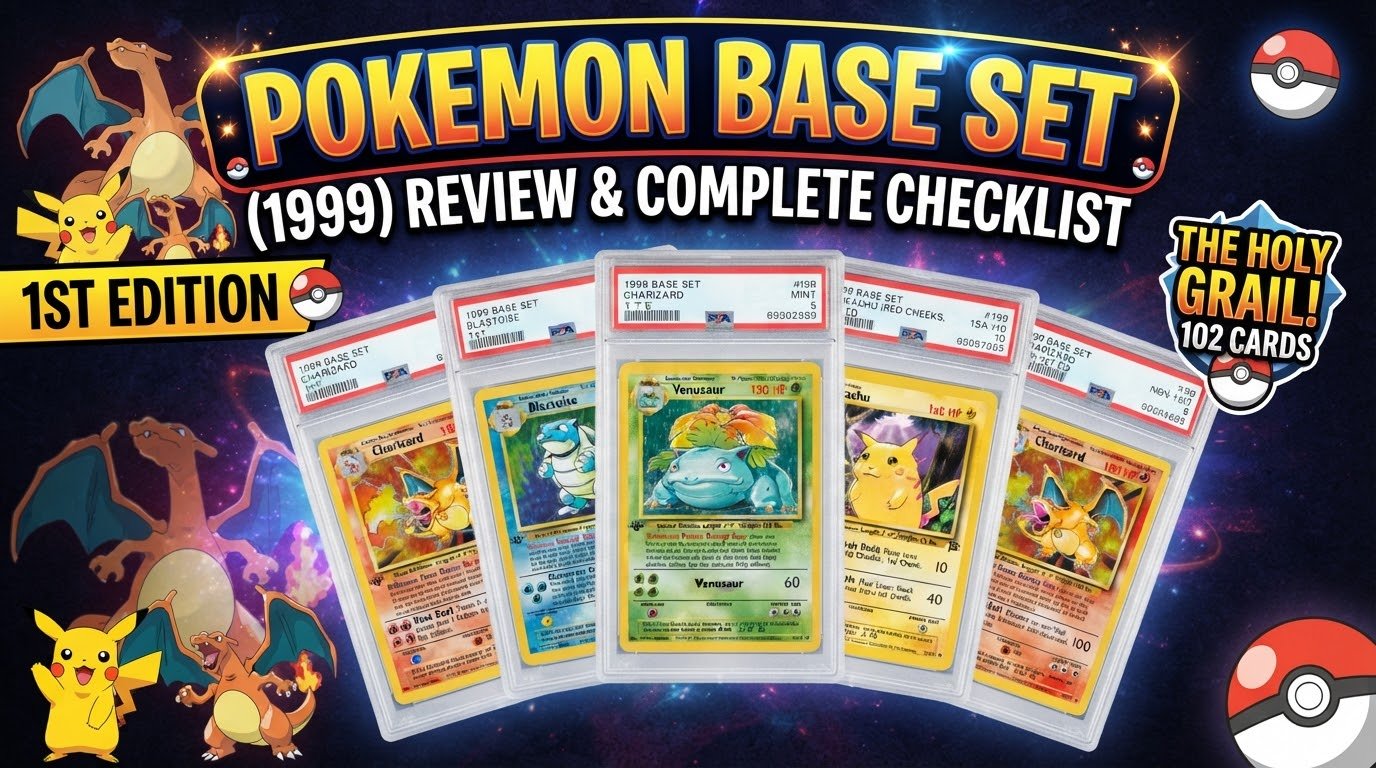
Pokémon Base Set (1999) Review: Why This Set Still Matters
The Pokémon Base Set is where the English-language Pokémon Trading Card Game began. Released in North America on January 9, 1999, the set established the visual style, card numbering, rarity structure, and original-era collecting culture that would define the early Pokémon TCG.
For collectors today, however, Base Set is much more than a nostalgic 102-card checklist. The set exists across several English print runs, including 1st Edition Shadowless, Shadowless, Unlimited, and a later Unlimited printing with a ©1999–2000 copyright line. Those versions can look surprisingly similar at first glance while having very different collecting significance.
That distinction is one of the most important things to understand before buying a supposed “1999 Base Set” card.
Collector Note: A Base Set card number alone does not tell you which printing you own. For example, Charizard is always 4/102, but a 1st Edition, Shadowless, Unlimited, and later ©1999–2000 copy are different printings of that same numbered card.
This guide is designed to function as a long-term reference for collectors rather than simply another list of famous Base Set cards. We will cover the history of the set, the complete 102-card checklist, rarity structure, print-run identification, major errors and variations, collecting strategies, condition and grading considerations, authenticity concerns, and how to think about Base Set value without relying on a single outdated price figure.
Base Set at a Glance
| Feature | Details |
|---|---|
| Set | Pokémon Base Set |
| English Release | January 9, 1999 |
| Set Number | English Set #1 |
| Numbered Cards | 102 |
| Era | Original / Wizards of the Coast era |
| Generation | Generation I |
| Major English Printings | 1st Edition Shadowless, Shadowless, Unlimited, ©1999–2000 Unlimited |
| Holo Rares | 16 |
| Non-Holo Rares | 16 |
| Uncommons | 32 |
| Commons | 32 |
| Energy Cards | 6 |
Bulbapedia records the English Base Set as a 102-card expansion and identifies January 9, 1999 as its English release date. It also documents the four major English print runs and several notable card variations and corrected errors. See the Base Set reference on Bulbapedia.
The Story Behind the 1999 Base Set
The English Base Set followed the Japanese Pokémon Card Game’s original release, which dates to 1996. The English version translated the concept into a Western trading-card market at a time when Pokémon was rapidly expanding beyond the Game Boy games and television series.
The result was a set that combined recognizable Generation I Pokémon with a relatively simple early TCG design. There were no modern-style Pokémon ex, Pokémon V, Pokémon VMAX, full-art cards, alternate arts, secret rares, or textured chase cards. Instead, the excitement centered on holographic Pokémon, familiar characters, and the possibility of pulling a card such as Charizard from a booster pack.
The set’s simplicity is part of its historical importance. Modern Pokémon cards have become significantly more complicated in both gameplay and collecting structure, but Base Set provides a snapshot of what the TCG looked like at the beginning of its English-language history.
Why Base Set is historically important:
- It is the first main English Pokémon TCG expansion.
- It introduced the original English card numbering system.
- It established the early holo-rare chase structure.
- It contains the original English Charizard, Blastoise, Venusaur and other iconic Generation I cards.
- It exists in multiple documented English print runs that collectors actively distinguish.
How Many Cards Are in Pokémon Base Set?
The official numbered English checklist contains 102 cards, running from Alakazam 1/102 through Water Energy 102/102.
That number is important because the phrase “Base Set master set” can mean different things depending on the collector. A traditional complete numbered Base Set is 102 cards. A more advanced collection may attempt to document multiple printings, error cards, promotional versions, and other recognized variations.
For a beginner, the cleanest goal is therefore:
| Collection Goal | What It Means |
|---|---|
| Complete Base Set | One copy of each numbered card from 1/102 through 102/102. |
| 1st Edition Set | A complete set consisting of 1st Edition copies. |
| Shadowless Set | A complete set of English Shadowless copies without the 1st Edition stamp. |
| Unlimited Set | A complete set of the later Unlimited printing. |
| Variant / Master Collection | A broader project documenting different printings, recognized errors and notable variations. |
Understanding the Four English Base Set Print Runs
This is arguably the most useful section of the entire guide if you are buying vintage Base Set cards.
There are four documented English print runs that collectors commonly distinguish. The first three are particularly important when identifying cards sold simply as “1999 Base Set.”
1. 1st Edition Shadowless
The 1st Edition printing carries the familiar 1st Edition stamp on the left side of the card’s artwork area. It also uses the Shadowless design.
The absence of a drop shadow around the Pokémon illustration window is one of the most recognizable visual characteristics. The HP and attack text also use the thinner style associated with the early printings.
2. Shadowless
Shadowless cards look very similar to 1st Edition cards but do not have the 1st Edition stamp.
This distinction is critical. A card without a 1st Edition stamp is not automatically Unlimited. If it has the Shadowless layout, it may belong to the Shadowless printing.
3. Unlimited
The Unlimited printing introduced the familiar drop shadow around the illustration window and thicker HP and attack text.
These cards are generally easier to find than the earlier printings, but that does not mean every Unlimited Base Set card is common in excellent condition. Vintage condition remains a major variable.
4. Unlimited ©1999–2000
A later Unlimited printing retained the same general Unlimited design but changed the copyright line from ©1999 to ©1999–2000.
Easy identification rule:
1st Edition stamp + no shadow = 1st Edition Shadowless.
No 1st Edition stamp + no shadow = Shadowless.
No 1st Edition stamp + visible illustration shadow = Unlimited.
Unlimited design + ©1999–2000 copyright = later Unlimited printing.
These differences are documented in the Base Set reference material, which describes the 1st Edition Shadowless, Shadowless, Unlimited, and ©1999–2000 Unlimited printings separately. Review the documented print-run differences.
Why Shadowless Cards Are So Important to Collectors
The Shadowless printing occupies an interesting position between the 1st Edition and Unlimited releases.
It does not carry the 1st Edition logo, but it retains many of the visual characteristics associated with the earliest English Base Set production. This makes Shadowless cards particularly useful for collectors who want to explore the history of the set without limiting themselves to 1st Edition examples.
The key mistake to avoid is treating “Shadowless” as simply another word for “1st Edition.” They are related printings, but they are not identical.
A Shadowless Charizard without a 1st Edition stamp is still a Shadowless Charizard. The absence of the stamp is precisely one of the features that separates it from the 1st Edition version.
1st Edition Stamp: Thin vs. Thick Variations
Advanced Base Set collectors can go even deeper. Bulbapedia documents variations among English 1st Edition Holofoil cards involving what collectors commonly call thin-stamp and thick-stamp versions.
This is an example of why a 102-card checklist can become much more complicated when a collector moves from basic set completion into variant collecting.
For a normal binder collection, you do not need to chase every stamp variation. For a specialist collection, however, documenting these differences can become part of the appeal.
Base Set Rarity Structure
The 102 numbered cards are divided into several rarity groups. Understanding the numbering makes the checklist much easier to navigate.
| Card Numbers | Rarity Group | Count |
|---|---|---|
| 1–16 | Rare Holo | 16 |
| 17–32 | Rare | 16 |
| 33–64 | Uncommon | 32 |
| 65–96 | Common | 32 |
| 97–102 | Energy | 6 |
Pokémon Base Set 1999 Complete Checklist: Cards 1–32
Use the boxes below as a simple collector checklist. The list follows the official English collector numbering.
| # | Card | Rarity | Collected |
|---|---|---|---|
| 1/102 | Alakazam | Rare Holo | ☐ |
| 2/102 | Blastoise | Rare Holo | ☐ |
| 3/102 | Chansey | Rare Holo | ☐ |
| 4/102 | Charizard | Rare Holo | ☐ |
| 5/102 | Clefairy | Rare Holo | ☐ |
| 6/102 | Gyarados | Rare Holo | ☐ |
| 7/102 | Hitmonchan | Rare Holo | ☐ |
| 8/102 | Machamp | Rare Holo | ☐ |
| 9/102 | Magneton | Rare Holo | ☐ |
| 10/102 | Mewtwo | Rare Holo | ☐ |
| 11/102 | Nidoking | Rare Holo | ☐ |
| 12/102 | Ninetales | Rare Holo | ☐ |
| 13/102 | Poliwrath | Rare Holo | ☐ |
| 14/102 | Raichu | Rare Holo | ☐ |
| 15/102 | Venusaur | Rare Holo | ☐ |
| 16/102 | Zapdos | Rare Holo | ☐ |
| 17/102 | Beedrill | Rare | ☐ |
| 18/102 | Dragonair | Rare | ☐ |
| 19/102 | Dugtrio | Rare | ☐ |
| 20/102 | Electabuzz | Rare | ☐ |
| 21/102 | Electrode | Rare | ☐ |
| 22/102 | Pidgeotto | Rare | ☐ |
| 23/102 | Arcanine | Uncommon | ☐ |
| 24/102 | Charmeleon | Uncommon | ☐ |
| 25/102 | Dewgong | Uncommon | ☐ |
| 26/102 | Dratini | Uncommon | ☐ |
| 27/102 | Farfetch’d | Uncommon | ☐ |
| 28/102 | Growlithe | Uncommon | ☐ |
| 29/102 | Haunter | Uncommon | ☐ |
| 30/102 | Ivysaur | Uncommon | ☐ |
| 31/102 | Jynx | Uncommon | ☐ |
| 32/102 | Kadabra | Uncommon | ☐ |
Complete Base Set Checklist: Cards 33–70
| # | Card | Rarity | Collected |
|---|---|---|---|
| 33/102 | Kakuna | Uncommon | ☐ |
| 34/102 | Machoke | Uncommon | ☐ |
| 35/102 | Magikarp | Uncommon | ☐ |
| 36/102 | Magmar | Uncommon | ☐ |
| 37/102 | Nidorino | Uncommon | ☐ |
| 38/102 | Poliwhirl | Uncommon | ☐ |
| 39/102 | Porygon | Uncommon | ☐ |
| 40/102 | Raticate | Uncommon | ☐ |
| 41/102 | Seel | Uncommon | ☐ |
| 42/102 | Wartortle | Uncommon | ☐ |
| 43/102 | Abra | Common | ☐ |
| 44/102 | Bulbasaur | Common | ☐ |
| 45/102 | Caterpie | Common | ☐ |
| 46/102 | Charmander | Common | ☐ |
| 47/102 | Diglett | Common | ☐ |
| 48/102 | Doduo | Common | ☐ |
| 49/102 | Drowzee | Common | ☐ |
| 50/102 | Gastly | Common | ☐ |
| 51/102 | Koffing | Common | ☐ |
| 52/102 | Machop | Common | ☐ |
| 53/102 | Magnemite | Common | ☐ |
| 54/102 | Metapod | Common | ☐ |
| 55/102 | Nidoran♂️ | Common | ☐ |
| 56/102 | Onix | Common | ☐ |
| 57/102 | Pidgey | Common | ☐ |
| 58/102 | Pikachu | Common | ☐ |
| 59/102 | Poliwag | Common | ☐ |
| 60/102 | Ponyta | Common | ☐ |
| 61/102 | Rattata | Common | ☐ |
| 62/102 | Sandshrew | Common | ☐ |
| 63/102 | Squirtle | Common | ☐ |
| 64/102 | Starmie | Common | ☐ |
| 65/102 | Staryu | Common | ☐ |
| 66/102 | Tangela | Common | ☐ |
| 67/102 | Voltorb | Common | ☐ |
| 68/102 | Vulpix | Common | ☐ |
| 69/102 | Weedle | Common | ☐ |
| 70/102 | Clefairy Doll | Trainer | ☐ |
Complete Base Set Checklist: Cards 71–102
| # | Card | Rarity / Type | Collected |
|---|---|---|---|
| 71/102 | Computer Search | Trainer | ☐ |
| 72/102 | Devolution Spray | Trainer | ☐ |
| 73/102 | Imposter Professor Oak | Trainer | ☐ |
| 74/102 | Item Finder | Trainer | ☐ |
| 75/102 | Lass | Trainer | ☐ |
| 76/102 | Pokémon Breeder | Trainer | ☐ |
| 77/102 | Pokémon Trader | Trainer | ☐ |
| 78/102 | Scoop Up | Trainer | ☐ |
| 79/102 | Super Energy Removal | Trainer | ☐ |
| 80/102 | Defender | Trainer | ☐ |
| 81/102 | Energy Retrieval | Trainer | ☐ |
| 82/102 | Full Heal | Trainer | ☐ |
| 83/102 | Maintenance | Trainer | ☐ |
| 84/102 | PlusPower | Trainer | ☐ |
| 85/102 | Pokémon Center | Trainer | ☐ |
| 86/102 | Pokémon Flute | Trainer | ☐ |
| 87/102 | Pokédex | Trainer | ☐ |
| 88/102 | Professor Oak | Trainer | ☐ |
| 89/102 | Revive | Trainer | ☐ |
| 90/102 | Super Potion | Trainer | ☐ |
| 91/102 | Bill | Trainer | ☐ |
| 92/102 | Energy Removal | Trainer | ☐ |
| 93/102 | Gust of Wind | Trainer | ☐ |
| 94/102 | Potion | Trainer | ☐ |
| 95/102 | Switch | Trainer | ☐ |
| 96/102 | Double Colorless Energy | Energy | ☐ |
| 97/102 | Fighting Energy | Energy | ☐ |
| 98/102 | Fire Energy | Energy | ☐ |
| 99/102 | Grass Energy | Energy | ☐ |
| 100/102 | Lightning Energy | Energy | ☐ |
| 101/102 | Psychic Energy | Energy | ☐ |
| 102/102 | Water Energy | Energy | ☐ |
The complete numbered list above follows the English Base Set sequence documented by Bulbapedia. View the full documented checklist.
The 16 Base Set Holo Rares
The first 16 cards in the set are the famous holographic rares. These cards form the visual centerpiece of most Base Set collections.
| # | Holo Rare | Why Collectors Recognize It |
|---|---|---|
| 1 | Alakazam | Iconic Psychic-type holo from the original set. |
| 2 | Blastoise | One of the three original fully evolved starter Pokémon. |
| 3 | Chansey | Distinctive high-HP original holo. |
| 4 | Charizard | The set’s most famous chase card. |
| 5 | Clefairy | Classic Generation I holo. |
| 6 | Gyarados | Popular Water-type holo with dramatic artwork. |
| 7 | Hitmonchan | Original Fighting-type holo. |
| 8 | Machamp | Important card with unusual distribution history. |
| 9 | Magneton | Original Lightning-type holo. |
| 10 | Mewtwo | One of the most recognizable Generation I Pokémon. |
| 11 | Nidoking | Popular evolution-line holo. |
| 12 | Ninetales | Classic Fire-type holo with known early-print variation. |
| 13 | Poliwrath | Original Water/Fighting-era favorite. |
| 14 | Raichu | Iconic Pikachu evolution and Base Set holo. |
| 15 | Venusaur | One of the three original starter final evolutions. |
| 16 | Zapdos | Legendary Bird Pokémon represented as a Base Set holo. |
Charizard, Blastoise and Venusaur: The Original Starter Trio
The three final-stage Kanto starters occupy three of the most recognizable positions in the set: Charizard 4/102, Blastoise 2/102, and Venusaur 15/102.
For many collectors, these three cards are the centerpiece of a Base Set binder. Their importance is not simply connected to price. They represent the original starter trio from the first generation and became some of the earliest Pokémon TCG cards that a large audience learned to recognize.
Charizard’s popularity is especially significant, but a collector building a complete set should avoid reducing Base Set to one card. The historical appeal of the set comes from the entire 102-card composition and the different printing histories that surround it.
Important collecting principle: Do not buy a Base Set card based solely on the Pokémon’s name. A Charizard is not automatically a 1st Edition Charizard, and a 1999 card is not automatically Shadowless. Always identify the printing before comparing prices.
Base Set Errors and Recognized Variations
One reason Base Set remains fascinating to advanced collectors is that the 102-card checklist does not tell the entire story.
Several cards have documented errors, corrected versions, promotional versions, or other variations. Some are relatively easy to understand, while others require comparing multiple copies.
Blastoise 2/102 Error
Bulbapedia documents an early Blastoise variation where the word “Stage” is missing from the upper-right evolution information. A corrected version contains the expected Stage information.
Ninetales 12/102 Error
A Shadowless Ninetales variation is documented with missing attack damage. This is an excellent example of why collectors should not automatically assume that every copy of a numbered Base Set card is identical.
Raichu 14/102 Pre-Release Stamp
Raichu has a documented pre-release stamped version. This is not simply another standard Base Set printing and should be catalogued separately by collectors interested in promotional or pre-release material.
Beedrill 17/102 Typographical Error
Beedrill has a documented printing error involving the word “D.efending”.
Wartortle 42/102 Error
A Wartortle variation is documented with an incorrect evolution-box presentation.
Diglett 47/102 Error
Diglett has a documented variation involving rotated attack-energy cost symbols.
Pikachu 58/102 Variations
Pikachu is particularly interesting. The card exists in recognized Red Cheeks and Yellow Cheek versions, along with several stamped promotional variations documented in the Base Set reference material.
Water Energy 102/102 Variation
The Water Energy card also has a documented printing variation involving spacing around the Water symbol and the word “ENERGY.”
Advanced Collector Tip: Errors should be verified against reliable references and, where possible, compared with multiple confirmed authentic copies. A strange-looking card is not automatically an official error; some unusual appearances can come from counterfeits, damage, printing defects, lighting, or altered cards.
Bulbapedia’s Base Set documentation provides a dedicated list of corrected error cards and additional variants, including the Blastoise, Ninetales, Raichu, Beedrill, Wartortle, Diglett, Pikachu and Water Energy examples described above. Check the documented variations before labeling a card an error.
Why a “Complete Base Set” Can Mean Different Things
Collectors sometimes use the phrase complete set differently.
If your goal is simply to own all 102 numbered cards, you need one copy of each card number.
If your goal is to build a 1st Edition complete set, every numbered slot needs to be represented by the appropriate 1st Edition printing.
If you are pursuing a specialist collection, you may start documenting Shadowless cards, Unlimited versions, later copyright variants, error cards, stamped cards and other recognized variations.
| Collector Type | Suggested Finish Line |
|---|---|
| Beginner | 102 different numbered cards. |
| Vintage Collector | A complete set in a specific printing. |
| 1st Edition Collector | Complete 1st Edition set. |
| Variant Collector | Multiple printings plus documented variations. |
| Advanced Master Project | 102-card checklist plus carefully documented printing and error variants. |
How to Identify a Base Set Printing Before You Buy
Before purchasing any vintage Base Set card, make printing identification the first step rather than the last.
A practical inspection can follow this sequence:
- Check the card number. Confirm that the card is actually from Base Set and note the number, such as 4/102.
- Look for the 1st Edition stamp. If present, investigate whether the card is the expected English 1st Edition printing.
- Inspect the illustration window. Determine whether the characteristic drop shadow is present.
- Examine the HP and attack text. Early Shadowless printings use the thinner text treatment.
- Check the copyright line. Pay attention to ©1999 versus ©1999–2000 when identifying later Unlimited copies.
- Inspect the card back. Compare color, borders, typography and overall print quality with a confirmed authentic example.
- Compare multiple details together. Never authenticate a vintage card from one feature alone.
The documented print-run characteristics are summarized in the table below.
| Printing | 1st Edition Stamp | Drop Shadow | Text Style | Copyright |
|---|---|---|---|---|
| 1st Edition Shadowless | Yes | No | Thin | ©1999 |
| Shadowless | No | No | Thin | ©1999 |
| Unlimited | No | Yes | Thicker | ©1999 |
| Later Unlimited | No | Yes | Thicker | ©1999–2000 |
These characteristics are consistent with the documented English Base Set print-run history. See the detailed print-run documentation.
Condition Matters More Than Many New Collectors Expect
Two Base Set cards from the same printing can have dramatically different market positions because of condition.
Vintage Pokémon cards have often spent decades in binders, boxes, attics, storage containers or collections. As a result, whitening, scratches, dents, edge wear, surface marks and centering differences are common considerations.
When inspecting a valuable Base Set card, separate the evaluation into four major areas:
| Area | What to Inspect |
|---|---|
| Centering | Balance of the borders around the artwork and card design. |
| Corners | Whitening, rounding, dents and loss of sharpness. |
| Edges | Chipping, whitening, rough cuts and edge damage. |
| Surface | Scratches, dents, stains, print lines and other surface defects. |
PSA’s current grading standards specifically discuss corners, focus, gloss, stains, centering and other condition characteristics. PSA also states that cards showing evidence of trimming, recoloring, restoration or questionable authenticity may be rejected from normal numeric grading. Read PSA’s current grading standards.
Should You Grade a Base Set Card?
Professional grading can make sense for certain Base Set cards, particularly when the card is valuable enough that authentication, encapsulation and a professional condition assessment justify the cost.
But not every Base Set card needs to be graded.
Before submitting a card, consider:
- Is the card authentic?
- Is the printing correctly identified?
- Is the card sufficiently valuable to justify grading costs?
- Does the surface have scratches or dents?
- Are the corners clean?
- Are the edges free of significant whitening?
- Is the centering reasonable?
- Is there any crease, bend, stain or structural damage?
- Would you actually benefit from having the card encapsulated?
Grading reminder: “Pack fresh” is not the same thing as “guaranteed PSA 10.” Manufacturing defects, centering differences and print imperfections can exist before a card ever reaches a collector.
For a deeper inspection process, see our Pokémon Card Pre-Grading Inspection Guide and our guide to measuring Pokémon card centering.
Authenticity: Why Base Set Requires Extra Attention
Base Set is one of the most recognizable vintage Pokémon releases, which also makes its high-value cards attractive targets for counterfeiters.
A suspicious card should never be judged from one “test.” Instead, compare multiple characteristics.
Useful Authenticity Checks
- Compare the card’s typography with confirmed authentic examples.
- Inspect the printing quality and registration.
- Examine the card back carefully.
- Check the thickness and overall construction of the card.
- Compare borders and artwork positioning.
- Look for unnatural colors or excessively blurry printing.
- Inspect holofoil behavior on holographic cards.
- Compare the suspected card with known authentic copies from the same printing.
No single home test should be treated as absolute proof of authenticity. Light tests, feel tests and visual comparisons can provide clues, but expensive vintage purchases deserve a more comprehensive verification process.
For a broader authenticity workflow, see our Ultimate Guide to Spotting Fake Pokémon Cards.
How to Think About Base Set Value in 2026
There is no single “Base Set price.”
The value of a specific card depends on a combination of variables, including:
| Variable | Why It Matters |
|---|---|
| Card | Different Pokémon have very different collector demand. |
| Printing | 1st Edition, Shadowless and Unlimited are distinct collecting categories. |
| Condition | Wear and defects can substantially change market value. |
| Grade | Professional grades create separate market segments. |
| Authenticity | An apparent bargain has no value if the card is counterfeit or altered. |
| Timing | Vintage card prices can change as supply, demand and auction activity change. |
For that reason, collectors researching Base Set should compare recent completed sales for the exact card, exact printing and similar condition instead of relying on a generic “Base Set price.”
This is especially important when comparing raw and graded cards. A PSA-graded Shadowless Charizard should not be evaluated using the same benchmark as an Unlimited raw Charizard, even though both are technically 4/102.
Building a Base Set Collection on a Budget
You do not need to start with the most expensive cards.
A practical strategy is to build the lower-cost portion of the checklist first and gradually upgrade important cards as opportunities appear.
Stage 1: Complete the Binder Foundation
Begin with commons, uncommons, trainers and energy cards. These cards allow you to establish the visual structure of the full 102-card set without committing most of your budget immediately.
Stage 2: Add the Non-Holo Rares
Once the foundation is complete, move toward the rare cards numbered 17–32.
Stage 3: Add Holo Rares Strategically
Instead of buying every holo at once, compare condition and printing carefully. A clean Unlimited holo may be a sensible way to complete a binder while a collector can continue searching for a specific Shadowless or 1st Edition version later.
Stage 4: Upgrade Rather Than Duplicate Randomly
Once you have a complete set, you can improve condition or printing quality. This creates a much more structured collecting project than repeatedly buying random Base Set cards without a defined target.
Smart collecting strategy: Decide whether your goal is completion, condition, or printing rarity before spending heavily. A collector who wants a complete binder does not necessarily need every card to be 1st Edition.
How to Store a 1999 Base Set Collection
Vintage cardboard deserves consistent storage conditions. The goal is to reduce exposure to moisture, excessive heat, direct sunlight, dirt and unnecessary handling.
- Use archival-quality sleeves appropriate for trading cards.
- Use a quality binder with pages that do not force cards against each other.
- Keep valuable cards in appropriate semi-rigid holders or protective cases when necessary.
- Avoid direct sunlight for long periods.
- Avoid damp areas and large temperature fluctuations.
- Do not stack loose cards under heavy pressure.
- Handle valuable holographic cards by the edges.
For especially valuable cards, consider photographing both sides and documenting the card’s condition, printing and any visible defects before storing or shipping it.
Base Set Collecting Mistakes to Avoid
- Assuming every 1999 Base Set card is Shadowless. It is not.
- Assuming no 1st Edition stamp means Unlimited. Shadowless cards do not have the stamp either.
- Comparing prices without checking the printing. Printing is one of the first variables to identify.
- Trusting seller descriptions without inspecting photographs. Terms such as “mint” and “pack fresh” are not substitutes for examination.
- Ignoring the card back. Important condition and authenticity clues can appear there.
- Using one authentication test. Authenticity should be assessed from multiple characteristics.
- Assuming every unusual card is an error. Compare it with documented references and confirmed examples.
- Grading everything automatically. Grading costs money and is not necessary for every card.
- Cleaning or altering vintage cards. Attempted improvements can damage the card or affect grading and authenticity assessments.
Related Pokémon TCG Guides
If you are researching Base Set as part of a larger Pokémon TCG collection, these guides from PokeVault Guide can help you continue your research:
- Pokémon Card Condition Guide: NM vs LP vs MP vs HP vs Damaged — Learn how raw card condition is described and what defects to inspect.
- Pokémon Card Pre-Grading Inspection Guide — A practical inspection process before sending cards to a grading company.
- How to Measure Pokémon Card Centering — Understand centering and why it matters during grading.
- How to Spot Fake Pokémon Cards — A broader authenticity guide for collectors.
- How to Spot a Fake Graded Pokémon Card Slab — Useful when buying already-graded vintage cards.
- Pokémon Card Grading Guide: PSA vs BGS vs CGC — Compare the major grading approaches before submitting valuable cards.
- Pokémon TCG 30th Anniversary Market Impact — Explore how anniversary attention can affect collector interest and the vintage market.
- Pokémon TCG Mega Evolution Perfect Order Set Review & Checklist — A modern-set comparison for collectors interested in how newer expansions differ from the original Base era.
Sources & References
- Bulbapedia — Base Set (TCG) — Set history, 102-card checklist, release date, print runs, variations and documented errors.
- PSA — Official Grading Standards — Current grading criteria, centering information, condition considerations and alteration-related no-grade conditions.
- PSA Set Registry — 1999 Pokémon Base Set Complete 1st Edition — Current registry data demonstrating how collectors track complete vintage Base Set collections.
- Trading Card Database — 1999 Pokémon Base Set — Independent checklist and variation reference.
Final Thoughts on Pokémon Base Set (1999)
Pokémon Base Set remains one of the most important sets in the history of the Pokémon TCG because it represents the beginning of the English card game rather than simply another vintage expansion.
Its 102 numbered cards are relatively straightforward to understand. The fascinating part begins when you look beneath the checklist.
1st Edition Shadowless, Shadowless, Unlimited and later ©1999–2000 printings create multiple collecting paths. Add documented errors, promotional cards, stamp variations, condition differences and professional grading, and the seemingly simple 102-card set becomes a much deeper collecting project.
For a new collector, the best starting point is still simple: identify the printing correctly, build the 102-card checklist, learn how to inspect condition, and avoid paying a premium for a card you have not properly identified.
For an advanced collector, Base Set can become an almost forensic hobby: comparing print characteristics, documenting variations, tracking condition, researching sales and building a carefully defined master collection.
PokeVault Guide Takeaway: The real key to collecting Pokémon Base Set is not simply knowing that a card is “from 1999.” You need to know which printing it is, which variation it represents, what condition it is in, and whether the card is authentic. Once those four questions are answered, you can make a much more informed collecting or buying decision.
Base Set may have started the Pokémon TCG, but understanding its print history is what turns a basic 102-card checklist into serious vintage collecting knowledge.