Graded Pokémon cards used to be the safest way to buy with confidence. A PSA, BGS, or CGC slab was supposed to mean the guesswork was already done — the card had been inspected by professionals, sealed in tamper-resistant plastic, and assigned a grade you could trust without seeing the raw card yourself. That assumption is being tested harder than ever in 2026.
Counterfeit and altered slabs have become a real, documented problem across the grading industry, and Pokémon cards specifically have been named among the categories hit hardest. Add to that a wave of controversy this year around grading consistency at PSA itself, and the result is a market where more collectors than ever are asking the same question: how do you actually know the slab in front of you is real?
This guide walks through exactly that — the three ways a slab can be faked, the verification steps that actually work, the visual red flags to check before you buy, and what to do if you discover you’ve already been sold a fake.
Quick Answer: How do I know if a graded Pokémon card slab is real?
Look up the certification number printed on the slab’s label directly on the grading company’s official website (PSA, Beckett for BGS, or CGC). Confirm that the card, set, and grade shown online match what’s physically inside the slab, then check the label font, hologram, and case seams for signs of tampering. If the cert number doesn’t resolve, doesn’t match, or the physical slab looks altered in any way, don’t buy it.
Why Fake and Resealed Slabs Are Becoming More Common
Slab fraud isn’t new, but a few things have made it worse specifically in the Pokémon TCG space over the past couple of years. The most obvious factor is value: as PSA 10 copies of popular modern chase cards climbed into four and five-figure territory, they became worth the effort of faking. Counterfeiters don’t bother cloning a slab worth $40 — they target the ones worth thousands.
The second factor is trust erosion. 2026 saw real controversy around grading consistency at PSA, with reports of inconsistent grades on cards that showed no visible flaws, and enough dissatisfaction that a meaningful share of submissions shifted toward Beckett and SGC afterward. When collectors start doubting the grading process itself, it also becomes easier for a convincing fake to slip past someone who’s already primed to accept “grading is inconsistent anyway” as an explanation for something that doesn’t look quite right.
The third factor is simple volume. Grading companies process an enormous number of submissions, and secondary-market resale of slabs happens almost entirely online — eBay listings, Facebook groups, marketplace apps — where buyers can’t physically handle the card before paying. That distance between buyer and item is exactly the gap counterfeiters rely on.
The Three Ways a Slab Can Be Faked
Not all “fake slabs” are the same kind of fake. Understanding the difference matters because each type leaves different clues, and the verification steps that catch one type won’t necessarily catch another.
The 3 Types of Slab Fraud, Ranked From Most to Least Common
1. The resealed slab (most common). A scammer buys a genuine, low-grade slab, cracks the case open, swaps in a better-looking card, and reseals it. The certification number is completely real and will check out online — but the card inside no longer matches what’s on record. This is the hardest type to catch by cert lookup alone, because the number itself isn’t fake.
2. The fully counterfeit slab. Everything is fake: the case, the label, the hologram, and the cert number. These are usually the easiest to catch, because the cert number either doesn’t exist in the database at all or returns a completely different card.
3. The altered card in a genuine slab. The rarest and most sophisticated version — a real card was trimmed, re-colored, or otherwise doctored before being submitted, and it fooled the grading company itself. The slab and cert number are both entirely legitimate; the problem happened before grading, not after.
Of these three, the resealed slab is the one every collector needs to be most alert to, simply because it’s the one a cert number lookup won’t automatically catch on its own. You have to go a step further and actually compare the card in your hands to the photo on file.
Step 1: Always Verify the Certification Number
This is the single most important habit to build, and it takes less than a minute. Every legitimate PSA, BGS, and CGC slab has a unique certification number printed on the label, and every one of those numbers can be looked up for free on the grading company’s own website.
- PSA: Go to PSA’s official cert verification page and enter the cert number exactly as printed on the label. The result should show the card’s set, year, grade, and — on most modern lookups — a photo of the actual card on file.
- BGS (Beckett): Use Beckett’s official grading lookup tool. Enter the cert number to see the card details and the individual sub-grades that should match what’s printed on the label itself.
- CGC: CGC’s certification lookup works the same way — enter the cert number to pull up the card’s recorded details and grade.
What you’re checking for isn’t just “does a result come up.” You’re comparing three specific things against the physical slab in front of you: the card name and set, the grade, and — critically — whether the photo on file (when available) actually looks like the card you’re holding. A cert number that resolves to a real entry only tells you the number is genuine. It doesn’t guarantee the card inside the case is the one that number was originally issued for.
Step 2: Check the Label Itself for Red Flags
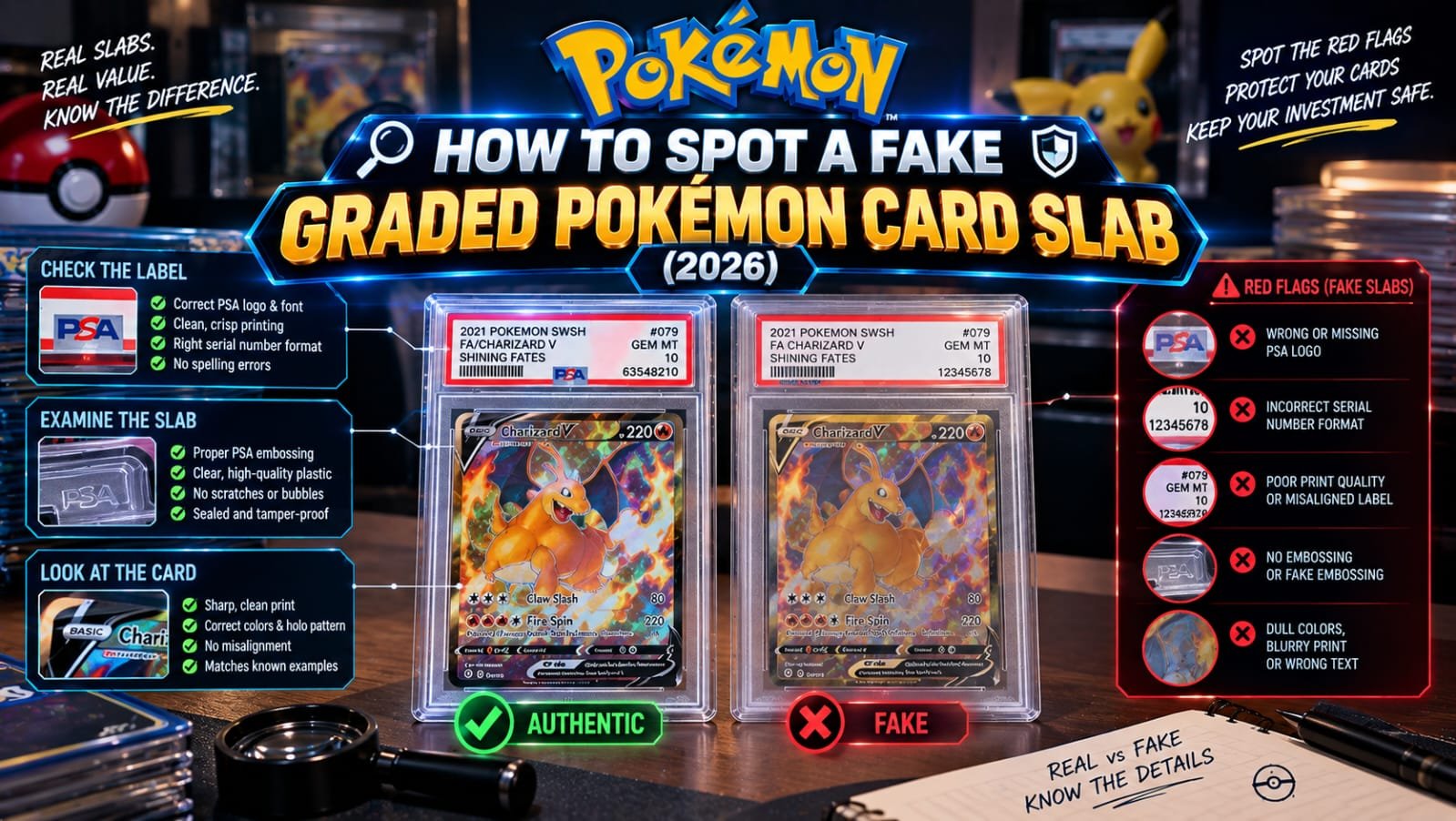
Once the cert number checks out, the label and case construction are your next line of defense — especially against resealed slabs, where the number alone won’t save you. Genuine labels from every major grading company follow a strict, consistent format that counterfeiters routinely get slightly wrong.
| What to Check | Genuine Slab | Red Flag |
|---|---|---|
| Label placement | Precisely centered, even margins on all sides | Crooked, shifted, or uneven spacing |
| Font and text | Consistent weight, spacing, and kerning | Slightly wrong font, uneven letter spacing |
| Hologram / security mark | Sharp, layered, reacts to light at an angle | Flat, missing, or crudely printed |
| Case seams | Clean, even, factory-sealed edges | Glue haze, bubbles, uneven or rough seams |
| Case thickness and fit | Consistent thickness, card sits snug and still | Noticeably thicker/thinner, card shifts when tilted |
| Plastic clarity | Crystal clear, no distortion | Cloudy, scratched, or warped-looking plastic |
| Opening resistance | Very difficult to open without visibly cracking the case | Case that opens with light pressure |
For BGS slabs specifically, there’s one extra detail worth memorizing: authentic cases have a patent number inscribed on the bottom edge of the holder, and it should include a period immediately after the first three letters. A missing or malformed patent number on a BGS slab is a strong sign something is wrong with the case itself.
Step 3: Compare the Card to the Cert Photo — Every Time
This is the step most collectors skip, and it’s exactly the step that catches a resealed slab. A real cert number with a real grade doesn’t guarantee the card inside is the one that number was issued to.
When the grading company’s database shows a reference photo, put the physical card side by side with it and check:
- Centering. Does the border ratio on the physical card match the reference photo, or does it look noticeably different?
- Surface marks. Are there scratches, print lines, or whitening visible on your card that aren’t visible in the reference photo (or vice versa)?
- Edge and corner wear. Does the wear pattern match? A “PSA 10” with visible edge wear that doesn’t appear in the file photo is a serious warning sign.
- Holo pattern and printing details. On foil cards, does the holo pattern line up with what’s shown in the reference image?
If anything doesn’t line up, don’t assume it’s just a bad photo or inconsistent lighting. A mismatch between the card in your hands and the card on file is the clearest sign of a resealed slab, and it’s the one red flag that a legitimate seller should be able to explain — or a scammer won’t be able to.
⚠️ The Most Common Real-World Scam Pattern
The pattern reported most often by collectors and dealers: a scammer buys a genuine slab holding a low-grade or otherwise inexpensive card. They crack the case open, remove the original card, and insert a higher-value or better-condition card that fits the same slot. The case is carefully resealed. When a buyer looks up the cert number, everything checks out — because the number, label, and grade were all real to begin with. The only thing wrong is that the card physically inside no longer matches the card the number was issued for. This is exactly why cert lookup alone is not enough, and why comparing the physical card to the reference photo is a non-negotiable step, especially on higher-value purchases.
Where This Happens Most
Fake and resealed slabs aren’t evenly distributed across every sales channel. Understanding where the risk concentrates helps you know when to be extra careful.
Online marketplaces with limited buyer protection. Facebook groups, marketplace apps, and direct social media sales carry the highest risk, since there’s often no formal dispute process if something turns out to be fake.
eBay and other platforms with buyer protection. Risk is lower here because of formal return and authenticity guarantee policies, but it isn’t zero — verification is still your responsibility before you commit to a purchase, since disputes take time and aren’t always resolved in the buyer’s favor.
In-person shows and conventions. Counterintuitively, this isn’t automatically safer. A confident seller and a busy table can be enough to make a buyer skip a careful inspection they’d normally do at home — precisely the environment counterfeiters rely on.
High-value modern chase cards specifically. PSA is the most frequently counterfeited grading company simply because its slabs historically carry the highest resale premium, which makes faking a PSA label more profitable than faking a less-recognized competitor’s.
What to Do If You Discover a Fake or Resealed Slab
Finding out that a slab you already paid for is fake or doesn’t match its certification is frustrating, but how you respond in the first few hours matters. Acting quickly and methodically gives you a real shot at getting your money back — waiting or confronting the seller emotionally first usually doesn’t.
- Document everything immediately. Before you do anything else, take clear, well-lit photos of the slab from every angle — the label, the seams, the case edges, and the card itself. Screenshot the original listing, your payment confirmation, and any messages exchanged with the seller. If the platform later asks for evidence, having this ready from day one strengthens your case significantly.
- Re-verify the cert number carefully. Double-check that you entered the number correctly and confirm exactly what mismatches you found — wrong card, wrong grade, or a card that doesn’t match the reference photo. Screenshot the official lookup result as evidence.
- Open a dispute through the platform you bought on. If you bought through eBay, use eBay’s Money Back Guarantee and specify that the item is “not as described” — a mismatched or fake certification is exactly the kind of claim this protection is built for. If you paid through PayPal directly, you can file a separate claim there as well.
- Contact the grading company directly. PSA, Beckett, and CGC all have channels for reporting suspected counterfeit or altered slabs bearing their name. This won’t necessarily get your money back on its own, but it creates an official record and helps the grading company track counterfeiting patterns — which benefits every collector down the line.
- Escalate for high-value purchases. If the amount involved is significant, consider a formal police report and, for cross-border purchases, a report to your local consumer protection agency. Card fraud involving thousands of dollars is a real crime, not just a marketplace dispute, and having an official report can matter if the case ever needs to go further.
- Warn the community. Posting your findings (with evidence, not accusations) in relevant collector forums or subreddits can help other buyers avoid the same seller, especially if the listing is still active.
The good news is that platforms with formal buyer protection — eBay in particular — have gotten noticeably better at handling authenticity disputes for graded cards specifically, precisely because this problem has become common enough that they’ve had to build clearer processes for it. Don’t assume a dispute is hopeless just because the seller pushes back.
Pre-Purchase Checklist: Verify Before You Buy, Not After
The steps in this guide only protect you if you actually use them before sending payment. Here’s the condensed version to run through on every graded card purchase, especially anything above $100.
| Step | What You’re Confirming |
|---|---|
| 1. Look up the cert number | The number exists and returns a real, matching entry |
| 2. Compare card details | Set, card name, and grade match the online record exactly |
| 3. Compare to the reference photo | Centering, surface, and wear pattern match the card in hand |
| 4. Inspect the label | Correct font, centered placement, no odd spacing |
| 5. Inspect the case | Clean seams, consistent thickness, no glue haze or bubbles |
| 6. Check seller history | Established account, genuine feedback, no pattern of similar complaints |
| 7. Request extra photos if unsure | Close-ups of the label, seams, and case edges before paying |
This Doesn’t Mean You Should Avoid Graded Cards
It’s worth putting this problem in perspective. The overwhelming majority of PSA, BGS, and CGC slabs in circulation are exactly what they claim to be, and grading still provides real, meaningful protection against buying a card with hidden condition issues or an outright fake raw card. Counterfeit and resealed slabs are a growing risk, not the norm.
The right response isn’t to stop trusting graded cards altogether — it’s to treat verification as a normal, five-minute part of any purchase, the same way you’d check a tracking number or read seller reviews. Collectors who build that habit are far less exposed than collectors who assume a slab is automatically safe just because it looks official.
Frequently Asked Questions
Can a fake PSA slab pass a cert number lookup?
Only if the slab is a resealed genuine holder — the cert number itself is real in that case, but the card inside no longer matches the record. A fully counterfeit slab typically fails the cert lookup entirely, since the number either doesn’t exist or returns a different card.
Which grading company is counterfeited the most?
PSA is the most frequently targeted, largely because PSA slabs have historically carried the highest resale premium, making them the most profitable to fake.
Is it safe to buy graded Pokémon cards on eBay?
Generally yes, especially compared to peer-to-peer sales with no formal protection. eBay’s buyer protection policies give you recourse if a card turns out to be fake or not as described, but you should still verify the cert number and inspect photos carefully before buying.
What if the grading company’s database doesn’t show a reference photo?
Rely more heavily on the label and case inspection steps in this guide, and consider requesting additional close-up photos from the seller before purchasing, especially for higher-value cards.
Can a resealed slab be detected just by looking at the case?
Sometimes. Uneven seams, glue haze, bubbles, or a case that feels slightly off in thickness are all signs of tampering. But a well-executed reseal can look clean, which is exactly why comparing the card to the cert photo matters just as much as inspecting the case.
Should I crack open a slab I suspect is fake to check the card myself?
No. Opening a slab yourself destroys any chance of a refund or dispute through the platform you bought it on, and it voids any recourse with the grading company. Document your suspicions with photos first and pursue a dispute before taking any physical action.
Does a scratched or cloudy case always mean the slab is fake?
Not necessarily — older slabs can develop surface scratches from years of handling. But cloudiness combined with uneven seams, a loose-fitting card, or a mismatched cert lookup should always be treated as a serious warning sign together, not dismissed individually.
Related Articles
- Pokémon Card Grading Guide: PSA vs. BGS vs. CGC
- Pokémon Card Pre-Grading Guide: How to Inspect Your Cards Before Submitting
- How to Measure Pokémon Card Centering: The Ultimate PSA 10 Submission Guide
- Pokémon Card Condition Guide: NM vs LP vs MP vs HP vs Damaged
- PSA Qualifiers Explained: OC, MC, MK, ST, PD & OF
- Pokémon TCG Market Liquidity: Why Some Cards Sell Faster
Final Thoughts
Grading was built to remove uncertainty from buying and selling Pokémon cards, and for the vast majority of transactions, it still does exactly that. But as slab values have climbed and grading itself has come under more scrutiny in 2026, a new layer of verification has become just as necessary as checking a raw card’s condition used to be.
The habit that actually protects you isn’t complicated: look up the cert number, compare the card to the photo on file, check the label and case for anything that looks off, and don’t skip that process just because a slab looks official at first glance. Counterfeiters are betting that most buyers won’t take the extra five minutes. Make sure you’re not one of them.