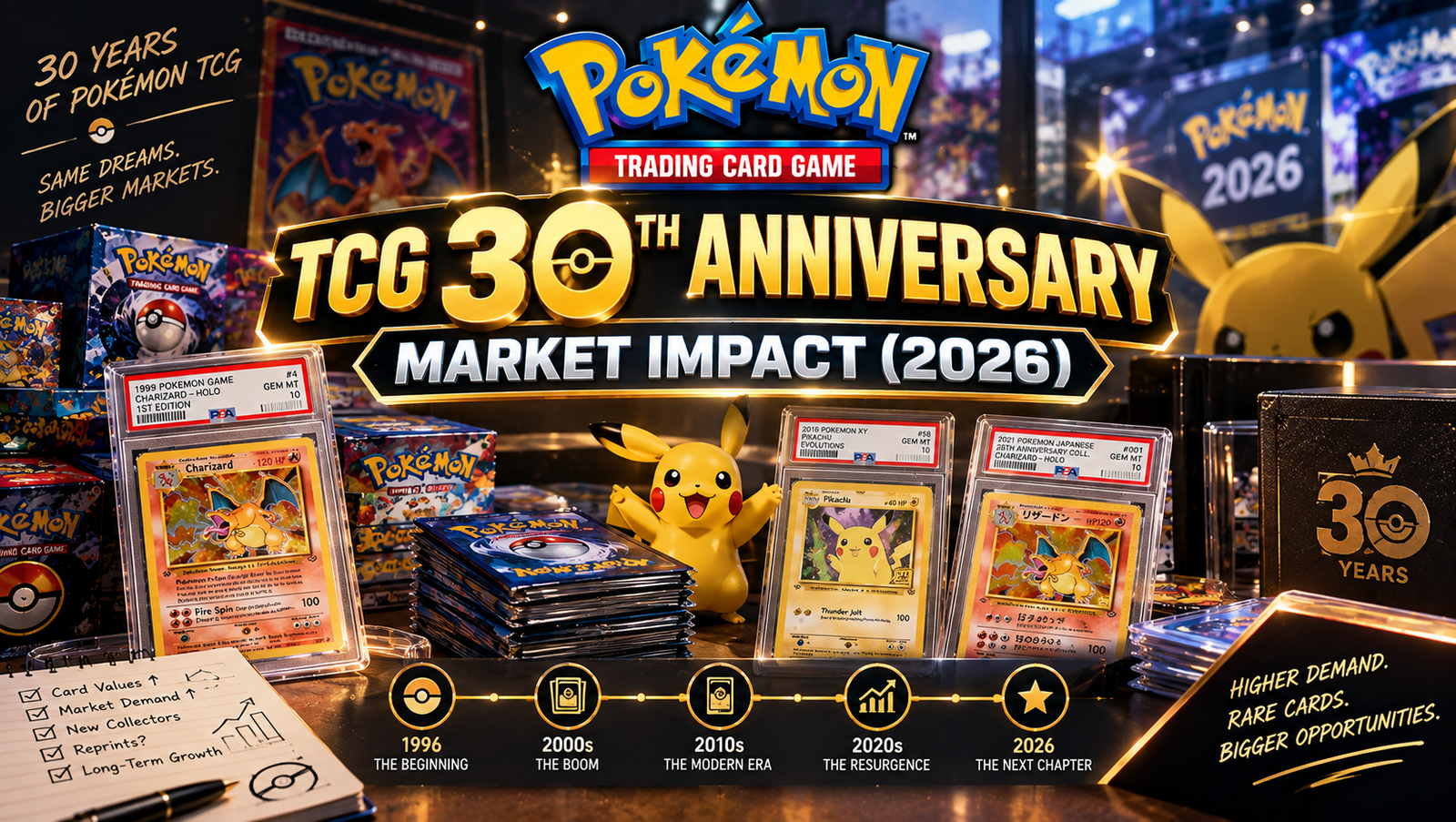
The Pokémon TCG just hit a milestone no expansion in its history has reached before: a simultaneous worldwide release. Pokémon TCG: 30th Celebration launched everywhere at once on September 16, 2026, and the ripple effect is already visible across the entire secondary market — not just for the new cards themselves, but for vintage singles, graded slabs, and even unrelated modern sealed product.
This isn’t a typical set-launch bump. Anniversary releases have a track record of pulling collector attention away from everything else for weeks at a time, and 30th Celebration is doing exactly that. This guide breaks down what’s actually moving in the market right now, why vintage and graded cards are climbing while some modern sealed product is cooling off, and what that gap means for anyone buying, holding, or selling this season.
Quick Answer: What’s happening in the Pokémon TCG market right now?
Pokémon TCG: 30th Celebration released worldwide on September 16, 2026, and collector attention has shifted heavily toward vintage cards, graded slabs, and anniversary sealed product. At the same time, several modern and overprinted sealed sets are softening due to oversupply. The result is a market moving in two directions at once: up for vintage, Japanese, and graded cards, and down for some overprinted modern sealed product.
Disclosure: This article contains eBay affiliate links. If you make a purchase through one of them, PokeVault Guide may earn a small commission at no extra cost to you. Prices and trends referenced below reflect the market as of September 2026 and can change quickly — always check current listings before buying or selling.
What Is Pokémon TCG: 30th Celebration, and Why Is It Moving the Market?
30th Celebration marks three decades of the Pokémon Trading Card Game, and Pokémon made sure it stood out. Every single card in the set is foil, including the Basic Energy cards — something no standard expansion has ever done. Each booster pack contains five cards instead of the usual ten, with one guaranteed Pikachu pulled from a run of 30 different illustrations.
The set totals 199 cards: 128 main-set cards, 33 secret rares, a 30-card Classic Collection of reprinted fan-favorite cards stamped with a special anniversary mark, and 8 foil Basic Energy cards. It also introduces a brand-new rarity tier, Futuristic Rare, debuting on Mewtwo and Mew with artwork from illustrator YOSHIROTTEN. A day/night subtheme built around Espeon and Umbreon runs through the set’s design.
What makes 30th Celebration different from a market perspective isn’t just the content of the set — it’s the release format. This is the first Pokémon TCG expansion ever released simultaneously worldwide, rather than debuting in Japan first. That means collector demand hit every region at the same time, concentrating buying pressure instead of spreading it out over weeks or months the way it normally would.
Why Vintage and Graded Cards Are Climbing
Anniversary hype tends to do something predictable: it sends new collectors and returning “nostalgia buyers” looking backward, not just at the new set. Base Set cards, early Japanese promos, and other vintage staples are seeing renewed demand as the 30th Celebration release reminds a wider audience how long the game has been around.
Graded cards are benefiting even more directly. As new collectors enter the market during an anniversary wave, many prefer buying pre-graded cards over raw ones — grading feels safer to someone who isn’t confident judging condition themselves. That pushes demand toward PSA, BGS, and CGC-slabbed cards specifically, widening the gap between what a raw card and a graded copy of the same card are worth.
Japanese releases are showing a similar pattern. Because 30th Celebration launched everywhere at once this time, there’s less of the usual scramble to import Japanese product early — but Japanese vintage and rare promos are still pulling strong demand from collectors who see anniversary periods as a good time to fill gaps in older collections.
Why Modern and Overprinted Sets Are Cooling Off
While vintage and graded cards are climbing, a different story is playing out on the modern side of the market, and it’s important to understand why — because it’s not a sign of a broader crash, it’s a supply problem specific to certain sets.
Modern Pokémon TCG sets are printed in large volumes to meet retail demand, and print runs don’t stop the moment collector interest cools. When a set stays on shelves and in distributor warehouses longer than expected, sealed product from that set tends to soften in price even if individual chase cards from it are still desirable. Some overprinted Sword & Shield-era sealed sets, for example, have posted noticeable declines over the past 30 days as supply continues to outweigh active demand.
Anniversary releases make this effect more visible than usual. When a huge portion of collector spending shifts toward a single flagship release like 30th Celebration, the sets that aren’t part of that moment simply see less buying activity by comparison. That’s not the same as those sets losing long-term value — it’s a short-term attention shift, and attention-driven dips in modern sealed product have historically recovered once the anniversary wave passes and buyers spread their spending back out.
There’s also a reprint factor worth watching. Whenever a set’s most in-demand cards get reprinted in a Classic Collection or similar subset — which 30th Celebration does for 30 iconic cards — the original printings of those same cards can see short-term softening too, simply because a fresh, easier-to-find alternative just entered the market.
Market Segment Snapshot: Where the Money Is Moving
Here’s a simplified breakdown of how different segments of the Pokémon TCG market are behaving as of September 2026. Treat this as a general snapshot rather than a precise forecast — individual cards within each category can still move against the overall trend.
| Market Segment | Current Trend | Main Driver |
|---|---|---|
| Vintage Singles (Base Set era and earlier) | Rising | Anniversary nostalgia demand |
| Graded Cards (PSA / BGS / CGC) | Rising | New collectors prefer graded safety |
| Japanese Vintage & Rare Promos | Rising | Collectors filling older gaps |
| 30th Celebration Sealed Product | Rising / High Demand | First-ever global simultaneous release |
| Overprinted Modern Sealed Sets | Softening | Oversupply, attention shifted elsewhere |
| Cards Freshly Reprinted in Classic Collection | Mixed / Short-term dip | New reprint reduces scarcity temporarily |
The Widening Gap Between Raw Cards and PSA 10s
One of the clearest signals of this market cycle is how much wider the spread has become between a raw (ungraded) card and the same card graded PSA 10. During anniversary-driven demand spikes, this gap tends to widen faster than usual, and there are two reasons why.
First, grading turnaround times don’t scale instantly with demand. When more collectors decide to submit cards for grading at once, backlogs grow, and freshly-graded PSA 10s become temporarily scarcer relative to demand — even for cards that aren’t hard to find raw. Second, new collectors entering the hobby during a high-visibility moment like a 30th anniversary tend to shop for certainty. A PSA 10 removes the guesswork of judging centering, surface, and corners yourself, so it commands a premium that goes beyond just the condition itself.
For fan-favorite modern chase cards, this spread has been especially visible: several popular alt-art and VMAX-era cards are showing meaningfully larger gains in their PSA 10 price than in their raw price over the same 30-day window. If you’re planning to submit cards for grading soon, understanding this gap now — before you submit — can change whether a particular card is worth grading at all.
If you want a deeper breakdown of how to choose between grading companies before submitting anything, our PSA vs. BGS vs. CGC grading guide walks through the turnaround times, costs, and resale premiums of each service.
Sealed Product Trends Around the Anniversary
Sealed product is where the 30th Celebration effect is most dramatic. Because every card in the set is foil and the release format is unprecedented, demand for 30th Celebration booster packs, blisters, and premium collections has been consistently strong since launch — and products with guaranteed hits, like the Ultra Premium Collections, are commanding especially high attention.
This is also where collectors need to be the most careful. Anniversary sealed product tends to sell out quickly at retail, which pushes secondary-market prices above MSRP almost immediately. Some smaller blister and 2-pack products have already been trading well above their original retail price on the secondary market within days of release — a pattern that’s common with commemorative Pokémon releases but doesn’t guarantee the premium will hold once initial hype settles.
Compare that to the historical precedent: 2021’s Celebrations set for the 25th anniversary generated some of the strongest secondary-market demand of its era for a commemorative product, and that demand held up reasonably well over the following years — but not every product within that release aged the same way. Larger, easier-to-restock items cooled off faster than scarcer, harder-to-find configurations. 30th Celebration is likely to follow a similar split: the scarcest products (Ultra Premium Collections, low-print blisters) have a stronger case for holding value than the higher-volume booster packs and bundles.
For more context on how print runs and reprint waves affect sealed product value over time in general, see our Pokémon TCG sealed product trends report.
What to Buy, Hold, or Avoid Right Now
Every anniversary cycle creates a short window where the smartest moves aren’t obvious just from watching prices go up. Here’s a practical breakdown based on the trends above.
| Category | Suggested Approach | Why |
|---|---|---|
| Consider Buying | Vintage singles you’ve wanted for a while, especially raw copies before they get graded and repriced | Demand is climbing but the gap between raw and graded hasn’t fully caught up yet on every card |
| Consider Buying | Overprinted modern sealed product you actually want to open or play with, not flip | Prices are softer than usual, which favors buyers who aren’t chasing resale margin |
| Consider Holding | Cards freshly reprinted in the Classic Collection | Short-term softening from the reprint may reverse once initial supply gets absorbed |
| Consider Holding | Graded cards you already own from hyped modern sets | Selling into a temporary attention dip rarely gets you a fair price |
| Be Cautious | High-volume 30th Celebration booster boxes at well above MSRP | Higher-print items historically cool off faster once launch hype settles |
| Be Cautious | Rushing to submit cards for grading right now | Backlogs grow during demand spikes, which can delay returns for months |
None of this is financial advice — it’s a read on current market behavior, not a guarantee of future performance. Pokémon card values can move quickly in either direction, so always check live listings before making a decision.
Practical Tips for Collectors This Season
- Check completed sales, not just active listings. During a hype cycle, active listings often reflect what sellers hope to get, not what buyers are actually paying. Filter for sold/completed listings on eBay before deciding a price is fair.
- Compare prices across platforms before buying. The same card can differ significantly in price between eBay, TCGplayer, and Cardmarket depending on currency, fees, and regional demand. Our guide to why Pokémon card prices differ across marketplaces breaks down exactly why this happens.
- Don’t submit a card for grading without checking centering first. A card that looks fine to the eye can still miss PSA 10 by a hair on centering alone. Use our Pokémon card centering guide before you spend money on a submission.
- Separate what you’re collecting from what you’re speculating on. Cards you want for your personal collection are worth buying regardless of short-term price movement. Cards you’re buying purely to flip should be judged against the trends in this article, not against emotional attachment.
- Watch for reprint effects before buying “chase” vintage cards. If a card just appeared in the Classic Collection, its original printing may be temporarily cheaper than it will be in a few months once the reprint’s novelty wears off.
- Set a personal ceiling for sealed product and stick to it. Anniversary sealed product sells out fast and prices spike quickly. Decide your maximum price before you start browsing, not while you’re mid-purchase and caught up in the moment.
- Track liquidity, not just price. A card with a high listed price but almost no completed sales isn’t actually worth that price yet — it’s an ask, not a market. Our market liquidity guide explains how to tell the difference before you buy or sell.
Risks to Watch This Cycle
Anniversary hype cycles create real opportunities, but they also create predictable traps. Here’s what to keep an eye on before the 30th Celebration wave settles down.
Scalping and artificial scarcity. The combination of a global simultaneous release and an all-foil, limited-configuration set is exactly the kind of launch that attracts bulk buyers looking to resell at a markup rather than collectors. Expect early secondary-market prices on the scarcest products to run well above what the set is likely worth once initial supply catches up with demand.
edgesOverhyped short-term spikes. Not every price increase during an anniversary period reflects a lasting shift in value. Some of it is simply attention — collectors bidding against each other in a moment of high visibility. Prices on cards or products with no historical track record of holding value after past anniversary cycles deserve extra skepticism.
Correction risk in overhyped segments. Historically, the sharpest post-anniversary corrections happen in the highest-volume, easiest-to-restock products — not in genuinely scarce vintage or low-print items. If you’re buying anything purely because “everyone else is,” that’s usually the segment most exposed to a pullback once the hype fades.
Grading backlogs delaying your returns. If you submit cards during a demand spike, expect longer turnaround times than usual. Factor that delay into your decision-making, especially if you were planning to grade-and-flip quickly.
How This Compares to Past Anniversary Releases
The closest historical comparison is 2021’s Celebrations set, released for the Pokémon TCG’s 25th anniversary. That release generated some of the strongest secondary-market demand the game had seen up to that point, and several of its scarcer products held their value well in the years that followed. But the comparison isn’t perfect: Celebrations was a single collection box concept, while 30th Celebration is a full, all-foil expansion with a much wider product lineup — booster packs, multiple blister configurations, Ultra Premium Collections, and a staggered release schedule running into November 2026.
That wider product range means the outcomes are likely to be less uniform this time. Expect a bigger spread between the products that hold or grow in value and the ones that settle back down once the initial excitement passes — which is exactly why the “buy, hold, or avoid” breakdown above separates scarce products from high-volume ones rather than treating the whole release as one investment.
Frequently Asked Questions
Why are vintage Pokémon cards rising in price right now?
The worldwide release of 30th Celebration is drawing new and returning collectors into the hobby, and anniversary moments tend to send buyers looking backward at older, nostalgic cards in addition to the new set itself.
Why are some modern sealed Pokémon products dropping in price?
Several modern sets were printed in large volumes and remain in oversupply. When collector attention shifts heavily toward a major release like 30th Celebration, sets outside that spotlight see less buying activity, which softens their sealed prices in the short term.
Is now a good time to get cards graded?
It depends on the card. The raw-to-PSA-10 gap has widened for many cards, which can make grading worthwhile — but expect longer turnaround times due to demand-driven backlogs across grading companies right now.
Will 30th Celebration sealed product hold its value long-term?
Scarcer configurations, like the Ultra Premium Collections, have historically had a better track record of holding value than high-volume booster boxes and bundles, based on how 2021’s Celebrations set played out over time. There’s no guarantee, since 30th Celebration has a much larger and more varied product lineup.
What’s the safest way to check a card’s real market value before buying or selling?
Filter for completed and sold listings rather than active ones, and compare prices across at least two marketplaces. Active listings often reflect optimistic asking prices rather than what buyers are actually paying.
Does this market shift affect every Pokémon card, or just certain sets?
It’s concentrated in specific segments: vintage, graded, and Japanese cards are trending up, while some overprinted modern sealed sets are trending down. Individual cards within either group can still move against the overall pattern, so this is a general snapshot, not a rule for every card.
Related Articles
- Pokémon TCG Market Liquidity: Why Some Cards Sell Faster
- Why Pokémon Card Prices Different Across Marketplaces
- Pokémon Card Grading Guide: PSA vs. BGS vs. CGC
- How to Measure Pokémon Card Centering
- Pokémon TCG Market Report: Sealed Product Trends & Card Value Shifts
- Pokémon Card Pre-Grading Inspection Guide
Final Thoughts
The 30th Celebration launch is doing exactly what a well-timed anniversary release is supposed to do: pulling attention, money, and new collectors into the hobby all at once. The market split it’s created — vintage and graded cards climbing while some modern sealed product cools — isn’t a warning sign for the hobby overall. It’s a normal, predictable pattern that plays out around major milestone releases, and it tends to correct itself as attention spreads back out over the following months.
The collectors who come out ahead in moments like this are usually the ones who separate genuine long-term scarcity from short-term hype, check completed sales before trusting a listed price, and resist the urge to chase every price spike in real time. Use the breakdown in this guide as a starting point, but always verify current prices before buying, selling, or submitting anything for grading — this market moves fast, and it’s still moving.