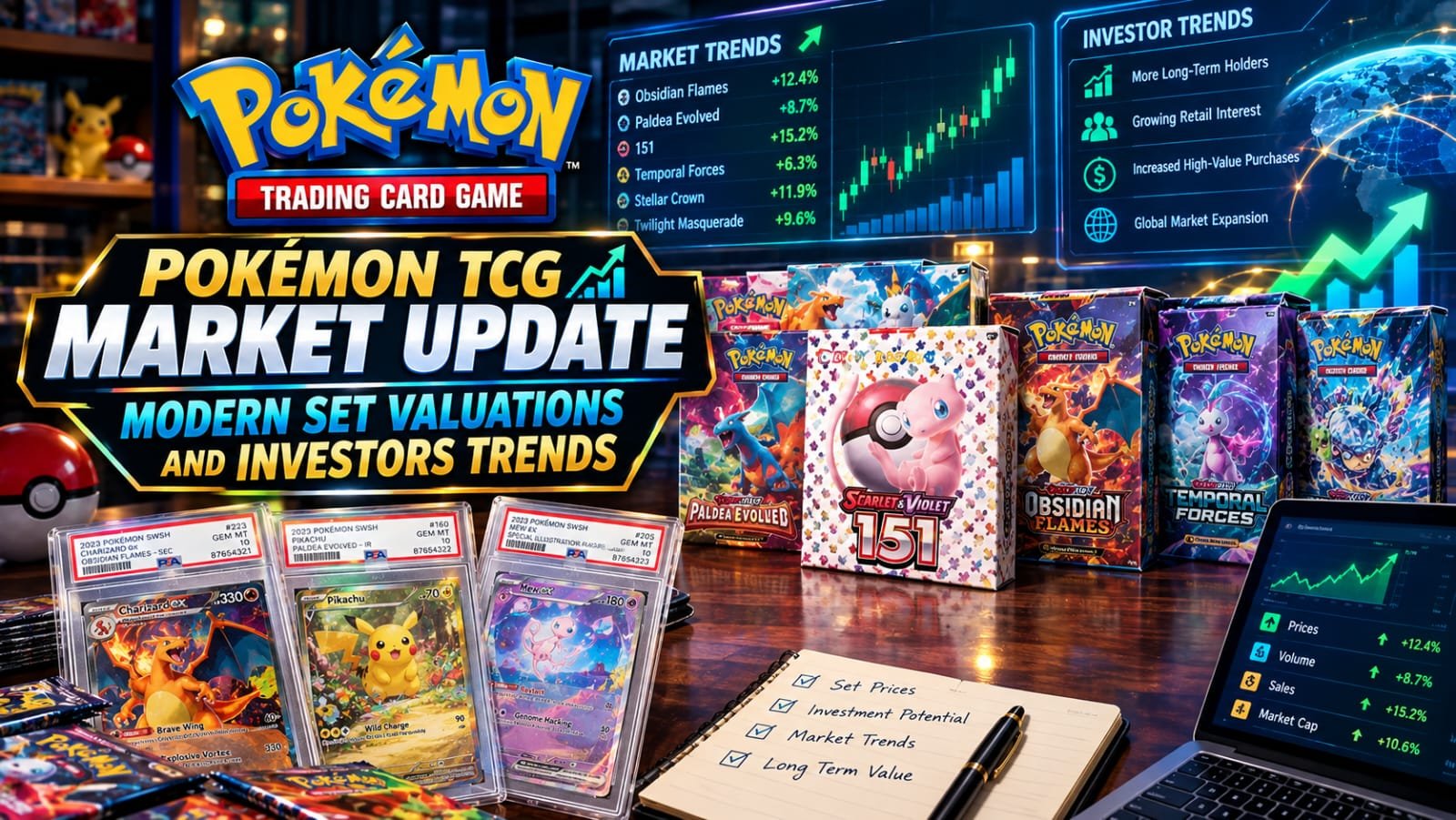
The Pokémon TCG market is experiencing notable shifts as collector interest balances between vintage grails and modern high-demand sets.
With sealed product availability changing rapidly and Special Illustration Rares (SIR) dominating secondary market activity, staying informed on current market dynamics is essential for smart collecting and investing.
This report breaks down current pricing shifts, high-performing sealed products, and key market trends across the Pokémon TCG landscape.
Modern vs. Vintage Market Performance
While vintage WOTC (Wizards of the Coast) era cards remain solid store-of-value assets, modern specialty sets are driving the highest trading volume.
High-grade vintage cards maintain strong floors, but liquidity and fast price movement are currently concentrated in modern Special Illustration Rares.
- Vintage Staples: PSA 10 Base Set and Neo-era holos show steady long-term stability with low volatility.
- Modern Chase Cards: Alt-art singles from sets like Prismatic Evolutions and Scarlet & Violet 151 experience fast liquidity and high demand among modern Master Set builders.
- Sealed Product Outperformance: Out-of-print modern sealed booster boxes and bundles continue to appreciate faster than individual raw singles.
Sealed Product Outperformance: Out-of-print modern sealed booster boxes and bundles continue to appreciate faster than individual raw singles.
| Product / Category | Market Status | 30-Day Value Trend | Primary Demand Driver |
| Scarlet & Violet 151 Sealed | Out Of Print / High Demand | Up (+12%) | Nostalgia & Kanto Set Completion |
| Prismatic Evolutions SIRs | Active High Trading Volume | Strong Hold | Eeveelution Collector Demand |
| WOTC Vintage Holos (Graded) | Stable Floor | Neutral (+1.5%) | Long-term Collector Security |
| In-Print Booster Boxes | High Retail Supply | Flat / Near MSRP | TCG Competitive Play |
3 Key Market Insights for Collectors
- The Power of Out-of-Print Specialty Sets
Special subsets that bypass traditional individual booster box releases (such as Crown Zenith and Scarlet & Violet 151) historically show stronger long-term sealed appreciation. Once retail shelf supply dries up, secondary market prices rise due to concentrated demand.
- Modern Raw Singles vs. Graded Premiums
Pulling top-tier chase cards like Special Illustration Rares carries high risk due to low pull rates. Buyers are increasingly opting to purchase high-grade slabbed copies (PSA 9/10) directly on the secondary market rather than opening sealed boxes, creating a strong market premium for pre-graded singles.
- Sealed Product Bifurcation
The market is clearly dividing into two tiers:
In-Print Product: Readily available at MSRP; ideal for opening and playing TCG.
Out-of-Print Sealed: Moves directly into investment-grade territory as retail restocking stops.
Collector Summary
For active collectors, focusing on out-of-print sealed bundles or targeting key single chase cards during market pullbacks offers the best balance of value preservation and growth potential.
Macroeconomic Factors & Inflation Impact on Pokémon TCG Valuations
While community nostalgia and set pull rates dictate micro-movements, broader macroeconomic conditions—such as inflation rates, alternative asset class performance, and disposable income shifts—play a monumental role in high-tier Pokémon card valuations. Institutional capital and high-net-worth collectors increasingly view grade-10 vintage holos and low-pop modern chase cards as tangible alternative assets, insulating portfolios against traditional market volatility. Understanding these macroeconomic currents is vital for long-term portfolio diversification within the collectible space.
Strategic Blueprint for Q4 2026 Collectors
To maximize ROI and portfolio resilience as we navigate through late 2026, collectors should adopt a hybrid allocation strategy:
- Anchor with Scarcity: Secure out-of-print sealed bundles before secondary market supply tightens further.
- Target Dips for Singles: Use market pullbacks to acquire key Special Illustration Rares (SIRs) only in high-grade slabs (PSA 9/10 or BGS 9.5+) to mitigate raw card centering and surface risks.
- Avoid Over-Hype Traps: Exercise caution with heavily printed, in-print booster waves unless designated for immediate TCG competitive play or casual opening.
Long-Term Storage & Vaulting Best Practices for Sealed Products
For collectors and investors holding out-of-print booster boxes or high-value bundles for multi-year appreciation, environmental control is just as important as market timing. Protecting your alternative assets from physical degradation ensures maximum secondary market liquidity when liquidation time arrives:
- Climate and Humidity Control: Fluctuating humidity levels can warp cardboard packaging, weaken booster box seals, and degrade foil integrity over time. Maintaining a stable ambient temperature between 18°C to 22°C with relative humidity kept strictly below 50% is essential.
- UV Protection Shielding: Direct sunlight or harsh fluorescent office lighting causes fading on booster box artwork and packaging colors. Always store high-end sealed products in UV-resistant acrylic cases or dark, temperature-controlled storage environments.
- Professional Vaulting Services: For institutional-grade portfolios, utilizing secure third-party vaulting services (such as those integrated with major grading and auction platforms) eliminates shipping friction, insurance overhead, and domestic storage risks.
The Rise of AI and Predictive Analytics in TCG Market Tracking
As the Pokémon TCG secondary market matures into a multi-million-dollar alternative asset class, reliance on traditional manual price tracking is no longer enough for serious investors. Modern high-end collectors and algorithmic portfolio managers are leveraging advanced technological tools to stay ahead of market curves:
- Algorithmic Price Indexing: Automated scraping and machine learning models now track real-time sales velocity across global platforms like eBay, TCGplayer, and Yahoo! Auctions Japan to spot undervalued chase cards instantly.
- Predictive Historical Modeling: By analyzing historical reprint cycles, set distribution volumes, and collector sentiment indices, data-driven platforms can forecast potential market corrections before they hit mainstream collector groups.
- Digital Slabs and Registry Tracking: Integrating physical grading certificates with blockchain or secure digital registry numbers allows instantaneous cross-border verification, drastically reducing fraud and increasing global market liquidity.
Portfolio Diversification & Risk Management for TCG Investors
Treating Pokémon TCG collecting purely as a hobby is a thing of the past for high-level market participants. Building a resilient, inflation-resistant asset portfolio requires a disciplined financial approach to risk mitigation:
- The 60/40 Split Rule: Many seasoned alternative asset collectors allocate roughly 60% of their capital into stable, out-of-print sealed booster boxes and bundles for steady compounding, while reserving 40% for high-grade modern chase cards (PSA 10 Special Illustration Rares) to capture rapid short-term liquidity and high-growth trends.
- Mitigating Concentration Risk: Avoid putting all capital into a single high-profile set or character (such as heavily over-indexing on a single Charizard or Rayquaza variant). Spreading investments across multiple eras (WOTC vintage, mid-era, and modern special sets) buffers against sudden community shifts or downward price corrections in specific sub-markets.
- Exit Strategy Planning: Successful portfolio management dictates knowing when to realize profits. Setting clear target valuation thresholds and utilizing reputable platforms like eBay, Goldin, or specialized European card markets ensures you can liquidate positions smoothly during peak market cycles.
Frequently Asked Questions (FAQ)
Q: Are modern Pokémon cards a safe long-term investment compared to vintage WOTC sets?
A: While vintage WOTC (Wizards of the Coast) cards offer historical stability and lower volatility due to fixed supply, modern high-grade Special Illustration Rares (SIRs) and out-of-print specialty sets often provide faster liquidity and higher short-term growth potential. A balanced portfolio usually incorporates both.
Q: Is it better to store Pokémon cards raw or graded in slabs?
A: For investment and long-term protection, grading cards through reputable services like PSA, BGS, or CGC is strongly recommended. Slabs protect against humidity, surface damage, and handling wear while maximizing market trust and resale value.
Q: How do reprint waves affect sealed product values?
A: In-print booster boxes can experience short-term price stagnation or dips during major retail reprint waves. However, once the Pokémon Company officially moves out of print (OOP), historical data shows that supply constraints drive steady, long-term compound appreciation.
Conclusion: Navigating the Future of Pokémon TCG Collecting
Q: Are modern Pokémon cards a safe long-term investment compared to vintage WOTC sets?
A: While vintage WOTC (Wizards of the Coast) cards offer historical stability and lower volatility due to fixed supply, modern high-grade Special Illustration Rares (SIRs) and out-of-print specialty sets often provide faster liquidity and higher short-term growth potential. A balanced portfolio usually incorporates both.
Q: Is it better to store Pokémon cards raw or graded in slabs?
A: For investment and long-term protection, grading cards through reputable services like PSA, BGS, or CGC is strongly recommended. Slabs protect against humidity, surface damage, and handling wear while maximizing market trust and resale value.
Q: How do reprint waves affect sealed product values?
A: In-print booster boxes can experience short-term price stagnation or dips during major retail reprint waves. However, once the Pokémon Company officially moves out of print (OOP), historical data shows that supply constraints drive steady, long-term compound appreciation.
The Pokémon TCG landscape in late 2026 is more dynamic and institutionalized than ever before. By combining disciplined risk management, proper environmental storage, awareness of macroeconomic trends, and strategic asset allocation between sealed products and high-grade slabs, collectors and investors can successfully protect their capital while enjoying a lifelong hobby. Stay informed, diversify wisely, and let your collection grow with the market!