Giratina V Price Guide & Ultimate Collector Guide: All Versions, Value & PSA
Giratina V is one of the most important Pokémon V cards of the Sword & Shield era. It is not simply a popular card because Giratina is a Legendary Pokémon. The card became especially important because of its connection to the Lost Zone, the popularity of the Lost Origin expansion, and, above all, the extraordinary artwork created by Shinji Kanda for its most famous version.
Today, collectors can encounter Giratina V in several different forms, languages, sets, rarities, and price ranges. That can make researching the card surprisingly confusing. A seller may simply write “Giratina V” in an eBay title even though the card could be the regular version, Full Art, Alternate Art, a promo, or a foreign-language printing.
This guide is designed to solve that problem.
Instead of focusing on one specific listing, this is a complete Giratina V collector and value guide. We will look at the card’s history, the major versions, the famous Alternate Art, the Japanese and Simplified Chinese equivalents, current market values, PSA populations, grading potential, authenticity, liquidity, and the factors that can make one Giratina V significantly more valuable than another.
Quick Collector Summary: Giratina V first appeared during the Sword & Shield era and became closely associated with the Lost Zone mechanic. Its most famous version is the English Giratina V #186/196 from Lost Origin, featuring Shinji Kanda’s highly distinctive illustration. The same artwork also exists in other languages, including Japanese #111/100 and Simplified Chinese #150/131, but each printing has its own market.
What Is Giratina V?
Giratina V is a Basic Dragon-type Pokémon V with 220 HP. It was introduced during the Sword & Shield era and became one of the defining Pokémon associated with the Lost Origin expansion.
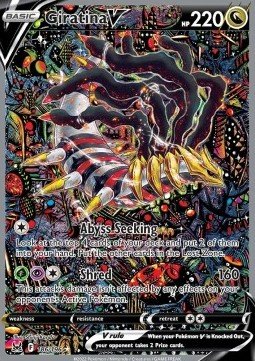
The card is mechanically connected to the Lost Zone, a special game zone that had returned to the Pokémon TCG in the Sword & Shield era. Giratina V’s first attack, Abyss Seeking, allows the player to look at the top four cards of the deck, put two into the hand, and place the others into the Lost Zone.
Its second attack, Shred, deals 160 damage and is designed to ignore effects on the opponent’s Active Pokémon that would otherwise affect the damage.
When Giratina V is Knocked Out, its Pokémon V rule means the opponent takes two Prize cards.
Although the gameplay history is important, collectors today are usually much more interested in another aspect of Giratina V: the artwork and the different collectible versions of the card.
Why Giratina V Became So Important to Collectors
There are several ingredients behind Giratina V’s popularity.
| Factor | Why It Matters |
|---|---|
| Giratina | One of Pokémon’s most recognizable Legendary Pokémon, with a particularly strong following among older and newer collectors. |
| Lost Origin | A major Sword & Shield expansion built around Giratina and the Lost Zone. |
| Shinji Kanda | His distinctive illustration turned the highest-profile Giratina V into a major artwork-focused collectible. |
| Multiple Versions | Collectors can pursue regular, Full Art, Special Full Art/Alternate Art, promo, Japanese, Chinese and other language versions. |
| Grading Demand | High-value copies have created an active graded-card market, especially for the iconic Alternate Art. |
Lost Origin was released in English on September 9, 2022, following the Japanese Lost Abyss expansion. Giratina was one of the central Pokémon of the set, and Giratina V and Giratina VSTAR were closely connected to the Lost Zone strategy. Bulbapedia – Lost Origin
Giratina V Versions: The Most Important Difference
If you are researching Giratina V prices, never search for “Giratina V” alone and assume every result is comparable.
The English Lost Origin release alone contains multiple Giratina V versions with different collector numbers and completely different artwork.
| Version | English Number | Artwork / Illustrator | Collector Interest |
|---|---|---|---|
| Regular Giratina V | 130/196 | 5ban Graphics | Lower |
| Full Art Giratina V | 185/196 | N-DESIGN Inc. | Moderate to strong |
| Special Full Art / Alternate Art | 186/196 | Shinji Kanda | Extremely strong |
| SWSH Black Star Promo | SWSH259 | PLANETA Mochizuki | Specialized |
These differences are confirmed in the card database record for Giratina V. The regular, Full Art, and Special Full Art prints all have different artwork and illustrators, while the SWSH259 promo uses another illustration. Bulbapedia – Giratina V
Important Buying Tip: A listing titled “Giratina V” is not enough information to determine value. Always check the collector number, artwork, language, set, and condition before comparing a price with another copy.
Giratina V 186/196: The Famous Alternate Art
When collectors casually say “the Giratina V”, they are often referring to the English #186/196 from Lost Origin.
Technically, the card is catalogued as a Special Full Art, while the collecting community commonly calls it the Alternate Art or “Alt Art” Giratina V.
This is the version illustrated by Shinji Kanda, and it is by far the most important Giratina V from Lost Origin from a collector-value perspective.
The illustration depicts Giratina in its Origin Forme surrounded by an extraordinarily detailed and distorted environment. The composition has a chaotic quality that fits Giratina’s connection to the Distortion World and makes the card feel different from conventional Pokémon TCG artwork.
It is the kind of card that rewards looking at it for more than a few seconds.
Instead of presenting Giratina as a simple central character, the illustration uses the entire card as a scene. The viewer has to explore it.
Why the Shinji Kanda Artwork Matters
Artwork is one of the biggest reasons modern Pokémon cards can maintain collector demand even when their competitive usefulness changes.
Giratina V #186/196 is an excellent example.
Its long-term appeal is not dependent entirely on whether Giratina V remains playable. The character, the artwork, the artist, and the reputation of the Lost Origin era all contribute to its collector identity.
That distinction matters because playable cards and collectible cards can behave very differently in the market.
Collector Perspective: Giratina V #186/196 is best understood as an artwork-driven chase card. Its appeal extends beyond gameplay because collectors can want it for Giratina, Shinji Kanda, the Lost Origin era, the Alternate Art style, or simply the artwork itself.
The Japanese Giratina V Versions
The Japanese market is especially important when researching Giratina V because the Japanese Lost Abyss expansion predates the English Lost Origin release and contains the corresponding Giratina V artwork variations.
| Japanese Version | Number | Relationship |
|---|---|---|
| Giratina V | 080/100 | Regular version |
| Giratina V | 110/100 | Full Art version |
| Giratina V | 111/100 | Shinji Kanda artwork / corresponding Alternate Art |
The important point is that the Japanese number 111/100 is the counterpart collectors should compare with the English #186/196 when researching the famous Shinji Kanda artwork.
However, Japanese and English cards should still be treated as separate markets. A sale of one should not automatically be converted into a price prediction for the other.
Giratina V and the Lost Zone
Giratina V is also historically significant because of its role in the Lost Zone strategy.
The Lost Zone is not simply another discard pile. Cards placed there generally cannot be recovered through ordinary effects, making the mechanic strategically important.
Giratina V’s Abyss Seeking attack directly interacts with this mechanic, while Giratina VSTAR later became one of the strongest competitive expressions of the Lost Zone strategy.
Pokémon’s official strategy article for Lost Origin included Giratina V #186/196 as part of a Giratina VSTAR deck, showing how the card functioned as the basic Pokémon supporting the strategy. Pokémon.com – Giratina VSTAR Deck Strategy
Giratina V Card Details
| Pokémon | Giratina |
| Card Type | Basic Pokémon V |
| Type | Dragon |
| HP | 220 |
| Pokédex | #487 |
| Main Expansion | Sword & Shield—Lost Origin |
| Japanese Expansion | Sword & Shield—Lost Abyss |
| Famous Artwork | Shinji Kanda |
| Famous English Number | 186/196 |
Giratina V Artwork vs. Giratina VSTAR
It is also important not to confuse the Giratina V Alternate Art with Giratina VSTAR cards.
They belong to the same broader Lost Origin story and were central to the Lost Zone strategy, but they are different cards with different collector numbers, mechanics, and artwork.
Giratina V is the Basic Pokémon that can evolve into Giratina VSTAR. The famous #186/196 card is therefore not the same collectible as Giratina VSTAR #131/196 or its higher-rarity versions.
Search Tip: If you are researching prices online, include the full number in your search. “Giratina V 186/196” will give you a much cleaner market picture than simply searching “Giratina V.”
Giratina V Price Guide: Why There Is No Single Value
One of the biggest mistakes collectors make with Giratina V is asking, “How much is Giratina V worth?” as if there were one answer.
There isn’t.
The price depends on the exact version, language, condition, grade, marketplace, and timing.
A regular Giratina V and the Alternate Art #186/196 can feature the same Pokémon but occupy completely different parts of the market.
The same is true for English #186/196 compared with Japanese #111/100 or Simplified Chinese #150/131.
| Price Factor | Why It Changes Value |
|---|---|
| Version | Regular, Full Art and Alternate Art have very different demand. |
| Language | English, Japanese, Simplified Chinese and other markets have different buyer pools. |
| Condition | A clean Near Mint copy can command substantially more than a damaged example. |
| Grade | PSA 9 and PSA 10 are separate collector markets. |
| Timing | Modern Pokémon prices can move significantly as demand changes. |
| Sales Platform | Auction, Best Offer, fixed-price and private sales can produce different results. |
Giratina V 186/196 Current Market
The English Alternate Art is currently the most valuable and heavily watched Giratina V version.
Recent PSA certification data illustrates the size of the graded market. One current PSA record for a PSA 8 copy lists an estimated value of $723 and shows a PSA population of more than 3,000 for the exact #186 card. The same PSA page shows recent comparable transactions around the high-$600s to high-$700s for graded copies in the relevant range. PSA certification and sales data
That does not mean every raw Giratina V #186 is worth hundreds of dollars or that every PSA 8 sells for exactly the PSA estimate.
It demonstrates something more useful: there is a substantial and active graded market around this card.
Current market trackers can also show a large difference between the English, Japanese and Simplified Chinese versions of the same artwork. For example, Simplified TCG currently lists the English #186 market substantially above its Simplified Chinese #150/131 equivalent, while the Japanese #111/100 has its own separate market. Simplified TCG – Giratina V #150/131 and comparable prints
Market Rule: Never calculate the value of one Giratina V version by simply taking another language’s price and applying an arbitrary discount. Each version has its own supply, buyer pool, and transaction history.
Raw Giratina V vs. Graded Giratina V
Raw and graded Giratina V cards should be viewed as separate products.
A raw card gives the buyer the opportunity to grade it, but also transfers condition risk to the buyer. A graded card provides an established condition assessment and authentication through the grading company, but the buyer pays a premium for that service and the grade.
| Option | Advantages | Risks / Disadvantages |
|---|---|---|
| Raw | Lower entry cost; grading upside. | Condition risk; buyer must inspect authenticity and flaws. |
| PSA 9 | Authenticated, protected and generally cheaper than PSA 10. | Large premium over raw can reduce grading/value upside. |
| PSA 10 | Strong collector demand and easy grade recognition. | Highest entry cost and potentially large grade premium. |
PSA 9 vs. PSA 10 Giratina V
The difference between PSA 9 and PSA 10 is not simply “one point.”
For highly collectible cards, the market can assign a substantial premium to the top grade because collectors often want the best-looking possible example.
But that premium should always be compared with actual sales.
A PSA 10 is only a good purchase at a particular price if buyers in the market are actually paying around that level.
The same principle applies to PSA 9. A PSA 9 can be excellent value when the PSA 10 premium becomes too large, but it can also be overpriced if sellers are asking almost PSA 10 money.
Smart Comparison: Compare recent PSA 9 sales against recent PSA 9 sales, and PSA 10 against PSA 10. Then calculate the premium between the grades. Do not compare one active PSA 9 listing with one active PSA 10 listing and call the difference “market value.”
The Giratina V #150/131 Simplified Chinese Version
Now we get to the version shown in the listing that inspired this article.
Giratina V #150/131 is a Simplified Chinese printing from the Shadow of the Blue Sea – Set B release, also identified as CS6b/CS6bC in market databases.
It uses the same Shinji Kanda artwork that collectors know from the English #186/196 and Japanese #111/100 versions.
This makes it particularly interesting because it allows collectors to own the iconic artwork in another language without automatically paying the same market price as the English or Japanese copies.
| Card | Giratina V |
| Number | 150/131 |
| Language | Simplified Chinese |
| Set | Shadow of the Blue Sea – Set B / CS6bC |
| Rarity | Super Rare |
| Illustrator | Shinji Kanda |
| Release | September 20, 2024 |
Current Simplified TCG data shows meaningful transaction activity for this exact card. Its current ungraded reference is around the $190 level, while its US eBay reference is around the mid-$200s. The same database currently shows a 90-day PSA 10 median around $442 and a PSA 9 median around $228. These figures are market snapshots and will change over time. Simplified TCG – Giratina V 150/131
That difference is extremely useful for collectors because it demonstrates how much language can influence a collectible’s market even when the artwork is essentially the same.
Is the Chinese Giratina V “the Same Card” as the English Alt Art?
From an artwork perspective, they are closely related versions of the same illustration.
From a collecting and market perspective, they are not interchangeable.
The English version has its own collector number, language, print run, buyer pool and market history. The Japanese version has its own market. The Simplified Chinese version has another.
This is why a serious collector should always write down the exact version before researching value.
| Number | Language | Artwork | |
|---|---|---|---|
| Lost Origin | 186/196 | English | Shinji Kanda |
| Lost Abyss | 111/100 | Japanese | Shinji Kanda |
| Shadow of the Blue Sea – Set B | 150/131 | Simplified Chinese | Shinji Kanda |
What Makes the Giratina V #186/196 So Expensive?
There is no single reason.
Its value is the result of several forces working together:
- Giratina is highly collectible.
- The artwork is widely considered one of the standout Sword & Shield illustrations.
- Shinji Kanda has a recognizable collector following.
- Lost Origin is strongly associated with Giratina.
- The card is visually distinctive even among other Alternate Arts.
- Graded copies have a well-established market.
- There is international demand for different language versions.
When several collector groups want the same card, demand can remain strong even after the card stops being relevant to competitive play.
Why Asking Prices Can Be Misleading
This is especially important when researching Giratina V on eBay.
You may see one seller asking $900, another asking $1,100, and another asking $700. That does not mean the card has a $900–$1,100 market value.
Those are simply three sellers testing three prices.
A completed transaction is stronger evidence.
This is also why a listing with hundreds of views or several watchers should not automatically be interpreted as proof that the card is about to sell at the asking price.
Golden Rule for Giratina V: Sold price > active asking price when you are trying to establish what the market actually supports.
Giratina V and Market Liquidity
Value and liquidity are not the same thing.
A card can be worth $1,000 but take weeks to sell. Another card worth $300 may sell within hours because there are many buyers actively searching for it.
This becomes particularly important when comparing different Giratina V languages.
The English Alternate Art has a broad international collector audience. Japanese cards have a large and established collector market. Simplified Chinese cards can have strong demand among collectors who specifically like the language or want the artwork at a lower entry point, but the buyer pool can be different.
Our Pokémon TCG Market Liquidity Guide explains this concept in detail.
Why Rarity Does Not Automatically Equal Liquidity
A rare card can have a small buyer pool.
That is why population, rarity and liquidity should never be treated as synonyms.
| Metric | What It Tells You |
|---|---|
| Rarity | How the card is classified within its release. |
| Population | How many copies a grading company has graded. |
| Demand | How strongly collectors want the card. |
| Liquidity | How easily copies can actually be bought and sold. |
How to Grade a Giratina V Before Sending It to PSA
If you own a raw Giratina V, especially the #186/196 Alternate Art, it can be tempting to look at the card and immediately think, “This is a PSA 10.”
That is where many collectors make an expensive mistake.
Modern Pokémon cards can leave the factory with centering problems, whitening, print lines, surface imperfections, edge issues, or subtle dents. A card can be pulled directly from a pack and still fail to reach Gem Mint.
Before grading, inspect four major areas:
| Area | What to Inspect | Common Problems |
|---|---|---|
| Centering | Left/right and top/bottom borders. | Noticeable border imbalance. |
| Corners | Sharpness and whitening. | Soft corners, whitening, dents. |
| Edges | Front and back perimeter. | Chipping, whitening, rough factory cuts. |
| Surface | Inspect under angled light. | Scratches, print lines, dents and surface defects. |
For a complete inspection workflow, see our Pokémon Card Pre-Grading Guide.
Centering Matters More Than Many Buyers Realize
Centering is one of the first things I would inspect on a high-value raw Giratina V.
Look at the front first, then flip the card over and inspect the back. Do not judge centering only while holding the card in your hand. Place it flat under even lighting and compare opposite borders.
Our Pokémon Card Centering Guide goes into the measurement process in much more detail.
One practical lesson from grading modern cards is that a beautiful surface does not automatically compensate for obvious centering problems. Likewise, a perfectly centered card can still lose significant grade potential because of a single surface dent or corner issue.
Pre-Grading Tip: Inspect Giratina V under angled light before deciding to grade it. Textured modern cards can hide small surface imperfections that are difficult to see under normal room lighting.
What About PSA Qualifiers?
Collectors should also understand that numerical grades are not always the complete story.
PSA qualifiers can identify characteristics such as Off Center, Miscut, Marks, Staining, Print Defect, or Out of Focus.
If you encounter a Giratina V slab with a qualifier, do not compare it automatically with an ordinary slab carrying the same numerical grade.
Our PSA Qualifiers Explained Guide covers OC, MC, MK, ST, PD and OF in detail.
PSA vs. BGS vs. CGC for Giratina V
If you decide to grade a valuable Giratina V, the grading company itself can influence the resale market.
PSA generally has the largest Pokémon TCG collector base and one of the strongest resale markets. BGS has its own appeal, especially for collectors chasing sub-grades and Black Label cards. CGC is also a major player in the modern TCG grading market.
The best grading company therefore depends on your objective.
| Goal | Potential Choice |
|---|---|
| Maximum mainstream resale liquidity | PSA |
| Sub-grade information | BGS |
| Chasing an elite Black Label | BGS |
| Alternative modern TCG slab | CGC |
For a deeper comparison, read our PSA vs. BGS vs. CGC Pokémon Card Grading Guide.
How to Authenticate a Graded Giratina V
As Giratina V values rise, authenticity becomes increasingly important.
If you are buying a graded copy, verify the certification number through the grading company’s official website. More importantly, compare the certification record with the physical card and slab in front of you.
A genuine certification number does not automatically prove that the card currently inside a slab is the exact card originally associated with that certification.
This is why collectors should inspect the slab, label, certification information, card details, and available certification images rather than simply searching the number and stopping there.
For a detailed walkthrough, read our How to Spot a Fake Graded Pokémon Card Slab guide.
Raw Giratina V: What Should You Check Before Buying?
If you are buying a raw copy online, especially a high-value #186/196, ask for clear photographs of:
- The entire front of the card.
- The entire back of the card.
- All four front corners.
- All four back corners.
- The edges.
- The surface under strong lighting.
Blurry photographs are one of the biggest problems with expensive raw-card purchases.
If the seller only provides one distant photograph, you are being asked to accept unnecessary condition risk.
Is a Pack-Fresh Giratina V Automatically PSA 10?
No.
“Pack fresh” describes the card’s history, not its professional grade.
A card can come directly from a sealed product and still have a manufacturing defect, poor centering, print line, whitening, surface issue, or corner imperfection.
This is particularly important with expensive modern chase cards because the difference between a potential PSA 9 and PSA 10 can be substantial.
Giratina V as a Long-Term Collectible
The strongest argument for Giratina V as a collectible is that its appeal is not based on one temporary factor.
It has several independent sources of collector demand.
- Giratina is a major Legendary Pokémon.
- Lost Origin is strongly associated with Giratina.
- The Lost Zone mechanic gives the card historical TCG significance.
- The Shinji Kanda artwork has exceptional display appeal.
- The Alternate Art belongs to one of the most collectible modern Pokémon card categories.
- Graded examples have an established secondary market.
- Multiple language versions create additional collecting opportunities.
That does not guarantee future appreciation.
No Pokémon card should be treated as a guaranteed investment simply because it has a famous character or expensive current price.
Instead, the better question is whether the card has characteristics that can support long-term collector interest.
Who Should Collect Giratina V?
| Collector Type | Best Giratina V Approach |
|---|---|
| Giratina Fan | Collect the versions and artwork you personally enjoy. |
| Artwork Collector | Focus on the Shinji Kanda #186/196 and matching international prints. |
| Graded Collector | Compare PSA 9 and PSA 10 sales before buying. |
| Budget Collector | Explore Japanese or Simplified Chinese versions and non-10 grades. |
| Resale-Focused Buyer | Prioritize established markets, recent sold data and liquidity. |
Where the Giratina V #150/131 Listing Fits
The Simplified Chinese copy shown in this guide is an interesting example of how the same artwork can occupy a completely different price tier from the English and Japanese markets.
If you specifically want the CS6b / Shadow of the Blue Sea – Set B #150/131 version, you can check the current eBay listing here:
Looking for Giratina V #150/131?
Check the current eBay listing and availability.
View Giratina V on eBayThis is an affiliate link. PokeVault Guide may earn a commission from qualifying purchases at no additional cost to you.
How to Research Giratina V Before Buying
- Identify the exact card number. 130/196, 185/196, 186/196, SWSH259, 111/100 and 150/131 are not interchangeable.
- Identify the language. English, Japanese and Simplified Chinese have different markets.
- Check the artwork. Shinji Kanda’s artwork is the key identifier for the famous Alternate Art.
- Separate raw and graded sales. They represent different products.
- Compare the same grade. PSA 9 should be compared with PSA 9.
- Look at completed sales. Do not establish value from active listings alone.
- Check population data. Population tells you about graded supply, not total supply.
- Inspect condition carefully. Especially for expensive raw copies.
- Verify graded certification. Never rely solely on a seller’s description.
- Consider liquidity. A card can have a high asking price without having strong buyer activity.
Giratina V Related Guides from PokeVault Guide
Want to go deeper? These guides on PokeVault Guide cover the areas that matter most when buying, grading and evaluating Giratina V.
- Pokémon Card Pre-Grading Guide: How to Inspect Your Cards Before Submitting
- How to Measure Pokémon Card Centering: PSA 10 Guide
- PSA vs. BGS vs. CGC: Pokémon Card Grading Guide
- PSA Qualifiers Explained: OC, MC, MK, ST, PD & OF
- How to Spot a Fake Graded Pokémon Card Slab
- Pokémon Card Condition Guide
- Pokémon TCG Market Liquidity: Why Some Cards Sell Faster
- More Pokémon Card Value Guides
- More Grading & Authenticity Guides
Sources & Market References
This guide combines official Pokémon information, card databases, grading-company records, current market tracking, and collector-market observations. Because Pokémon card prices change continuously, market figures should be treated as snapshots rather than permanent values.
- Pokémon.com – Giratina VSTAR Deck Strategy and Lost Origin
- Bulbapedia – Giratina V Versions and Release Information
- Bulbapedia – Sword & Shield Lost Origin
- PSA – Giratina V #186/196 Certification and Sales Data
- Simplified TCG – Giratina V #150/131 Market Data
- PSA Official Certification & Population Database
Final Verdict: Is Giratina V Worth Collecting?
Giratina V is one of the strongest collector cards of the Sword & Shield era, but its different versions should always be treated separately.
The regular Giratina V, Full Art, Alternate Art, promo and international-language versions are not interchangeable from a market perspective. The most famous version, English #186/196, has earned its reputation because of the combination of Giratina’s popularity, Lost Origin’s identity, Shinji Kanda’s artwork and strong collector demand.
At the same time, the Japanese #111/100 and Simplified Chinese #150/131 demonstrate why language collecting can be fascinating. The same artwork can exist across multiple markets while each version develops its own price, population and buyer base.
For someone buying Giratina V today, the most important lesson is simple:
Know exactly which Giratina V you are buying, then research that exact version.
Check the number. Check the language. Check the artwork. Check the condition. Check completed sales. If it is graded, verify the certification. And if you are considering a raw copy for grading, inspect it much more carefully than you would an ordinary binder card.
Most importantly, don’t let one expensive eBay listing define the market for you.
The real story of Giratina V is much more interesting than a single price tag. It is a card family with multiple artworks, languages, collector markets and grading opportunities — with the Shinji Kanda Alternate Art standing at the center of the entire conversation.
Last updated: October 2026. Market prices, grading populations, active listings and recent sales can change over time. Always verify current completed-sale data before making a significant purchase or sale.