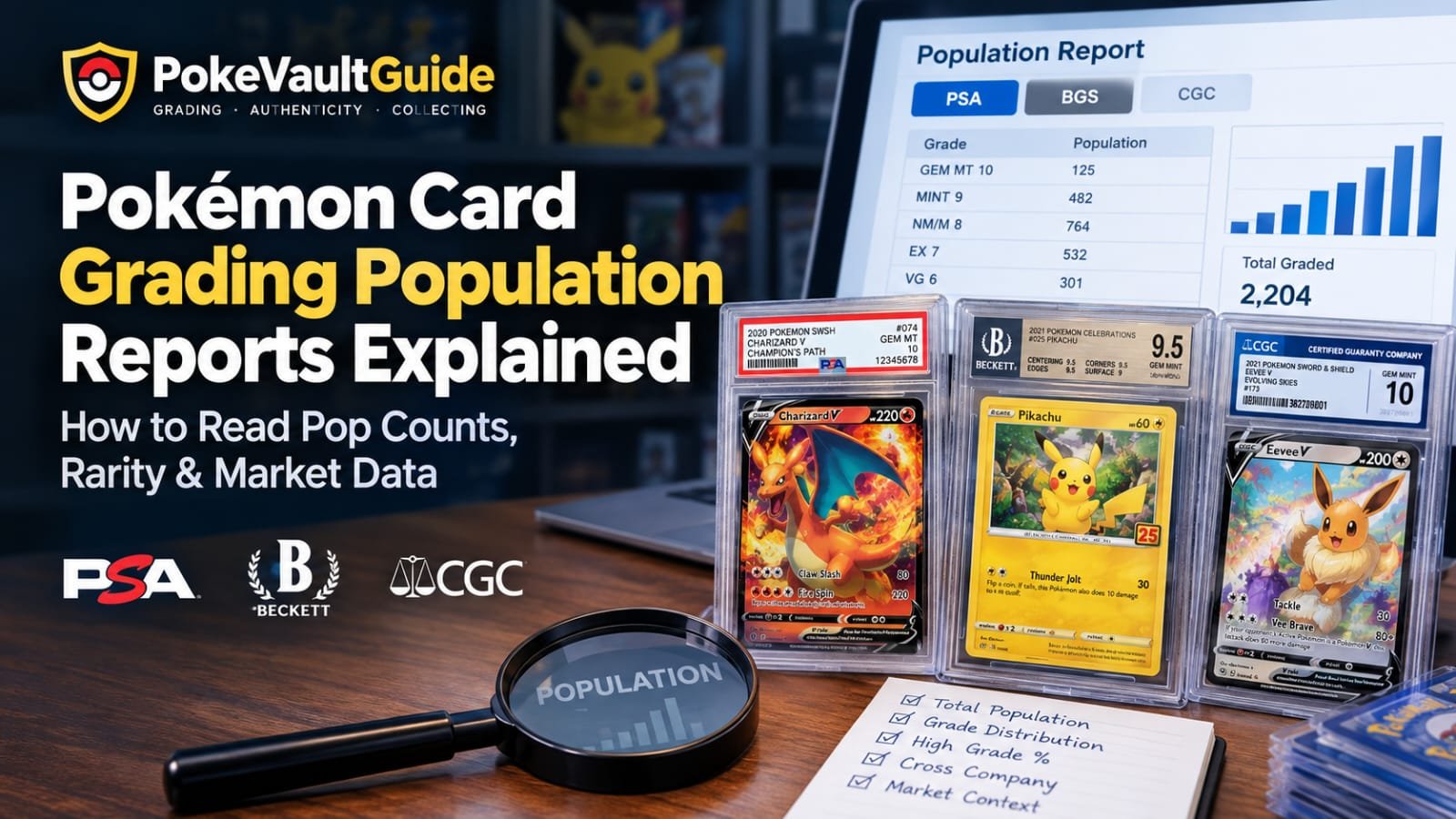
Pokémon Card Grading Population Reports Explained: How to Read Pop Counts, Rarity & Market Data
If you collect Pokémon cards seriously, you will eventually come across a number that looks incredibly simple but can be surprisingly difficult to interpret: the population count.
You may see a card with a population of 1, another with a population of 25, and another with a population of 5,000. At first glance, it is tempting to conclude that the card with a population of 1 must be extremely rare and that the card with a population of 5,000 must be common.
That conclusion can be wrong.
A grading population report tells you something important, but it does not tell you everything. It records cards that have been submitted to a particular grading company and how those cards were classified. It does not count every copy of the card that exists, every raw copy sitting in someone’s collection, or every copy that may still be hidden in sealed product.
The key idea: A population report is best understood as a record of graded supply, not a complete census of the surviving Pokémon cards in existence.
That distinction becomes especially important when you are researching vintage Pokémon cards, modern chase cards, promotional releases, high-grade copies, or cards that appear to have unusually low populations.
In this guide, we will break down how population reports work, how to read the numbers, why different grading companies can show very different populations, and how to use population data without turning a single number into a misleading conclusion.
What Is a Pokémon Card Grading Population Report?
A grading population report, often shortened to a pop report, is a database showing how many cards a grading company has graded for particular issues and how those cards are distributed across grades.
For example, a report might show a simplified distribution like this:
| Grade | Population |
|---|---|
| PSA 10 | 12 |
| PSA 9 | 87 |
| PSA 8 | 143 |
| PSA 7 | 96 |
| PSA 6 and lower | 62 |
| Total graded | 400 |
This hypothetical example tells us that the grading company has recorded 400 examples of the particular card and that 12 of those received a PSA 10.
It does not tell us that only 400 copies of the card exist.
There could be thousands of ungraded copies in collections, binders, storage boxes, sealed products, dealer inventories, or private collections. There could also be copies that were submitted to other grading companies.
PSA describes its Population Report as a record of items it has graded and provides grade-by-grade population figures. Its current population system separates standard whole-number grades, half-point grades, and qualifying designations into different lines. 1
Population vs. Census: Are They the Same Thing?
You will often see collectors use the words population and census almost interchangeably.
In the grading world, this is understandable because companies commonly use both terms when discussing their databases. However, collectors should be careful about what the number actually represents.
A grading-company population is essentially the number of examples recorded by that particular company.
Think about it this way:
| Term | What it tells you | What it does not tell you |
|---|---|---|
| Graded population | Cards recorded by a specific grading company | Total surviving copies |
| Grade population | Cards receiving a particular grade | All copies capable of receiving that grade |
| Total graded | All recorded grades for that card within the report | Total cards in existence |
| Cross-company population | Potentially broader graded supply when multiple companies are considered | Unique physical copies across all companies |
CGC makes this limitation particularly clear in its population report disclaimer. The company states that census and population reports reflect the quantities and types of collectibles previously graded by its companies and are not an indicator of value or rarity. 2
Important: Never replace the sentence “PSA has graded 50 copies” with “only 50 copies exist.” Those are completely different statements.
Why Do Population Reports Matter to Pokémon Collectors?
Population data can still be extremely useful.
The important thing is understanding exactly what question the data can answer.
For example, a population report can help you determine:
- How many copies a grading company has recorded.
- How many examples received a particular grade.
- Whether high-grade examples are relatively uncommon within that company’s database.
- How the grade distribution compares with another card.
- Whether a card’s population has changed over time.
- Whether a particular variant has very limited graded representation.
- Whether a card has received substantially more grading attention than another card.
That information can be valuable when researching a card before buying, grading, selling, or writing about it.
However, population data becomes much more useful when combined with other evidence such as print era, distribution method, known variants, condition sensitivity, historical grading volume, and actual sales data.
PSA Population Reports
PSA provides a searchable Population Report covering cards and other collectibles that PSA has graded.
The current PSA system allows collectors to search for a specific card and retrieve population information. PSA explains that its population figures are divided into separate lines for whole-number grades, half-point grades, and qualifiers. 3
For Pokémon collectors, this can be particularly useful when researching older sets and specific card numbers.
A typical PSA population result can contain columns such as:
- Card number
- Card name
- Authentic
- Individual grades
- Total population
The exact information displayed can vary depending on the card and how PSA identifies the issue.
PSA also warns that population information can sometimes be affected by changes in how varieties are identified. If PSA began recognizing a particular variety after many copies had already been graded, older examples may not have been recorded under the newer variety classification until cards were reholdered. 4
This is an excellent example of why population data should be treated as a research tool rather than an absolute measurement of physical rarity.
CGC Cards Population Reports
CGC Cards also maintains a population report for trading cards, including Pokémon.
The CGC system can provide set-level and card-level information, including total graded quantities and grade distributions. Current Pokémon population pages can be searched by set, card and other identifying information. 5
One useful feature of the CGC system is that collectors can encounter detailed set-level information. For example, a population page may show the total number of cards CGC has graded from a particular Pokémon set and then list individual cards with their recorded populations.
CGC also explicitly notes that its population data reflects cards previously graded by the CCG companies and should not be interpreted as a direct measure of rarity or value. 6
Beckett BGS Population Reports
Beckett Grading Services also maintains population-report data.
Beckett’s population pages can display information such as:
- Copies graded
- Percentage or number of the set population
- Copies graded higher
- Copies graded lower
- First graded
- Last graded
Depending on the page and access level, some Beckett Online Price Guide functionality may require additional access. Nevertheless, the population-report structure provides another way of studying how graded examples are distributed across grades. 7
Beckett’s reports can be particularly interesting for collectors studying the distribution of high-end grades because BGS uses a grading structure that includes half grades and subgrades on applicable cards.
Why PSA, BGS and CGC Populations Are Not Directly Interchangeable
Suppose you find the following numbers:
| Company | Total Graded | Top Grade |
|---|---|---|
| PSA | 1,000 | 120 |
| BGS | 300 | 25 |
| CGC | 500 | 40 |
It would be tempting to add the numbers and say there are 1,800 graded copies.
That may not represent 1,800 unique physical cards.
The same physical card can move between grading companies through crossover or regrading processes. For example, PSA describes crossover as evaluating a card already housed by another grading service and moving it into a PSA holder if the specified requirements are met. 8
CGC similarly offers a CrossOver service for cards already encapsulated by PSA, Beckett, or SGC, with conditions governing when the card is removed from its original holder and certified by CGC. 9
Therefore, adding populations from different companies should never automatically be treated as a count of unique surviving cards.
Better approach: Treat each grading company’s population as its own dataset. Compare the datasets for context, but avoid assuming that every record represents a completely different physical card.
What Does “Pop 1” Actually Mean?
“Pop 1” is one of the most misunderstood phrases in the hobby.
If someone says a card is “PSA 10 Pop 1,” the basic meaning is that the PSA population report currently records one example at that grade for that particular issue.
It does not automatically mean:
- Only one copy of the card exists.
- Only one copy can ever receive that grade.
- The card is the rarest version of the card.
- The card is the most valuable card in its set.
- No other grading company has graded a similar example.
It simply tells you that the relevant population entry is currently one.
That can be interesting, especially for a genuinely old or condition-sensitive card, but the number needs context.
Pop 1, Pop 5 and Pop 100: Why the Number Alone Is Not Enough
Consider three hypothetical cards.
| Card | Total PSA Population | PSA 10 Population |
|---|---|---|
| Card A | 8 | 1 |
| Card B | 5,000 | 1 |
| Card C | 200 | 100 |
Which card has the most interesting population profile?
There is no responsible answer based solely on those three numbers.
Card A may be from a very obscure release that almost nobody submits for grading.
Card B may be an extremely popular modern card where thousands of copies have been submitted, but only one has reached the highest grade so far.
Card C may have a relatively large high-grade population because the card is easier to preserve or was manufactured with better quality control.
The same population number can therefore represent very different situations.
Total Population vs. Population at a Specific Grade
This is one of the most important distinctions to understand.
When researching a card, you should separate at least two questions:
- How many examples has this company graded in total?
- How many examples has this company graded at the grade I care about?
Imagine a card with a total population of 10,000.
That sounds like a large graded population.
But suppose only 35 copies have received the highest grade.
Now the population story is completely different.
Conversely, a card with only 50 total graded copies may have 30 examples at its highest grade. In that case, the total population is small, but the high-grade population is not necessarily difficult to understand from a grading perspective.
This is why serious research should examine the entire grade distribution instead of looking only at the total.
How to Calculate the High-Grade Share
You can make population data more useful by calculating simple ratios.
For example:
High-grade share = high-grade population ÷ total population × 100
Imagine a hypothetical card with:
- Total graded: 2,000
- Highest grade: 100
The high-grade share would be:
100 ÷ 2,000 × 100 = 5%
This does not prove that 5% of all surviving copies can achieve that grade. It only describes the distribution within the grading company’s recorded population.
That distinction is essential.
Use the ratio as a grading-data statistic, not as a prediction. A 5% high-grade share in a population report does not mean that exactly 5% of every raw copy in existence will receive the same grade.
Why a Low Population Does Not Automatically Mean a Rare Pokémon Card
Low population is one of the easiest statistics to misuse.
Imagine discovering a Pokémon card with only three graded copies.
Before calling it rare, ask:
- Is the card from a major set?
- Is it a recent release?
- Is it an obscure promotional card?
- Is the card difficult to identify correctly?
- Has the grading company received many submissions from this release?
- Are collectors actually submitting this type of card?
- Are there large numbers of raw examples available?
- Do other grading companies show substantially larger populations?
A population of three could mean genuine scarcity.
It could also simply mean that very few collectors have bothered to submit the card.
This is particularly relevant to modern Pokémon cards.
A card released recently may have a low population today simply because grading takes time. As more collectors submit copies, the population can increase dramatically.
Population Growth Can Change the Story
Population reports are not static.
New submissions can increase the number of graded examples, and changes in classification or holdering can also affect how certain information appears in a database.
PSA itself notes that population information can change as new cards are submitted and previously graded cards are reholdered, particularly when varieties are being recognized differently over time. 10
That means a population of 10 should always be mentally understood as:
“10 currently recorded in this dataset.”
It should not automatically be interpreted as:
“There will always be only 10.”
Example: A Modern Pokémon Card
Imagine a modern Pokémon card released in 2026.
Six months after release, a grading company shows:
| Grade | Population |
|---|---|
| 10 | 4 |
| 9 | 31 |
| 8 | 12 |
| 7 or lower | 3 |
| Total | 50 |
Someone might advertise the card as “Pop 4 in the world.”
That wording would be misleading.
The correct interpretation would be closer to:
The grading company’s current population report records four examples at that grade.
There could be hundreds or thousands of ungraded copies waiting to be submitted.
Six months later, the population could look like this:
| Grade | Population |
|---|---|
| 10 | 75 |
| 9 | 410 |
| 8 | 140 |
| 7 or lower | 25 |
| Total | 650 |
The original population of four was real at the time it was recorded. It simply wasn’t a permanent measure of supply.
Why Submission Rates Matter
Population reports are influenced by collector behavior.
Not every card has the same probability of being submitted to a grading company.
A highly popular Pokémon chase card may receive thousands of submissions because collectors specifically want graded examples.
A common card from the same set may receive very few submissions even if millions of copies were printed.
That means population data reflects both:
- The underlying supply of cards
- The behavior of people choosing what to grade
This is one of the most important concepts in population research.
Population is partly a grading-behavior statistic. A card cannot appear in a grading company’s population report until someone actually submits it.
Why Popular Cards Can Have Huge Populations
A large population does not necessarily tell you that a card is uninteresting.
Some Pokémon cards are so popular that collectors submit them at an unusually high rate.
That can produce a large graded population even when the card itself is highly collectible.
For example, a famous Pokémon character, iconic artwork, major chase card, or historically important release may receive enormous grading attention.
The population is therefore influenced by demand for grading as well as by the number of physical cards originally produced.
Why Older Cards Can Have Surprisingly Small Populations
The opposite can also happen.
An older Pokémon card may have a surprisingly low population because:
- Professional grading was less common when the cards were originally collected.
- Many copies remain raw.
- Some copies may have been damaged or discarded.
- Collectors may not consider every card worth grading.
- Some variants are difficult to identify.
- The card may be from a niche release.
Therefore, a low population for an older card can be meaningful, but it still needs context.
Population Reports and Card Variants
One of the biggest sources of population mistakes is comparing cards that are not actually the same issue.
Pokémon has an enormous number of variations, including:
- Different sets
- Different languages
- Promotional releases
- Holo and reverse-holo versions
- 1st Edition and unlimited versions where applicable
- Special prints
- Different card numbers
- Parallel variants
- Different promotional stamps or distribution versions
Two cards can have nearly identical artwork and still represent different collectible issues.
Always confirm the exact card identity before comparing population numbers.
Why Card Number Matters
When possible, use the card number along with the set name and card name.
This reduces the chance of comparing similar-looking cards or different versions.
PSA itself recommends using detailed search information, including card numbers where applicable, because more specific searches can produce more refined results. 11
For Pokémon research, a good identification format is:
Set + card number + card name + language/variant
For example:
Set Name + 123/XYZ + Pokémon Name + English
This is much safer than searching only for the Pokémon’s name.
Population Reports Do Not Tell You How Many Raw Copies Exist
This deserves its own section because it is one of the most common mistakes.
Suppose PSA has graded 250 copies of a card.
There are several possibilities:
- There could be 300 surviving copies total.
- There could be 3,000 surviving copies.
- There could be 30,000 surviving copies.
- There could be far more.
The population report alone cannot distinguish between these scenarios.
That is why collectors should never use a population report as a substitute for historical research about production, distribution, surviving examples, or the release itself.
Population Reports vs. Print Runs
These are completely different types of information.
| Data Type | What it measures |
|---|---|
| Print run | Production information, when known |
| Population report | Cards graded by a particular grading company |
| Sales volume | Recorded transactions |
| Market price | Observed prices from specific transactions or marketplaces |
| Raw supply | Ungraded cards available or known to collectors |
These datasets answer different questions.
A strong Pokémon card research process uses them together instead of treating one statistic as the entire story.
How to Use Population Reports When Researching a Pokémon Card
Now let’s turn the theory into a practical workflow.
If you are considering buying, grading, selling, or researching a Pokémon card, use the following process.
Step 1: Identify the Exact Card
Start with the basics.
- Set name
- Card number
- Card name
- Language
- Variant
- Edition or promotional designation where applicable
Do not begin with population numbers before confirming the exact issue.
Step 2: Check the Population Report
Search the relevant grading company’s population database.
For PSA, use the official PSA Population Report. For CGC, use the CGC Cards Population Report. Beckett also provides BGS population-report pages and related grading data.
Record:
- Total population
- Population at the grade you care about
- Population at neighboring grades
- Any relevant designation or variant information
Step 3: Look at the Entire Grade Distribution
Do not stop at the highest grade.
A complete distribution can tell you much more.
For example:
| Grade | Population |
|---|---|
| 10 | 20 |
| 9 | 150 |
| 8 | 220 |
| 7 | 100 |
| 6 or lower | 60 |
| Total | 550 |
This tells a much richer story than simply saying “Pop 20.”
Step 4: Compare the Data With Other Grading Companies
If the card is important enough, check multiple grading companies.
Do not simply add the populations together.
Instead, ask:
- Does the same card appear frequently across companies?
- Is one company’s population much larger?
- Are high-grade examples common across multiple databases?
- Does one database contain only a handful of examples?
Differences between companies can be useful context, but they are not automatically evidence that one company has found more “real” copies than another.
Step 5: Check Whether the Population Is Old or Still Growing
Population numbers become more useful when you track them over time.
If you recorded a population six months ago, compare it with the current report.
For example:
| Date | Total Population | Highest Grade |
|---|---|---|
| January | 100 | 3 |
| April | 240 | 11 |
| July | 500 | 27 |
| October | 900 | 51 |
This hypothetical example shows why a low early population should not automatically be treated as permanent.
How Population Data Can Help With Pre-Grading Research
Population reports can complement a pre-grading inspection, but they cannot tell you what grade your specific raw card will receive.
Before submitting a card, you should still inspect:
- Centering
- Corners
- Edges
- Surface
- Print defects
- Whitening
- Scratches
- Indentations
- Creases or bends
Population data can tell you how many examples have received a grade. It cannot inspect your copy.
For that reason, population research works best alongside a structured pre-grading inspection rather than replacing it.
Population Reports and Card Prices
Population can be relevant when studying the market, but it should never be treated as a standalone price formula.
A card’s observed price can be influenced by many variables, including:
- Character popularity
- Artwork
- Set popularity
- Age
- Condition
- Grade
- Language
- Edition
- Variant
- Buyer demand
- Availability
- Recent sales activity
- Grading-company preference among buyers
Population data is therefore one research variable among many.
Good research question: “How does the graded population compare with the number of recorded sales and the card’s grade distribution?”
Weak research question: “The population is low, so how much should the card be worth?”
Common Population Report Mistakes
Mistake 1: Treating Pop 1 as One Copy in Existence
This is the classic mistake.
Pop 1 means one recorded example in the relevant population data at that point in time. It does not prove that only one physical copy exists.
Mistake 2: Adding PSA + BGS + CGC Populations
This can double-count or otherwise duplicate physical cards that have moved between grading companies.
Compare the databases separately instead of automatically adding them together.
Mistake 3: Ignoring Submission Bias
Collectors do not submit every card equally.
Popular cards, expensive cards, visually attractive cards, and cards considered likely to receive high grades can attract disproportionately more submissions.
Mistake 4: Ignoring the Age of the Data
A population number is a snapshot of a changing database.
A number you saw months ago may no longer be current.
Mistake 5: Comparing Different Variants
Always make sure the cards are actually the same issue.
Mistake 6: Looking Only at the Highest Grade
The full distribution often provides more useful information than a single top-grade number.
Mistake 7: Assuming Low Population Equals High Value
Low population can be interesting, but demand still matters.
A card can have a very small graded population and limited collector demand. Conversely, a card can have a very large population and remain highly sought after.
Mistake 8: Assuming the Population Will Stay Low
Modern cards especially can experience rapid growth in grading populations as more collectors submit copies.
What a Population Report Can Tell You
| Question | Can the population report help? |
|---|---|
| How many cards has this company graded? | Yes |
| How many received a particular grade? | Yes |
| How does the grade distribution look? | Yes |
| How many copies exist worldwide? | No |
| Exactly how many raw copies exist? | No |
| What will my raw card grade? | No |
| What is the guaranteed future price? | No |
| Is a card automatically rare? | No |
| Can it provide useful grading-supply context? | Yes |
A Better Way to Think About “Rarity”
When collectors talk about rarity, they can actually be talking about several different things.
| Type of scarcity | Meaning |
|---|---|
| Production scarcity | Limited number produced or distributed |
| Survival scarcity | Few known or surviving copies remain |
| Raw scarcity | Few ungraded copies are readily available |
| Grading scarcity | Few copies have been graded |
| High-grade scarcity | Few graded examples achieved a particular grade |
| Market scarcity | Few examples are actually offered for sale at a given time |
These are not interchangeable.
A population report is most directly useful for understanding grading scarcity.
It can contribute to a broader discussion about rarity, but it cannot establish every form of scarcity on its own.
How Advanced Collectors Can Build a Population Research Log
If you regularly research Pokémon cards, consider keeping a simple spreadsheet.
Useful columns include:
- Date checked
- Card name
- Set
- Card number
- Language
- PSA total
- PSA top grade
- CGC total
- CGC top-grade data
- BGS data where available
- Recent population change
- Notes about variants
This turns population research into a repeatable process rather than something you check only when a seller mentions “Pop 1.”
Population Reports Are Most Useful When Combined With Other Evidence
The strongest Pokémon card research rarely depends on one statistic.
A better framework combines:
- Card identification — confirm exactly which card you are researching.
- Population data — understand the graded population and grade distribution.
- Condition research — understand how difficult the card is to grade well.
- Historical context — understand the set, release, and distribution.
- Market research — examine actual sales rather than relying only on asking prices.
- Cross-company comparison — use other grading databases for additional context.
This approach prevents one low population number from becoming the entire argument.
Frequently Asked Questions
What does “Pop” mean in Pokémon card collecting?
“Pop” is short for population. In grading terminology, it generally refers to the number of examples recorded in a grading company’s population report.
Does Pop 1 mean only one Pokémon card exists?
No. It means the relevant grading database currently records one example in the specified population category or grade. Many additional raw or differently graded copies could exist.
Can a card’s population increase?
Yes. New cards can be submitted and added to the grading database. Population information can also be affected by how varieties and previously graded cards are classified or reholdered. PSA specifically notes that population data can change as additional cards are submitted and older cards are reholdered. 12
Should I add PSA, BGS and CGC populations together?
No. Doing so can potentially count the same physical card more than once, particularly when cards are crossed between grading companies.
Is a low population automatically a sign that a card is rare?
No. Low grading volume can result from limited submission activity, especially for obscure, inexpensive, or recently released cards. Population data should be interpreted alongside other evidence.
Is a high population bad for a Pokémon card?
Not necessarily. A high population may simply reflect strong collector interest and heavy grading activity. Population by itself does not determine desirability or value.
Can population reports tell me whether my card will get a PSA 10?
No. Population reports describe previously graded cards. They do not evaluate your individual card. Your card still needs to be assessed for centering, corners, edges, surface and other grading factors.
Are population reports permanent?
No. They are dynamic datasets. New submissions can change the numbers, and database classifications can evolve.
Why can two grading companies show very different populations for the same Pokémon card?
Each company has its own submission history, customer base, grading process, database structure and classification system. A population report represents that company’s recorded submissions, not a universal census.
Final Takeaway: Read Population Numbers as Data, Not Headlines
Population reports are among the most useful research tools available to serious Pokémon card collectors, but they are also among the easiest to misunderstand.
The most important distinction is simple:
A grading population measures what a grading company has recorded, not everything that exists.
A Pop 1 card may be genuinely difficult to find, or it may simply have received very few submissions. A card with thousands of graded examples may still be highly collectible. A low high-grade population can be meaningful, but it should be examined alongside the total population, the age of the card, submission behavior, condition sensitivity, variants, and other evidence.
Instead of asking only, “What is the population?” ask better questions:
- What exactly is being counted?
- Which grading company produced the number?
- What is the total population?
- How many copies are at the grade I care about?
- Is the population still growing?
- Could submission behavior be affecting the number?
- Am I comparing the exact same card and variant?
- Could the same physical card appear in another company’s data?
- What does the population tell me that other evidence does not?
That is the difference between simply quoting a population number and actually understanding it.
Bottom line: Population reports are excellent for measuring recorded graded supply and understanding grade distributions. They are not a worldwide census, a guaranteed rarity indicator, a price formula, or a prediction of what any individual raw Pokémon card will receive when submitted for grading.
Related Pokémon TCG Guides
- PSA vs BGS vs CGC: Pokémon Card Grading Guide
- Pokémon Card Pre-Grading Guide: Inspect Before PSA
- How to Measure Pokémon Card Centering: PSA 10 Guide
- PSA Qualifiers Explained: OC, MC, MK, ST, PD & OF
- Pokémon Card Condition Guide: NM vs LP vs MP vs HP vs Damaged
- How to Spot a Fake Graded Pokémon Card Slab
Sources & Further Reading
- PSA Population Report
- PSA: Population Reports – What You Need to Know
- PSA Collecting Lingo
- CGC Cards Population Report
- CGC Cards Grading Services & CrossOver Information
- Beckett Grading Population Report
Population figures change as additional cards are submitted and databases are updated. Always check the relevant grading company’s current population report when researching a specific card.