Lugia Neo Genesis Price Guide: What Is It Worth?
Among vintage Pokémon TCG cards, few have the combination of character popularity, artwork, historical importance, and collector demand found in Lugia from Neo Genesis.
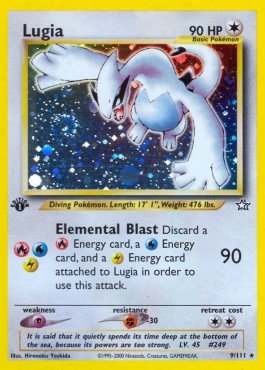
The card was released as Lugia #9/111 in the English Neo Genesis expansion in 2000. It is a Rare Holo featuring artwork by Hironobu Yoshida and depicts Lugia as a Basic Colorless Pokémon with 90 HP. The card’s signature attack, Elemental Blast, requires three different Energy types. 2
But asking “How much is Lugia Neo Genesis worth?” without identifying the exact copy is not enough.
A 1st Edition Lugia, an Unlimited Lugia, a heavily played raw copy, and a professionally graded high-grade example can occupy completely different parts of the market.
This guide breaks down those differences so you can evaluate your own card without relying on a single headline price.
Lugia Neo Genesis #9/111: Card Overview
| Card Detail | Information |
|---|---|
| Pokémon | Lugia |
| Set | Neo Genesis |
| Card Number | #9/111 |
| Rarity | Rare Holo |
| Release | 2000 |
| Illustrator | Hironobu Yoshida |
| HP | 90 |
| Type | Colorless |
| Stage | Basic |
| Main Attack | Elemental Blast — 90 damage |
Neo Genesis was historically important because it introduced Pokémon from the Johto region into the Pokémon TCG. Pokémon’s own historical coverage notes that Johto Pokémon were introduced to the TCG through Neo Genesis, which was released in 2000. 3
That historical context matters when evaluating Lugia today. The card is not valuable simply because it is old. Its value comes from the combination of age, character popularity, rarity, visual appeal, set history, surviving supply, and collector demand.
Why Lugia Neo Genesis Is So Collectible
There are several reasons this particular Lugia continues to attract attention from vintage Pokémon collectors.
1. Lugia Is One of the Most Recognizable Johto Pokémon
Lugia debuted as a major legendary Pokémon during the Gold, Silver, and Crystal era. That gives the Neo Genesis card strong nostalgia appeal among collectors who entered the hobby around the second generation.
The artwork also gives the card a distinctive identity. Unlike many modern cards that rely on elaborate full-art layouts, the Neo Genesis Lugia uses the classic WOTC-era presentation, making the card immediately recognizable to vintage collectors.
2. Neo Genesis Is a Major WOTC-Era Set
Neo Genesis belongs to the Wizards of the Coast era of the English Pokémon TCG. It followed the original Base Set-era expansions and expanded the card pool into the Johto generation.
The set also introduced important changes to the TCG’s visual and mechanical identity, while adding new Pokémon types and cards that became historically significant to the game. Pokémon’s historical coverage specifically highlights Neo Genesis as an important Johto-era expansion. 4
3. Lugia Is the Set’s Headline Chase Card
Collectors looking at Neo Genesis do not usually treat every card in the set equally. Lugia occupies a special position because it is the set’s iconic legendary Pokémon and its #9/111 Rare Holo has become one of the defining cards of the era.
This creates a collector dynamic that is different from ordinary vintage rares: people can want the card because they collect Lugia, because they collect Neo Genesis, because they collect WOTC holos, or because they want a high-grade example of a famous vintage card.
Current Lugia Neo Genesis Market Snapshot
Current market databases show why a single “Lugia price” can be misleading.
For the Unlimited #9/111 version, PriceCharting currently reports an estimated ungraded market value around $421, with its grade-specific estimates ranging from roughly $787 for Grade 7 to about $19,651 for PSA 10. These are algorithmic estimates based on historical sales, not guaranteed transaction prices. 5
Recent completed sales also show substantial variation. For example, September 2026 sales recorded by PriceCharting included Unlimited raw examples around $265–$520, while graded examples varied according to grade and condition. 6
European market data can look different because Cardmarket pricing, language, marketplace fees, shipping, and local supply all influence the observed price. One current European tracker places the Near Mint market value around €448, while showing recent Near Mint sales around a €584 median in its available dataset. 7
1st Edition vs Unlimited Lugia: The Difference Matters
One of the most important steps before valuing a Neo Genesis Lugia is identifying whether you have the 1st Edition or Unlimited printing.
The two should not be treated as interchangeable versions.
| Feature | 1st Edition | Unlimited |
|---|---|---|
| Edition Stamp | Has the 1st Edition stamp | No 1st Edition stamp |
| Collector Number | 9/111 | 9/111 |
| Set | Neo Genesis | Neo Genesis |
| Market | Separate collector market | Separate collector market |
| Typical Premium | Can be substantially higher | Lower than comparable 1st Edition copies |
The presence of the 1st Edition stamp is therefore one of the first things you should verify before searching for a price.
Current market data illustrates the difference. PriceCharting’s current 1st Edition page lists substantially higher estimates than its Unlimited page, while recent completed 1st Edition sales have included transactions in the thousands of dollars depending on condition. 8
That does not mean every 1st Edition Lugia is automatically worth thousands. Condition remains critical, and a damaged 1st Edition copy is a very different collectible from a high-grade example.
How Condition Changes Lugia’s Value
For vintage Pokémon cards, condition is one of the biggest variables in the final selling price.
A card can have the correct edition, correct set, and correct collector number and still be worth dramatically less than another copy because of whitening, scratches, dents, edge wear, poor centering, or other defects.
| Condition Area | What to Inspect | Potential Market Impact |
|---|---|---|
| Centering | Border symmetry on front and back | Important for high-grade submissions |
| Surface | Scratches, print lines, dents, holo damage | Can heavily reduce grade potential |
| Edges | Whitening, chipping, silvering | Especially important on vintage cards |
| Corners | Wear, bends, whitening | Visible flaws can affect raw and graded value |
| Creases | Any visible or hidden folding | Can cause a major reduction in value |
This is why you should never compare your raw Lugia to a PSA 10 sale simply because both cards are “Lugia Neo Genesis #9.”
The grade is not a cosmetic label added after the fact. It separates different condition markets that buyers treat very differently.
Raw Lugia vs Graded Lugia
A raw card is sold without a professional grading company’s encapsulation and numerical grade. Its price depends heavily on the buyer’s assessment of condition.
A graded Lugia has been authenticated and encapsulated by a grading company and assigned a grade. That creates a standardized reference point for buyers, although the market premium can vary by company, grade, population, and demand.
This is especially important with vintage cards because condition differences are often difficult to communicate through a listing title alone.
Lugia Neo Genesis Price by Grade
The graded market becomes especially interesting once you move above mid-grade condition. PriceCharting’s current market model for the Unlimited Lugia #9 shows a steep increase between mid-grade examples and the highest grades. Its current estimates include approximately $787 for Grade 7, $1,143 for Grade 8, $1,768 for Grade 9, and $19,651 for PSA 10. 9
The enormous difference at the top of the scale demonstrates an important point: grading premiums are not linear.
A card that moves from a 7 to an 8 does not necessarily gain the same percentage as a card that moves from a 9 to a 10.
For a vintage card with strong collector demand, the highest grades can become a separate market because far fewer examples qualify for them.
| Grade Level | What Buyers Generally Look For | Why It Matters |
|---|---|---|
| Raw / Ungraded | Condition judged from photos or in person | Largest condition uncertainty |
| PSA 6–7 | Clearly collectible vintage condition | Often more accessible than high grades |
| PSA 8 | Strong vintage presentation with visible but limited flaws | Important middle/high-grade collector tier |
| PSA 9 | Very high condition with minor imperfections possible | Scarcer and significantly more desirable |
| PSA 10 | Gem Mint-level condition | Can represent an entirely different price tier |
These are not promises about what any particular copy will sell for. The actual market price depends on the exact printing, grading company, certification, population, demand, and recent comparable sales.
Why a PSA 10 Lugia Can Be So Different From a PSA 8
The jump from a high-grade vintage card to a Gem Mint example is not simply about the card looking “a little cleaner.”
At the top of the grading scale, small manufacturing or preservation differences become increasingly important.
A candidate may appear excellent in a binder and still have:
- slightly uneven centering;
- tiny edge whitening;
- surface scratches visible under angled light;
- print lines across the holo;
- corner imperfections;
- small dents or pressure marks.
This is one reason our Pokémon Card Pre-Grading Guide can be useful before submitting a valuable vintage card.
Likewise, centering should be inspected separately rather than assumed from the card looking symmetrical at first glance. Our Pokémon Card Centering Guide covers the measurement process in detail.
What Makes a Raw Lugia More Valuable?
Not every raw Lugia should be valued using the same condition label.
A useful approach is to separate the card into several independent condition categories.
Centering
Look at the borders around the artwork and card frame. Small differences can be difficult to notice without a ruler or digital measurement tool.
Centering becomes particularly important if you are considering grading rather than selling the card raw.
Holo Surface
Neo-era holo cards can show scratches and other surface defects that are difficult to see under normal room lighting.
Use a strong directional light and slowly tilt the card. Surface marks often become much easier to identify when the holo catches the light at an angle.
Edges
Inspect the front and back edges carefully for whitening and chipping.
Vintage cards that have spent years in binders, boxes, sleeves, or top loaders can develop edge wear even when the central artwork still looks excellent.
Corners
Check all four corners from multiple angles.
A corner can appear clean from the front but show whitening or a small bend from the reverse.
Creases and Dents
These are particularly important because a crease can dramatically change the condition category of a card.
Do not press on the card or bend it to search for damage. Instead, use angled light and inspect the surface carefully.
1st Edition Lugia: Why the Stamp Changes the Equation
The 1st Edition version deserves its own market analysis because it is not simply an Unlimited Lugia with a different label.
Collectors often specifically search for the 1st Edition printing, and recent sales demonstrate a much higher price ceiling for strong examples. PriceCharting’s current 1st Edition page records recent sales including raw copies in the roughly $1,500–$2,900 range and a September 2026 sale listed at $6,600; these are individual completed transactions and should not be interpreted as a standard price for every copy. 10
Another current sales database reports a September 2026 median around $1,543 for ungraded 1st Edition copies based on a limited set of completed sales. That source also warns that short-term medians can be influenced by small sample sizes. 11
How to Identify the Correct Lugia Before Checking Its Price
This step is frequently skipped, and it can lead to completely incorrect price comparisons.
Check the Collector Number
The Neo Genesis Lugia discussed in this guide should read:
If your Lugia has another number, you are looking at a different printing and should not use this guide as your primary price reference.
Check for the 1st Edition Stamp
A genuine English 1st Edition Neo Genesis Lugia has the 1st Edition marking. An Unlimited copy does not.
This is one of the fastest ways to separate the two major English printings.
Check the Set and Era
Do not assume that every vintage Lugia is the same card.
Lugia has appeared across many Pokémon TCG expansions and promotional releases. Other Lugia cards can have completely different values even if the artwork or Pokémon looks familiar.
For example, databases tracking Lugia show numerous different printings across the Pokémon TCG, which is why the set name and collector number are essential when identifying a card. 12
What Is a Fair Price for Raw Lugia Neo Genesis?
There is no single fair price for every raw copy.
Instead, think in terms of a condition-adjusted range.
Current market trackers show that raw Neo Genesis Lugia prices can vary substantially. One September 2026 source reports a market value around $519 for an Unlimited copy, while another European tracker shows a lower market reference but a much wider distribution of listings and sales. 13
That variation is exactly why a seller should compare completed sales of similar condition rather than copying the cheapest or most expensive active listing.
| What You’re Comparing | Useful? | Why |
|---|---|---|
| Same card + same edition + similar condition + sold | ★★★★★ | Closest comparison to your copy |
| Same card + different condition + sold | ★★★☆☆ | Useful for understanding the market range |
| Same card + active listing | ★★☆☆☆ | Shows asking prices, not completed transactions |
| Different Lugia printing | ★☆☆☆☆ | Not a reliable direct comparison |
| Random online price guide | ★★☆☆☆ | Useful reference but methodology may differ |
Why Asking Prices Can Be Misleading
Imagine five sellers list Lugia for:
- $400
- $600
- $900
- $1,200
- $1,500
That does not mean the market value is $920.
The market value is better understood by looking at what comparable copies actually sold for, especially when the condition and edition are known.
A seller can list a card at any price. A completed transaction provides stronger evidence that a buyer was actually willing to pay that amount.
Does a Swirl Increase Lugia’s Value?
Some Neo Genesis Lugia copies display a visually attractive holo “swirl” pattern. Collectors can place additional value on visually appealing holo patterns, but this is not the same as a standardized grading attribute.
Recent sales databases contain individual Lugia transactions where sellers specifically highlighted swirls, and some of those sales were above other examples of similar grade. However, that does not establish a universal fixed premium for every swirl. 14
If you are evaluating a swirl Lugia, compare it against other swirl examples rather than automatically adding a fixed percentage to the card’s market value.
Raw vs Graded: Which Market Should You Compare?
This depends on what you are trying to do with the card.
| Situation | Most Relevant Comparison |
|---|---|
| You want to sell a raw Lugia | Recent raw sold copies in similar condition |
| You are considering grading | Raw value + realistic grade probability + grading costs |
| You already own PSA 8 | Recent PSA 8 sales |
| You own PSA 9 | Recent PSA 9 sales |
| You own PSA 10 | Recent PSA 10 sales and population data |
The biggest mistake is mixing these markets together and assuming the highest observed price represents the value of every copy.
Should You Grade a Lugia Neo Genesis?
Grading can make sense for some copies, but the decision should start with the card itself rather than the headline price of a PSA 10.
The first question is not:
It is:
A valuable vintage card can still receive a grade well below the level needed to justify a submission based purely on the PSA 10 market.
Before Grading, Check These Five Areas
- Centering: Measure rather than relying only on your eyes.
- Surface: Inspect the holo under angled light.
- Edges: Look for whitening and chipping.
- Corners: Inspect both front and back.
- Creases/dents: Check carefully without bending the card.
You should also factor in grading fees, shipping, insurance, turnaround time, and the possibility that the final grade will not match your initial estimate.
Lugia PSA 10 Value: Why the Number Can Be Misleading
A PSA 10 price can attract attention because the difference between a high-grade Lugia and a lower-grade copy can be enormous.
But the PSA 10 figure is not the correct valuation for a raw card simply because the raw card looks clean.
The current Unlimited market data illustrates this clearly: PriceCharting’s estimated PSA 10 value is far above its raw estimate, while the database also reports relatively infrequent PSA 10 sales. 15
That means a seller should not take the PSA 10 number and subtract a small amount to estimate a raw copy.
The grade itself is part of what creates the market value.
Lugia Neo Genesis Market Liquidity
Another factor worth watching is liquidity.
A card can have a high theoretical value but still require more patience to sell than a card with frequent transactions.
Current market data shows that Neo Genesis Lugia does have recurring sales activity across raw and graded markets. PriceCharting currently reports approximately one raw sale per week in its tracked data and less frequent activity at the highest grades. 16
This matters because a high price does not automatically mean a card will sell instantly at that price.
For a deeper explanation of how transaction frequency, buyer pools, market depth, and selling speed affect Pokémon cards, see our Pokémon TCG Market Liquidity Guide.
What Actually Drives Lugia Neo Genesis Demand?
The card’s market is supported by several different types of collectors rather than a single buyer group.
Vintage Set Collectors
Some collectors are building Neo Genesis collections and need Lugia to complete the holo portion of the set.
Lugia Collectors
Others collect Lugia across different eras and want specific milestone cards, including the original Neo Genesis appearance.
WOTC-Era Collectors
Collectors focused specifically on the English WOTC era may target high-grade examples from Neo Genesis as part of a broader vintage collection.
Graded Card Collectors
A fourth group focuses primarily on slabs and numerical grades. These buyers may care more about obtaining a specific grade than simply owning the card raw.
The existence of multiple buyer groups can help explain why an iconic vintage card continues to have an active secondary market.
Common Mistakes When Valuing Lugia #9/111
Mistake #1: Using the PSA 10 Price for a Raw Card
This is probably the easiest mistake to make.
A raw card is not automatically a PSA 10 candidate, and the grading process itself creates a distinction between the two markets.
Mistake #2: Mixing 1st Edition and Unlimited Prices
Always identify the edition before searching for comparable sales.
Mistake #3: Comparing a Damaged Copy to Near Mint Sales
A $500 Near Mint transaction does not tell you that a heavily played copy is also worth $500.
Mistake #4: Using Active Listings as Market Value
An unsold $1,000 listing is not evidence that the market is paying $1,000.
Mistake #5: Ignoring Language
English, German, French, Japanese, and other-language versions can have different collector markets.
Mistake #6: Ignoring the Exact Collector Number
“Lugia” is not enough information. You need the set and collector number.
How to Check Recent Lugia Neo Genesis Sales
If you’re valuing a copy today, use this process:
- Confirm the card says 9/111.
- Confirm whether it is 1st Edition or Unlimited.
- Determine the approximate raw condition.
- Search for completed/sold listings.
- Filter for the same edition.
- Compare cards with similar condition.
- Ignore extreme outliers unless you understand why they occurred.
- Look at multiple recent sales rather than one transaction.
Check Current Lugia Neo Genesis Listings
Looking for a Lugia Neo Genesis #9/111? Browse current listings and compare available copies, conditions, and prices.
View Lugia Neo Genesis ListingsPrice databases can make this process easier, but their methodologies differ. Some provide algorithmic market estimates, while others aggregate marketplace sales or Cardmarket data. Comparing the underlying sales evidence is more useful than assuming every price tracker is measuring the market in exactly the same way. 17
Is Lugia Neo Genesis a Good Card to Collect?
That question depends on your collecting objective.
If your goal is to own an important Johto-era Pokémon card, Lugia #9/111 has a strong historical and collecting identity. Neo Genesis introduced Johto Pokémon to the English TCG, and Lugia is one of the expansion’s most recognizable cards. 18
If your goal is specifically to build a graded collection, you may care more about centering, surface quality, grade population, and recent sales for the exact grade.
If your goal is simply to own the card, a lower-grade or raw example may provide access to the artwork and history without paying the premium attached to top grades.
Those are different collecting objectives, so there is no single price point that represents the “correct” Lugia for every collector.
Frequently Asked Questions
How much is Lugia Neo Genesis #9/111 worth?
There is no single value. Current market trackers place Unlimited raw examples in the several-hundred-dollar range, while graded and 1st Edition examples can reach substantially higher levels. The exact value depends on edition, condition, grade, and recent comparable sales. 19
Is Lugia Neo Genesis 1st Edition worth more than Unlimited?
The two printings trade in separate markets, and current sales data shows that 1st Edition examples can command substantially higher prices than comparable Unlimited copies. The premium varies with condition and grade. 20
What number is Neo Genesis Lugia?
The English Neo Genesis Lugia discussed in this guide is #9/111. 21
Is Lugia Neo Genesis a Rare Holo?
Yes. Lugia #9/111 is classified as a Rare Holo in Neo Genesis. 22
Does condition affect Lugia’s value?
Yes. Centering, surface condition, edge whitening, corner wear, dents, creases, and other defects can create major differences between otherwise identical copies.
Should I grade my Lugia Neo Genesis?
Consider grading when the card appears to have strong condition characteristics and the expected market value justifies the costs and risks involved. Inspect the card carefully before submitting it rather than assuming it will receive a top grade.
Does a holo swirl add value?
A desirable swirl can attract collectors and may influence individual sale prices, but there is no universal fixed swirl premium. Compare recent sales of similar copies rather than applying an automatic percentage.
Where should I check Lugia prices?
Use multiple sources and prioritize completed sales of the same printing and similar condition. Current databases such as PriceCharting and European marketplace trackers can provide useful reference data, but their methodologies and geographic coverage differ. 23
Final Takeaway
Lugia Neo Genesis #9/111 is not a one-price card. Its market value is determined by a combination of edition, condition, grading status, recent comparable sales, and buyer demand.
The first step is identifying the exact copy. Confirm 9/111, determine whether it is 1st Edition or Unlimited, inspect condition carefully, and then compare it with recent sales of genuinely comparable cards.
For collectors, the biggest lesson is simple: don’t value the card by its name alone. The printing and condition can change the market dramatically.
For more Pokémon TCG valuation research, explore our Card Value Guides and related Grading & Authenticity resources.