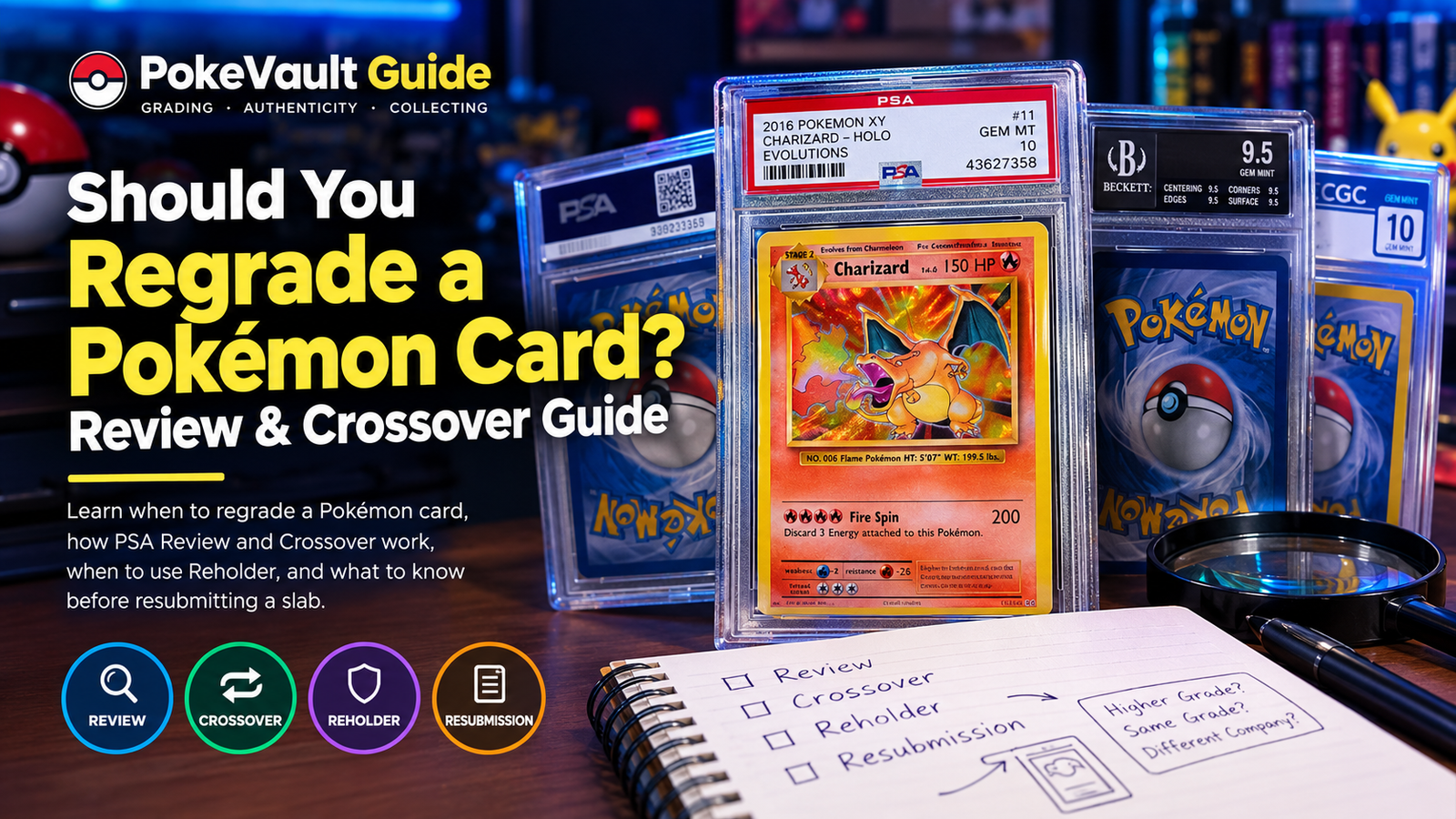
Should You Regrade a Pokémon Card? Review, Crossover & Reholder Explained
Getting a Pokémon card graded can feel like the end of the collecting journey. You submit the card, wait for the result, receive the slab, and finally see the number printed on the label.
But sometimes the story does not end there.
Maybe your Pokémon card received a PSA 9 and you believe the card has characteristics that could support a higher grade. Maybe you bought a BGS 9.5 and want to understand whether it could qualify for another grading company’s holder. Maybe the slab is old or damaged and you simply want the card placed into a newer holder without changing its grade.
Or perhaps the most frustrating situation has happened: you expected a higher grade, but the grading company disagreed.
That is when collectors start asking questions about regrading, reviews, crossovers, resubmissions, and reholders.
Understanding those differences matters because sending a graded Pokémon card back to a grading company is not the same thing as simply sending a raw card for the first time.
The card already has a grading history. It may already have a certification number. It may already have a holder. Depending on the service you choose, the card may remain inside its original slab during evaluation, be removed only if a required grade is achieved, or be treated as a fresh grading submission.
This guide explains the process in detail so collectors can understand what each option actually means before spending money or risking a valuable card.
What Does “Regrading” a Pokémon Card Actually Mean?
In everyday collecting conversations, people often use the word regrade to describe almost any attempt to have a graded card evaluated again.
Professionally, however, several different services can be involved.
| Service | Basic Purpose | Does the Card Stay in Its Holder? |
|---|---|---|
| Review | Ask the grading company to reconsider an existing grade | Usually submitted in its existing holder |
| Crossover | Move a card from another grading company to a new holder | Usually evaluated inside the existing holder first |
| Reholder | Replace an existing holder | Card generally keeps the existing grade |
| Resubmission | Submit the card again for another grading evaluation | Usually the card must be submitted according to the company’s current requirements |
These terms can sound interchangeable, but they can produce very different outcomes.
For example, PSA’s current Crossover service evaluates a card inside its existing holder and only removes it if PSA determines that it meets or exceeds the minimum grade specified by the submitter. If it does not meet that minimum, PSA returns the card in its original holder, while the grading fee still applies. 1
That is very different from cracking a slab yourself and submitting the raw card again.
Why Would Someone Regrade a Pokémon Card?
There are several reasons collectors consider another evaluation.
1. The Collector Believes the Grade Is Too Low
This is probably the most obvious reason.
A collector may receive a PSA 9 and notice that the card appears exceptionally clean. They may believe the centering, corners, edges, and surface could support a higher grade under the company’s published standards.
However, an important distinction must be made:
Thinking a card looks like a higher grade does not guarantee that a grading company will assign one.
Professional grading includes both measurable characteristics and an element of professional judgment. PSA itself explains that although much of grading is objective, there is also a subjective component involving factors such as eye appeal and what the market accepts for a particular issue. 2
2. The Card Was Graded Before and Standards or Interpretation Changed
Grading companies can update their standards, labels, holders, processes, and services over time.
A card graded years ago may therefore exist in an older holder or under an older label format.
That does not automatically mean the old grade is wrong.
It simply means that the card exists within a different point in the company’s grading history.
3. The Collector Wants a Different Grading Company
A collector might own a CGC, BGS, or another certified card and decide that they want the card in a different holder.
This is where crossover grading becomes relevant.
Instead of removing the card yourself, some grading companies allow you to submit the encapsulated card and specify the minimum grade you are willing to accept.
4. The Holder Is Damaged or Outdated
Sometimes the grade is not the problem at all.
The slab may have scratches, exterior wear, label fading, discoloration, or other holder-related issues.
In that situation, a reholder service may be more appropriate than a new grading evaluation.
PSA explains that its Reholder service generally preserves the card’s existing grade, authentication result, and certification number, although PSA still performs an inspection of the holder, label, and card circumstances before completing the service. 3
Review vs Regrade vs Resubmission
This is one of the most confusing areas for newer collectors.
The words may be used casually in forums and social media, but the actual service selected can matter considerably.
Review = “Please reconsider the grade already assigned.”
Crossover = “Evaluate this graded card for your holder.”
Reholder = “Replace the holder without normally changing the grade.”
Resubmission = “Have the card evaluated again under the applicable grading process.”
The exact terminology differs by company, so collectors should always read the current service description before submitting.
How PSA Review Works
PSA currently offers a Review service for cards that a collector believes warrant a different grade.
PSA’s own FAQ states that collectors who disagree with a grading result can resubmit the card for Review, with the submitter responsible for the applicable grading fee and shipping charges. 4
This makes Review particularly relevant when you believe the existing PSA grade should be reconsidered without treating the card as an ordinary raw submission.
PSA also currently provides Grader Notes for eligible submissions at certain service levels. According to PSA, these notes identify defects and provide additional information about categories such as corners, edges, surface, and centering. 5
That can be extremely useful when trying to understand why a card received its particular grade.
What Are PSA Grader Notes?
Imagine receiving a PSA 9 and wondering why it did not receive a 10.
Without additional information, you may inspect the card repeatedly and still be unsure whether the issue was centering, a tiny surface defect, a corner problem, edge wear, or something else.
Grader Notes are designed to provide additional information about defects identified during the grading process.
| Category | Possible Issue | Why It Matters |
|---|---|---|
| Centering | Uneven borders | Can affect the overall grade |
| Corners | Tiny whitening, rounding or ding | Small defects can affect high grades |
| Edges | Chipping or whitening | Often visible under magnification |
| Surface | Scratch, dent or print issue | Especially important for Gem Mint grades |
However, Grader Notes should not be treated as a promise that a Review will produce a higher grade.
The purpose is to provide information about the grading decision, not to guarantee a particular result.
Can a PSA 9 Become a PSA 10?
Yes, a card can potentially receive a different grade when reviewed or submitted again.
But there is no guarantee that the new grade will be higher.
The result can remain the same, or the grading company may determine that a different grade is appropriate under the applicable service.
This is why collectors should avoid thinking about regrading as an automatic “upgrade button.”
A better way to think about it is:
You are paying for another professional evaluation, not buying another chance at a higher number.
Why a Card Can Look Like a PSA 10 and Still Receive a PSA 9
This is where grading becomes more complicated than a simple checklist.
A collector may inspect a card under normal lighting and see:
- sharp corners,
- clean edges,
- strong centering,
- excellent color,
- and no obvious scratches.
Yet the grader may identify a small surface defect, printing imperfection, or another characteristic that affects the final grade.
Professional grading companies use their own published standards and professional judgment.
PSA’s grading standards state that a PSA 10 card is virtually perfect, while allowing for certain slight printing imperfections that do not impair overall appeal. PSA also explicitly states that cards showing evidence of trimming, recoloring, restoration, tampering, or questionable authenticity will not receive a normal numerical grade. 6
That is why a collector’s home inspection and a professional grading result should not be expected to match perfectly.
Related PokeVault Guide Articles
Continue learning about Pokémon card grading:
→ Pokémon Card Pre-Grading Guide: How to Inspect Your Cards Before Submitting
→ How to Measure Pokémon Card Centering: The Ultimate PSA 10 Submission Guide
→ Pokémon Card Grading Guide: PSA vs. BGS vs. CGC
→ Pokémon Card Condition Guide: NM vs LP vs MP vs HP vs Damaged
PSA Crossover: Moving a Pokémon Card From Another Grader
Suppose you own a valuable Pokémon card in a BGS, CGC, or other grading company’s holder.
You may want the card in a PSA holder without taking the risk of cracking the slab yourself.
That is exactly the type of situation PSA’s Crossover service is designed to address.
PSA explains that its Crossover service evaluates cards while they remain inside their existing holder. If PSA determines that the card meets or exceeds the minimum grade specified by the submitter, PSA removes the card and encapsulates it in a PSA holder. If the card does not meet the minimum grade, it is returned in the original holder. The grading fee still applies regardless of the result. 7
What Is a Minimum Grade?
A minimum grade is essentially a threshold.
Imagine you have a BGS 9 card and only want it crossed into PSA if PSA believes it deserves a PSA 9 or better.
You can specify that minimum.
| PSA Evaluation | Minimum Grade: PSA 9 | Result |
|---|---|---|
| PSA 10 | Meets threshold | Crossed into PSA holder |
| PSA 9 | Meets threshold | Crossed into PSA holder |
| PSA 8 | Below threshold | Returned in original holder |
PSA explicitly states that specifying a minimum grade does not influence the grade the card receives. It simply determines whether the card will be crossed into the PSA holder. 8
Why Crossover Can Be Safer Than Cracking a Slab
Cracking a graded card means physically removing it from its holder before submitting it again.
That creates an obvious risk: you are responsible for getting the card out safely.
With an encapsulated card, the holder provides protection during shipping and handling. With Crossover, the grading company evaluates the card while it is still protected by the existing holder.
That does not eliminate every risk, and it does not guarantee a successful crossover.
It simply changes the process.
Instead of:
Slab → physically crack → raw card → new submission
you have:
Existing slab → evaluation → crossover only if the threshold is met.
CGC CrossOver Works on a Similar Principle
CGC Cards also offers a CrossOver service.
CGC states that cards in PSA, Beckett, or SGC holders can be evaluated for CGC certification. CGC removes the card from the original holder and encapsulates it in a CGC holder only if CGC determines that the card will receive the same or higher grade than the grade assigned by the original grading service.
CGC also provides a Cross at Any Grade option for collectors who want the card moved even if the resulting grade is lower. 9
| Scenario | PSA Crossover | CGC CrossOver |
|---|---|---|
| Existing graded card | Yes | Yes |
| Evaluated in current holder | Yes | Yes |
| Minimum-grade concept | Yes | Yes |
| Can decline lower result | Yes, through minimum grade | Yes, unless Cross at Any Grade is selected |
| Fee if crossover fails | Applies | Applies |
Always verify the current service rules and fees before submitting because grading companies can change their service structures over time.
What About Beckett?
Beckett’s grading ecosystem is slightly different because BGS already provides detailed subgrades for centering, corners, edges, and surface.
Beckett also offers review services. In its 2026 National Sports Collectors Convention service information, Beckett listed Graded Card Review (GCR) as a service for cards already graded by Beckett or another grading company. Beckett describes GCR as an evaluation to determine whether a card may qualify for a higher grade. 10
This creates an interesting distinction between a standard grading submission and a review.
The collector is not simply asking, “What grade does this raw card deserve?”
The question becomes:
“Does this already-graded card have a reasonable basis for a higher grade under the applicable review process?”
Why BGS Subgrades Can Change the Regrading Conversation
One advantage of a BGS slab is that the label can provide more granular information about the card’s four major grading categories.
Beckett describes its grading system around:
- Centering
- Corners
- Edges
- Surface
This can make it easier for a collector to identify the apparent weakness of a card.
For example, imagine a hypothetical card with:
| Category | Subgrade |
|---|---|
| Centering | 9.5 |
| Corners | 9.5 |
| Edges | 9.0 |
| Surface | 8.5 |
The collector can immediately see that surface condition is the obvious area to investigate.
That does not mean the surface grade is wrong. It simply gives the collector more information about the existing evaluation.
Reholder: When the Grade Is Not the Problem
Now consider a completely different situation.
You own a PSA 10 Pokémon card.
The grade is exactly what you wanted.
But the holder is scratched.
Perhaps the plastic has developed surface marks over years of storage. Maybe the label has faded, or the holder is an older version that you would prefer to replace.
In that situation, resubmitting the card for a completely new grading evaluation may not be the most appropriate concept.
PSA’s Reholder service is specifically designed for replacing eligible PSA holders while generally maintaining the existing grade, authentication result, and certification number. PSA says that eligible cards are generally not regraded or re-authenticated, although PSA does inspect the holder, label, and relevant circumstances. 11
Reholder Is Not the Same as Regrading
| Question | Reholder | Review / Regrade |
|---|---|---|
| Main purpose | Replace holder | Reconsider grading result |
| Main concern | Holder condition | Card grade |
| Grade normally preserved? | Generally yes | Not necessarily |
| New grading decision? | Generally no | Yes |
Can a Reholder Ever Become More Complicated?
Yes.
Collectors should not interpret “reholder” as meaning the grading company will blindly preserve every old grade under every circumstance.
PSA’s current terms explain that if a holder is open, unsealed, tampered with, or damaged in a way that creates concerns, the item may be subject to new authentication and grading. PSA also notes circumstances in which the current condition of the card may be inconsistent with the previous grade or new information about counterfeiting may require additional examination. 12
That is one reason collectors should avoid deliberately damaging or tampering with a slab.
Should You Crack a Pokémon Card Out of Its Slab?
This is one of the biggest decisions in the entire regrading process.
Cracking means removing the card from the holder before submitting it again.
Some collectors do this because they want the card evaluated as a fresh raw submission.
But cracking introduces risk.
- The card can be physically damaged during removal.
- The original grade is no longer attached to the card in its original holder.
- The card may receive the same grade again.
- The card could receive a lower grade.
- The card could encounter an authentication or alteration issue during the new evaluation.
- You lose the protective function of the original slab during the transition.
A card that previously received a numerical grade is not automatically guaranteed to receive the same grade when evaluated again under a different submission or grading process.
The Psychology Behind “I Know This Card Is a 10”
One of the most dangerous parts of regrading is psychological rather than technical.
Once you own a card, you may become emotionally attached to the grade you believe it deserves.
A collector might inspect the card repeatedly and gradually convince themselves that the grading company simply “missed” something in the first evaluation.
Sometimes a review may produce a different result.
But the existence of a lower grade does not automatically mean the grader made an obvious mistake.
Professional grading involves judgment, and even grading companies acknowledge that differences of opinion can occur. PSA’s FAQ explicitly notes that grading opinions can differ from a collector’s personal perception. 13
A useful mindset is therefore:
Inspect the evidence, not the number you wish the card had.
What Evidence Should You Look For Before Requesting Another Evaluation?
Before considering another submission, go back to the physical card and examine it objectively.
| Area | Questions to Ask |
|---|---|
| Centering | Are the borders genuinely within the relevant standard? |
| Corners | Are there tiny dings or whitening visible under magnification? |
| Edges | Are there chips, roughness or factory imperfections? |
| Surface | Are there scratches, dents, print lines or other marks? |
| Back | Does the reverse reveal defects hidden by the front? |
This is where your existing PokeVault Guide pre-grading and centering articles become useful companion resources rather than duplicated content.
How the Same Pokémon Card Can Receive Different Grades
One of the most misunderstood aspects of professional grading is the assumption that every grader will always assign exactly the same number to the same card.
Professional grading aims for consistency, but grading is still an evaluation performed by people using established standards and professional judgment.
PSA’s own published standards acknowledge that some elements of grading are objective while others involve a degree of subjectivity, particularly when eye appeal and centering are involved. 14
CGC describes its grading process as a team effort in which multiple professionals examine cards and a consensus is reached on the final grade. 15
That does not mean grades are random.
It means that a card sitting close to the boundary between two grades can be a particularly interesting case.
Why a PSA 9 Is Not Automatically “Wrong” Compared With a BGS 9.5
Collectors sometimes compare labels as though all grading companies use identical scales.
They do not.
PSA, Beckett, and CGC publish their own grading scales and standards.
For example, CGC currently uses Pristine 10 and Gem Mint 10 as separate high-grade designations, while Beckett’s grading structure uses its own half-point system and subgrades. PSA uses its own 1–10 scale and published definitions. 16
| Company | Important Feature | Why It Matters |
|---|---|---|
| PSA | 1–10 grading scale | Grade is based on PSA’s own standards |
| Beckett | Four subgrades and half-point scale | Provides more detailed category information |
| CGC | Pristine and Gem Mint distinctions | High-grade labels have different definitions |
Therefore, a crossover should not be viewed simply as changing one company’s number into another company’s equivalent number.
What Is the Risk of a Crossover?
The main risk is simple:
The receiving grading company may disagree with the existing grade.
That disagreement can take several forms.
- The new company may assign the same numerical grade.
- The new company may assign a higher grade.
- The new company may assign a lower grade.
- The card may fail to meet the minimum required grade and remain in its original holder.
- The card may encounter an authenticity or alteration concern.
This is why minimum-grade options can be important for collectors who want to protect an existing grade.
What If the Card Is Altered?
This is particularly important when discussing expensive Pokémon cards.
Professional grading is not only about condition.
Authentication comes first.
PSA explains that its process begins with authentication and examination for evidence of doctoring such as recoloring or trimming before the card proceeds through grading. 17
PSA’s published standards list several types of alteration or other issues that can lead to no-grade designations, including trimming, restoration, recoloration, altered stock, cleaning, and questionable authenticity. 18
CGC similarly states that it will not grade altered cards when the alteration is intended to create the deception that the card is a rarer version, while it has separate designations for certain artistic alterations. 19
A card can look exceptionally clean and still fail authentication if the grading company determines that it is counterfeit or materially altered.
What About a Card That Was Cleaned?
Collectors sometimes think of cleaning as harmless because they are trying to improve the card’s appearance.
Professional grading standards can treat certain forms of cleaning or foreign substances as alteration.
PSA’s current grading standards specifically mention evidence of cleaning, whitening of borders, removal of stains, and foreign substances such as cleaning spray or wax within its no-grade definitions. 20
This is another reason collectors should avoid experimenting with valuable cards before grading.
A card that looks cleaner to the owner is not necessarily a card that is more acceptable to a professional grading service.
When a Review Makes More Sense Than Cracking the Slab
There is no universal answer for every card, but the service descriptions themselves provide an important distinction.
If your concern is specifically that an existing grade deserves reconsideration, a formal Review service may be designed for that purpose.
If your concern is that you want the card transferred from one grading company to another, Crossover is the relevant concept.
If your concern is only the condition of the holder, Reholder is a different service.
| Your Situation | Service Type to Research |
|---|---|
| “I think my PSA grade should be higher.” | Review |
| “I want my BGS card evaluated for PSA.” | Crossover |
| “My PSA slab is scratched.” | Reholder |
| “I want a completely fresh grading evaluation.” | Resubmission / new grading submission |
Should You Regrade a High-Value Pokémon Card?
The answer depends on what you are trying to accomplish.
If the card already has a grade that meets your collecting goal, changing the holder or grading company may not necessarily provide a practical benefit.
If the card has an existing grade that you believe should be reconsidered, Review may be a more direct route than immediately cracking the slab.
If the card is graded by another company and you want it evaluated by a different grader, Crossover can allow you to define a minimum acceptable outcome.
If the holder itself is the problem, Reholder addresses a different issue entirely.
The important part is identifying the actual problem before selecting the service.
A Simple Decision Tree for Graded Pokémon Cards
↓ Is the holder damaged or outdated?
→ Consider researching a Reholder service.
↓ Is the card graded by another company?
→ Research Crossover and minimum-grade requirements.
↓ Do you believe the existing grade deserves reconsideration?
→ Research the company’s Review / Graded Card Review process.
↓ Do you want a completely fresh grading evaluation?
→ Research the current submission rules before considering a resubmission.
The Economics of Regrading
There is another factor collectors sometimes overlook: cost.
A second evaluation can involve more than the advertised grading fee.
Depending on the service and location, collectors may need to consider:
- grading or review fees,
- shipping to the grading company,
- return shipping,
- insurance or declared-value considerations,
- membership requirements where applicable,
- the opportunity cost of having the card unavailable while it is being processed.
PSA’s current Review and Crossover documentation makes clear that fees can still apply even when the desired outcome is not achieved. 21
CGC similarly states that its CrossOver grading fee applies when the card does not meet the required grade and is returned in its original holder. 22
That means the calculation should not simply be:
“If I get one grade higher, I make more money.”
It should account for the entire process.
Why Regrading Is Especially Interesting for Pokémon Chase Cards
High-demand Pokémon cards can have very large differences between grades.
That creates an obvious temptation to keep chasing a higher grade.
But the same characteristic that makes a higher grade valuable can also make the decision more complicated.
When a card is already expensive, the cost of shipping and grading may be relatively small compared with the potential difference between grades. On the other hand, the physical and financial risks also become more meaningful.
This is why collectors should research actual recent sales and comparable cards rather than assuming that every higher grade automatically creates a worthwhile return.
Regrading Is Not the Same as “Fixing” a Card
This distinction deserves special attention.
A grading review is an evaluation service.
It is not an invitation to alter the card and then submit it again.
Do not attempt to:
- recolor whitening,
- remove scratches using chemicals,
- press dents,
- trim edges,
- restore corners,
- apply substances to change gloss,
- or otherwise alter the card to make it appear closer to a higher grade.
PSA specifically lists trimming, restoration, recoloring, altered stock and cleaning among issues that can prevent normal grading, while CGC also rejects certain alterations intended to deceive about rarity. 23
How to Document Your Card Before Sending It Back
If you decide to submit a valuable graded Pokémon card for Review, Crossover, or another service, documentation is useful.
Take clear photographs of:
- the front of the slab,
- the back of the slab,
- the certification label,
- the card through the holder,
- any existing scratches or holder damage,
- and the packaging before shipment.
For particularly valuable cards, keeping a record of the certification number and the card’s condition before shipment can help you maintain your own documentation.
Do not assume that photographs can replace the grading company’s official certification records, but they can provide useful personal documentation.
What Collectors Should Never Assume
| Don’t Assume | Better Interpretation |
|---|---|
| A PSA 9 is one defect away from a PSA 10. | Grades reflect an overall evaluation. |
| A BGS 9.5 must become PSA 10. | Each company uses its own standards. |
| A minimum grade increases your chances. | It sets an acceptance threshold. |
| Reholder means the card can never be reexamined. | Special circumstances can trigger additional inspection. |
| One grading result proves the next result. | A new evaluation can produce a different result. |
| A clean card should automatically grade 10. | Professional grading includes detailed standards and judgment. |
Final Verdict: What Does “Regrade” Really Mean?
For Pokémon collectors, the word regrade is often used to describe a whole family of different services.
But the distinction between them matters.
Review is about reconsidering an existing grading result.
Crossover is about evaluating a card already graded by another company for placement into a new company’s holder, often with a minimum-grade requirement.
Reholder is primarily about replacing an existing holder rather than seeking a new grade.
Resubmission is a new grading attempt and should be treated as such.
The biggest mistake is assuming that these services are interchangeable.
They are not.
PokeVault Guide Grading Rule
Before sending a graded Pokémon card anywhere, identify the problem first.
If the problem is the grade, investigate Review.
If the problem is the grading company, investigate Crossover.
If the problem is the holder, investigate Reholder.
If you want a completely new evaluation, understand the risks of resubmission before removing the card from its existing protection.
Frequently Asked Questions
Can a Pokémon card receive a higher grade after being reviewed?
It can receive a different grade, including a higher grade, but no higher grade is guaranteed. A Review is another professional evaluation, not a guaranteed upgrade.
Does PSA Review guarantee that the original grade will remain?
No. Collectors should read the current PSA Review terms and understand that a review can result in a grading outcome different from the original result.
Can I crossover a BGS Pokémon card to PSA?
PSA’s Crossover service is designed for cards previously graded by other grading companies. PSA evaluates the card inside the existing holder and uses the submitter’s minimum-grade requirement to determine whether it will be crossed into a PSA holder. 24
Can I crossover a PSA card to CGC?
Yes. CGC currently describes its CrossOver service as accepting cards in PSA, Beckett, and SGC holders, subject to its service requirements. 25
Does a minimum grade improve my chances of getting a higher grade?
No. PSA explicitly states that the minimum grade does not influence the grade assigned. It determines whether the card will be crossed into the new holder. 26
Should I crack my Pokémon card before resubmitting it?
Cracking a slab removes the protection of the existing holder and creates physical handling risk. Before doing so, understand whether the grading company offers a Review or Crossover option that could achieve your goal without requiring you to remove the card yourself.
Does a scratched PSA slab mean the card needs to be regraded?
No. If the card itself is fine and the issue is the holder, PSA has a Reholder service designed for eligible cards. 27
Can an already graded card be rejected because of authenticity concerns?
Yes. Grading companies retain authentication standards, and certain circumstances can trigger additional examination. PSA and CGC both publish policies concerning questionable authenticity and alterations. 28
Related Pokémon Card Grading Guides
Continue your grading research:
→ Pokémon Card Pre-Grading Guide: How to Inspect Your Cards Before Submitting
→ How to Measure Pokémon Card Centering: The Ultimate PSA 10 Submission Guide
→ Pokémon Card Grading Guide: PSA vs. BGS vs. CGC
→ Pokémon Card Condition Guide: NM vs LP vs MP vs HP vs Damaged
Official Sources & References
- PSA — Official Grading Standards
- PSA — Trading Card Crossover Service
- PSA — Trading Card Reholder Service
- PSA — Official FAQ and Review Information
- PSA — Submission Terms & Conditions
- CGC Cards — CrossOver & ReHolder FAQ
- CGC Cards — Official Grading Scale
- CGC Cards — Certification Guarantee & Appearance Review
- CGC Cards — Grading Process
- Beckett — Official Card Grading Services