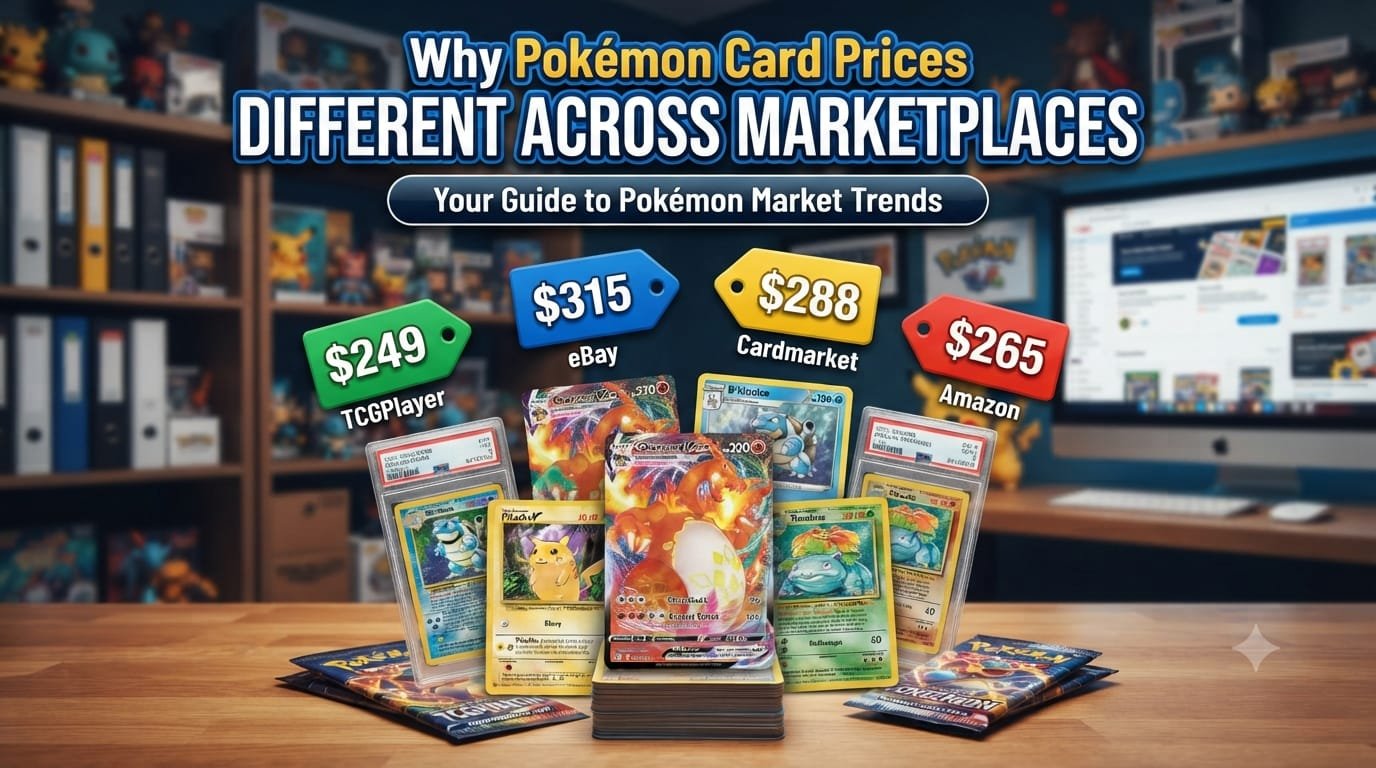
Have you ever checked the price of the same Pokémon card on three different marketplaces and wondered why the numbers do not match?
You might see one price on eBay, a different number on TCGplayer, and another price on Cardmarket. Sometimes the difference is small. Other times, the gap can be surprisingly large.
This does not necessarily mean that one marketplace is wrong.
The Pokémon TCG secondary market is made up of different marketplaces, buyer groups, currencies, fee structures, shipping costs, listing formats, and transaction histories. As a result, the same card can legitimately trade at different prices depending on where and how it is bought or sold.
Understanding these differences is important because one of the most common mistakes collectors make is treating the highest listing they can find—or the lowest advertised price—as the card’s true market value.
Why the Same Pokémon Card Can Have Different Prices
There is no single global price tag attached to most Pokémon cards.
Instead, a card has a range of prices created by actual transactions across different marketplaces.
Consider a hypothetical Near Mint copy of the same modern Pokémon chase card. You could encounter:
| Marketplace Situation | Possible Price | What It Represents |
|---|---|---|
| Lowest active listing | $95 | What one seller is currently asking |
| Recent completed sale | $105 | What a buyer actually paid |
| Another marketplace | $112 | A different buyer and seller environment |
| High active listing | $135 | An asking price that may not result in a sale |
All four numbers can exist at the same time.
The important question is not simply “What is the card listed for?”
The more useful question is:
“What are comparable copies actually selling for?”
Listed Price vs. Sold Price
This is one of the most important distinctions in Pokémon TCG market research.
An active listing represents a seller’s asking price. It does not prove that a buyer considers that price reasonable.
A completed sale provides stronger evidence because someone actually paid that amount.
TCGplayer’s own Market Price system illustrates this distinction. Its Market Price is calculated from recent completed transactions rather than simply using current asking prices. TCGplayer also separates Market Price from its Listed Median and other price points. 2
This matters particularly for older, scarce, or low-volume Pokémon cards.
Imagine there are only three copies of a vintage card currently listed:
- $180
- $225
- $300
Looking only at those listings could make the card appear to be worth around $225–$300.
But suppose the last five comparable sales were:
- $155
- $160
- $168
- $172
- $175
The active listings and completed sales are telling two very different stories.
The sellers still holding copies may simply be unwilling to sell at the recent market price. That does not automatically make the card worth $300.
What TCGplayer Market Price Actually Tells You
TCGplayer provides several different price signals, and they should not be treated as interchangeable.
| Price Metric | What It Can Tell You | What It Does Not Prove |
|---|---|---|
| Market Price | Recent transaction-based pricing | The guaranteed price of your individual copy |
| Most Recent Sale | The latest recorded transaction | The normal long-term market range by itself |
| Listed Median | Where current listings are positioned | What buyers are actually paying |
| Current Quantity | Visible supply on the marketplace | Total supply across the entire market |
| Current Sellers | Number of sellers offering the selected product | Total number of copies owned by collectors |
That distinction becomes especially important when a card has relatively few active listings. TCGplayer notes that a Listed Median can be significantly higher than Market Price when only a small number of sellers remain listed at elevated prices. 3
Why eBay Can Show a Different Pokémon Card Price
eBay operates differently from a marketplace where standardized product listings dominate.
Depending on the listing, buyers may encounter auctions, fixed-price listings, offers, promoted listings, different shipping charges, and sellers with very different reputations and return policies.
That creates another layer of variation.
For example, two copies of the same card can be listed at:
| Listing | Card Price | Shipping | Effective Price |
|---|---|---|---|
| Seller A | $100 | $8 | $108 |
| Seller B | $105 | $2 | $107 |
| Seller C | $110 | Free | $110 |
Looking only at the headline card price would make Seller A appear to be the cheapest option.
Looking at the actual checkout cost produces a different result.
TCGplayer similarly explains that price and shipping together influence how listings are presented to buyers, which is another reason that headline prices should not be analyzed in isolation. 4
Auction Prices Are Not Automatically the Market Price
Auctions introduce another variable: timing.
A Pokémon card sold through an auction can finish at a different price depending on:
- How many buyers are watching the auction
- When the auction ends
- How much attention the card receives
- Whether competing copies are available
- The seller’s shipping terms
- The quality and accuracy of the photographs
- The card’s stated condition
- The seller’s reputation
A single unusually high or unusually low auction result should therefore be treated carefully.
One transaction is evidence of what happened once.
A cluster of comparable transactions is much more useful for understanding the current market range.
Why Cardmarket Prices Can Differ From U.S. Prices
Cardmarket adds another important dimension to Pokémon TCG pricing: the European market.
Cardmarket describes itself as Europe’s largest marketplace for trading card games, and its Pokémon marketplace currently displays both individual card and sealed-product activity. 5
European collectors may therefore encounter prices that do not line up perfectly with U.S.-based marketplace data.
Several factors can contribute to the difference:
- Different buyer populations
- Different levels of local supply
- Currency conversion
- Shipping distances
- Import costs in some transactions
- Different seller fee structures
- Different competitive and collecting communities
- Different availability of English and non-English printings
This means that a Pokémon card being listed at €100 on Cardmarket and $110 on a U.S. marketplace does not automatically indicate an arbitrage opportunity or a pricing error.
The two prices exist within different market environments.
Fees Can Change the Real Value of a Sale
Another reason marketplace prices should not be compared without context is seller fees.
A seller does not necessarily keep the entire headline sale price.
For example, eBay publishes separate fee structures by market and category. Its U.S. seller information lists specific final-value fees for trading cards, while eBay Italy publishes its own fee information for collectible cards. 6
Cardmarket also charges sellers a marketplace fee based on the value of the merchandise, with its current fee information listing a 5% selling fee for private users. 7
These differences matter when comparing what a buyer pays with what a seller actually receives.
A card selling for €100 on one platform is not necessarily economically equivalent to a card selling for €100 on another platform if the associated fees, shipping, taxes, or other transaction costs are different.
Why Currency Conversion Can Create Misleading Comparisons
Currency is another reason that Pokémon card prices can appear different even when the underlying market is relatively close.
A card listed at €100 is not directly comparable with a card listed at $100. The exchange rate changes the relationship between the two prices, and the final cost can change further depending on payment method, shipping, taxes, and the buyer’s location.
For international collectors, the useful comparison is therefore not simply:
€100 vs. $100
Instead, think in terms of:
Converted card price + shipping + applicable taxes or import costs + marketplace costs.
Even after converting currencies, two markets may still produce different effective prices because buyers in those markets face different costs when purchasing the card.
Condition Is One of the Biggest Sources of Price Differences
Sometimes what looks like a marketplace price difference is actually a condition difference.
A seller may describe a card as Near Mint while another seller lists a visually similar copy as Lightly Played. Both listings may appear in the same search results, but they are not necessarily comparable products.
Condition differences can involve:
- Whitening on the back
- Edge wear
- Corner damage
- Surface scratches
- Print lines
- Holo scratches
- Dents or indentations
- Creases
- Centering
- Factory defects
This is particularly important when comparing expensive vintage cards or cards that are commonly graded.
A $200 Near Mint raw card and a $130 Lightly Played copy should not be treated as evidence that the market is simultaneously at $130 and $200 for the same condition.
They are different condition categories.
For a deeper inspection of raw condition, see our Pokémon Card Condition Guide before comparing prices across marketplaces.
English, Japanese, and Other Printings Are Not Interchangeable
Another common mistake is comparing different language versions as though they were the same product.
A Pokémon card can exist in English, Japanese, and other language versions, while the demand, supply, print history, and collector base can differ substantially between them.
Even when the artwork and card number appear similar, the market should be analyzed using comparable copies.
| Comparison | Usually Comparable? | Why |
|---|---|---|
| English Near Mint vs English Near Mint | Yes | Same language and broadly comparable condition |
| Japanese Near Mint vs English Near Mint | Not directly | Different language market and supply environment |
| 1st Edition vs Unlimited | No | Different printing and collector demand |
| Shadowless vs Unlimited | No | Different Base Set variant |
| Raw vs PSA 10 | No | Different product state and grading risk |
This principle is especially important when researching vintage Pokémon cards because printing differences can create large market gaps.
Raw Cards and Graded Cards Create Two Different Price Markets
A raw Pokémon card should not normally be compared directly with a professionally graded copy.
A graded card includes an additional layer of information: an independent grading result, encapsulation, authentication, and a standardized grade from the grading company.
That does not mean every graded copy automatically deserves a large premium.
The premium depends on the card, grade, grading company, population, condition expectations, buyer demand, and availability of comparable copies.
| Product | Main Pricing Question |
|---|---|
| Raw Near Mint | What are comparable raw copies selling for? |
| PSA 9 | What are comparable PSA 9 copies selling for? |
| PSA 10 | What are comparable PSA 10 copies selling for? |
| Other grading company | How does that specific grade trade in the current market? |
If you are considering grading a card, our Pokémon Card Pre-Grading Guide can help you inspect the copy before comparing graded prices.
Why the Cheapest Listing Is Not Always the Cheapest Purchase
The lowest advertised card price can be misleading when the complete transaction is considered.
Imagine three listings:
| Seller | Card Price | Shipping | Total Before Other Costs |
|---|---|---|---|
| Seller A | $90 | $15 | $105 |
| Seller B | $98 | $4 | $102 |
| Seller C | $104 | Free | $104 |
Seller A has the lowest headline price, but Seller B has the lowest combined price in this example.
The same principle applies internationally. A lower Cardmarket listing may become less attractive if the seller is located far away and the shipping cost is substantially higher.
For this reason, serious market research should distinguish between:
- Item price
- Shipping cost
- Taxes
- Import-related costs where applicable
- Marketplace fees paid by the seller
- Buyer protection or other transaction costs
Understanding the Spread Between Buyers and Sellers
Another useful concept is the difference between the prices at which sellers are willing to sell and buyers are actually completing purchases.
Suppose a card has current listings at:
- $150
- $155
- $160
- $165
But recent completed sales are concentrated around $135–$145.
The difference between the active supply and recent transaction range tells you something important about the current market.
Sellers may be asking more than buyers have recently been willing to pay.
That does not mean the sellers are wrong. They are simply setting their own asking prices.
But it does mean that using $165 as the card’s “market value” would ignore the evidence from actual transactions.
How to Build a More Realistic Pokémon Card Price Range
Instead of searching for one magic number, collectors can build a more realistic market range by combining several comparable transactions and separating them from current asking prices.
The goal is not to produce a perfectly precise number. The goal is to understand where comparable buyers and sellers are actually meeting in the market.
Step 1: Identify the Exact Card
Start by confirming the exact product you are researching.
- Card name
- Card number
- Set
- Rarity
- Language
- Printing or variant
- Raw or graded status
- Condition
This prevents different versions of the same Pokémon card from being mixed into one price range.
Step 2: Collect Recent Comparable Sales
Next, look for several completed transactions involving copies that are genuinely comparable to the card you are researching.
Recent sales are generally more useful than very old transactions because Pokémon TCG prices can change as supply, demand, new releases, and collector interest change.
For an actively traded modern card, you may find many recent transactions. For a scarce vintage card, there may be far fewer. The important point is to work with the strongest comparable evidence available rather than forcing an arbitrary number of sales.
Step 3: Separate Active Listings From Completed Sales
Keep active listings in a separate group from completed transactions.
For example, imagine you find the following active listings:
| Active Listing | Asking Price |
|---|---|
| Seller A | $150 |
| Seller B | $155 |
| Seller C | $160 |
| Seller D | $165 |
Those numbers tell you what sellers are currently asking.
Now imagine recent comparable sales were:
| Recent Sale | Sold Price |
|---|---|
| Sale 1 | $135 |
| Sale 2 | $139 |
| Sale 3 | $142 |
| Sale 4 | $145 |
| Sale 5 | $147 |
The two groups are providing different information.
The active listings suggest that sellers currently want approximately $150–$165, while the completed transactions suggest that buyers have recently been paying approximately $135–$147.
That gap is worth investigating rather than simply declaring the card to be worth $165.
Step 4: Check for Condition and Variant Mismatches
Before combining sales into one range, remove transactions that are not genuinely comparable.
A transaction may need to be excluded from your comparison if it involves:
- A different language
- A different printing
- A different card number
- A different condition
- A graded copy instead of a raw copy
- A different grading company or grade
- A damaged or unusually altered copy
- A bundle or multi-card transaction
This step is especially important for vintage Pokémon cards, where 1st Edition, Shadowless, Unlimited, promotional, and other variants can occupy very different parts of the market.
Step 5: Look for the Main Transaction Cluster
Once obvious mismatches are removed, look at where most of the comparable sales are concentrated.
For example:
| Sale | Price |
|---|---|
| 1 | $91 |
| 2 | $94 |
| 3 | $96 |
| 4 | $98 |
| 5 | $99 |
| 6 | $101 |
| 7 | $103 |
| 8 | $105 |
| 9 | $107 |
These transactions form a relatively tight cluster around the high-$90s to low-$100s.
That cluster can be more informative than searching for the single highest or lowest transaction.
Step 6: Investigate Outliers Instead of Automatically Deleting Them
If you find a transaction far outside the main cluster, do not immediately assume that it is wrong.
First investigate why it was different.
A higher sale could involve an exceptionally clean copy, stronger centering, a particular printing, better seller presentation, or another characteristic that buyers valued.
A lower sale could involve condition issues, poor photographs, an auction with limited competition, or another unusual circumstance.
The objective is not to manipulate the data until every transaction looks similar. The objective is to understand why the transactions differ.
Step 7: Account for the Effective Transaction Cost
When comparing different marketplaces, remember that the card price alone does not always represent the final economic cost.
Depending on the transaction, consider:
- Shipping
- Taxes
- Import-related costs
- Currency conversion
- Marketplace fees
- Payment-related costs
For a buyer, the relevant figure can be the total amount required to obtain the card.
For a seller, the relevant figure can be the amount remaining after applicable transaction costs.
Step 8: Create a Range Instead of One Exact Number
After completing the comparison, avoid presenting a single number as though it were a permanent universal value.
A more realistic conclusion might look like:
This type of range provides more context than simply saying, “The card is worth $100.”
It also makes the research easier to update when new transactions appear.
How Many Sales Should You Use?
There is no universal number of transactions that works for every Pokémon card.
A highly liquid modern card may generate enough sales to analyze a large group of recent transactions, while a scarce vintage card may have only a few genuinely comparable sales over a much longer period.
In lower-volume markets, each transaction should be examined more carefully because an individual sale can have a much larger influence on the visible price range.
The key principle is consistency: use as many recent, comparable transactions as the market reasonably provides, and clearly recognize when the available evidence is limited.
Why One Extreme Sale Can Distort Your Research
Collectors sometimes find a surprisingly high sale and immediately assume the card’s market has moved upward.
That conclusion can be premature.
Before treating an unusually high transaction as representative, check:
- Was the card actually the same version?
- Was the condition comparable?
- Was it graded?
- Was the grade from the same grading company?
- Was it a special language or printing?
- Was shipping included?
- Was the transaction part of a bundle?
- Was the listing clearly identified?
- Were there other sales around the same price?
The same principle applies to unusually low sales.
A very low transaction can be caused by a damaged copy, a rushed sale, a poorly described listing, an auction with limited competition, or another circumstance that does not represent the broader market.
Why Marketplace Differences Can Actually Be Useful
Price differences are not necessarily a problem for collectors.
They can provide useful information about how different parts of the Pokémon TCG market behave.
For example, if a card consistently sells for similar converted prices across several marketplaces, that can indicate that the market is relatively aligned.
If one marketplace repeatedly shows much higher asking prices while completed sales remain lower elsewhere, that can reveal a difference between seller expectations and realized transaction prices.
Likewise, if European prices consistently differ from U.S. prices after currency conversion and shipping are considered, the difference may reflect regional supply and demand rather than a simple pricing mistake.
This is one reason marketplace comparison is more useful when treated as market research rather than a hunt for one “correct” number.
Can You Buy on One Marketplace and Sell on Another?
Price differences naturally raise the possibility of arbitrage: buying a card where it appears cheaper and selling it where the visible price is higher.
However, the difference between two headline prices is not the same as a guaranteed profit.
A collector or seller would need to account for:
- Marketplace selling fees
- Payment-related costs
- Shipping
- Packaging
- Currency conversion
- Taxes
- Import or cross-border costs where applicable
- Time required to complete the sale
- Potential returns or disputes
- Differences in card condition
For example, a card that appears to be €20 cheaper in one market may not actually be €20 cheaper after shipping and conversion costs.
Likewise, a card listed for $150 on one platform does not mean a seller will necessarily receive $150 after marketplace costs.
eBay’s published seller-fee information, for example, shows that final-value fees vary by category and can be calculated on the total amount of the sale, including components such as shipping in applicable cases. 0
The lesson is simple: compare net transaction economics, not just sticker prices.
Market Price Is a Range, Not a Permanent Number
Pokémon card prices are constantly changing because supply and demand change.
A card can have a market range today and a different range several weeks later because of:
- New set releases
- Reprints
- New deck demand
- Collector interest
- Influencer or community attention
- Seasonal buying activity
- New grading population data
- Major tournament results
- New product releases
- Changes in available supply
That is why a price guide should be treated as a snapshot of market conditions rather than a permanent valuation.
TCGplayer’s Market Price is explicitly based on recent transaction data, while its other displayed metrics describe different aspects of current listings and sales activity. 1
How to Compare eBay, TCGplayer, and Cardmarket Properly
A useful comparison starts by making the products as identical as possible.
| Factor | What to Match |
|---|---|
| Card | Exact card name and number |
| Printing | 1st Edition, Unlimited, special variant, etc. |
| Language | English, Japanese, or another language |
| Condition | NM, LP, MP, HP, or Damaged |
| Grading | Raw or the same grading company and grade |
| Time period | Recent transactions from a similar date range |
| Currency | Convert everything into the same currency |
| Shipping | Include the buyer’s actual shipping cost |
| Transaction costs | Consider relevant fees and taxes |
Only after these factors are reasonably aligned does a marketplace-to-marketplace comparison become meaningful.
A Simple Pokémon TCG Market Research Method
If you want a repeatable process for checking the market price of a card, use this five-step method.
Step 1: Identify the Exact Product
Confirm the set, card number, rarity, language, printing, condition, and whether the card is raw or graded.
Step 2: Check Recent Sales
Look for multiple completed transactions rather than relying on one result.
Step 3: Separate Asking Prices
Record active listings separately. They describe current seller expectations and visible supply, not necessarily realized market value.
Step 4: Remove Obvious Mismatches
Exclude sales involving different conditions, languages, variants, grades, or unusual circumstances.
Step 5: Build a Market Range
Use the remaining comparable transactions to establish a realistic range rather than declaring one exact price.
This method can be particularly useful for cards that do not have a large amount of publicly visible market data.
What Different Marketplace Signals Can Tell You
| Signal | What It May Indicate |
|---|---|
| Many recent sales at similar prices | More consistent transaction evidence |
| Many listings but few sales | Visible supply without necessarily strong transaction activity |
| Very few listings | Limited visible supply, but not necessarily high demand |
| High listings with lower recent sales | Potential gap between asking prices and realized prices |
| Rapidly changing sold prices | Greater short-term price movement |
| Large regional price difference | Possible differences in supply, demand, currency, or transaction costs |
None of these signals should be interpreted alone.
Marketplaces are pieces of evidence that become more useful when combined.
How This Relates to Pokémon TCG Market Liquidity
Marketplace price differences are closely connected to liquidity, but they are not the same thing.
A card can have a high price while trading infrequently.
Another card can have a lower price but generate many transactions every week.
That is why price and liquidity should be analyzed separately.
Our Pokémon TCG Market Liquidity Guide explains how sales frequency, buyer demand, market depth, active listings, and transaction volume affect how easily different cards can be bought or sold.
When combined with marketplace comparison, these concepts provide a much clearer picture of the market than a single displayed price.
Common Mistakes When Comparing Pokémon Card Prices
- Using the highest active listing as the card’s value. An asking price is not proof of a completed sale.
- Using the cheapest listing without checking condition. The cheapest copy may have whitening, scratches, dents, or another condition difference.
- Comparing different languages. English and Japanese cards can have different supply and demand characteristics.
- Comparing raw and graded cards. They represent different products and different levels of condition certainty.
- Ignoring shipping. The headline card price may not be the final amount paid.
- Ignoring currency conversion. €100, $100, and £100 are not equivalent.
- Using one sale as the entire market. One transaction can be unusual.
- Ignoring transaction volume. A price supported by hundreds of recent sales provides different evidence from a price supported by one or two transactions.
- Comparing different variants. 1st Edition, Shadowless, Unlimited, promos, reprints, and other variants should be analyzed separately.
- Assuming marketplace differences guarantee arbitrage. Fees, shipping, taxes, currency conversion, and selling time can eliminate apparent price gaps.
Pokémon Card Marketplace Comparison Checklist
Before deciding that one marketplace is cheaper or that a card has changed in value, ask:
- Am I looking at the exact same card?
- Is the card number identical?
- Is the printing identical?
- Is the language identical?
- Is the condition comparable?
- Are both cards raw or graded?
- If graded, are the grades comparable?
- Am I comparing completed sales or active listings?
- How recent are the transactions?
- How many comparable sales did I find?
- Are there obvious outliers?
- Did I convert the currencies?
- Did I include shipping?
- Are taxes or import costs relevant?
- Would marketplace fees affect the seller’s net amount?
- Does the difference remain after all of these factors?
Frequently Asked Questions
Why is the same Pokémon card cheaper on one marketplace?
The difference can come from regional supply, buyer demand, seller competition, currency, shipping, fees, condition, language, or simply different transaction timing. A lower displayed price does not automatically mean the card is universally cheaper.
Should I use eBay or TCGplayer to determine Pokémon card value?
Neither should automatically be treated as the single universal price source. The more useful approach is to compare multiple recent, genuinely comparable transactions and understand what each marketplace’s price data represents.
Is TCGplayer Market Price the same as the lowest price?
No. TCGplayer distinguishes its transaction-based Market Price from current listed prices and other price metrics. Market Price is based on recent sales rather than simply selecting the cheapest active listing. 2
Why is Cardmarket sometimes cheaper than U.S. marketplaces?
Regional supply, seller competition, local demand, currency, shipping, taxes, and transaction costs can all contribute to differences between European and U.S. markets. Cardmarket operates within the European marketplace environment, so its visible prices should be interpreted in that context.
Does a higher listing price mean the card’s value increased?
Not necessarily. A higher asking price only shows what a seller currently wants. A meaningful change in market value is better supported by a consistent pattern of completed comparable sales.
How many sales should I check?
There is no universal number that works for every card. More active cards can provide many recent transactions, while scarce cards may have only a few. The key is to examine enough comparable sales to understand the normal range and identify unusual results.
Can I use marketplace price differences to make money?
Price differences can create opportunities to investigate, but the visible difference is not automatically profit. Shipping, selling fees, currency conversion, taxes, returns, and the time required to complete another sale all affect the actual economics of the transaction.
Final Takeaway: Look Beyond the Number
There is rarely one universal Pokémon card price that applies equally to every marketplace.
eBay, TCGplayer, and Cardmarket operate within different marketplace environments, and the prices you see can reflect different combinations of sellers, buyers, transaction histories, currencies, shipping costs, and fees.
The most reliable way to research a card is therefore not to search for the highest number or the lowest number.
Instead, identify the exact card, match the condition and printing, examine recent completed sales, separate asking prices from realized transactions, account for transaction costs, and build a realistic market range from comparable evidence.
That approach also makes it easier to understand why two apparently different prices can both exist without either marketplace necessarily being “wrong.”
For collectors tracking broader market behavior, combine marketplace comparisons with our Pokémon TCG Market Liquidity Guide and explore the latest analysis in our TCG Market News section.