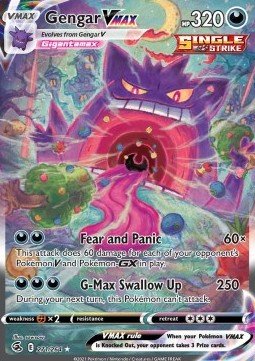
Gengar VMAX is one of the most recognizable and heavily collected cards from the Pokémon Sword & Shield era. Its distinctive artwork, Fusion Strike branding, VMAX rarity, and strong collector demand have made it an important card for anyone following the modern Pokémon TCG market.
But how much is Gengar VMAX actually worth? The answer depends heavily on which Gengar VMAX you have, its condition, whether it is raw or professionally graded, and what comparable copies have recently sold for.
This guide focuses specifically on Gengar VMAX #271/264 from Sword & Shield—Fusion Strike, the secret rare alternate-art-style card that appears beyond the main 264-card numbering of the set. Pokémon’s official card archive identifies it as Gengar VMAX #271/264 from Fusion Strike, with 320 HP and the attacks Fear and Anxiety and Gigantamax Swallow Up. 1
Because Pokémon card prices can change quickly, there is no single permanent value for this card. A clean raw copy, an LP copy with visible wear, a PSA 9, and a PSA 10 can occupy very different parts of the market. Recent sales also show that individual transaction prices can vary substantially depending on condition, timing, platform, and buyer demand. 2
Gengar VMAX #271/264: Card Overview
| Detail | Gengar VMAX #271/264 |
|---|---|
| Set | Sword & Shield—Fusion Strike |
| Card Number | 271/264 |
| Card Type | Pokémon VMAX |
| HP | 320 |
| Rarity | Secret Rare |
| Evolution | Evolves from Gengar V |
| Illustrator | sowsow |
| Set Release Era | Sword & Shield |
The official Pokémon archive lists Gengar VMAX #271/264 as a Rainbow Rare, while market databases and collector listings commonly identify the card by its 271/264 secret-rare number and alternate-art-style collector terminology. When searching for the card, the 271/264 number is one of the easiest ways to distinguish it from the regular Gengar VMAX #157/264. 3
Why Is Gengar VMAX #271/264 So Collectible?
Gengar has always had a strong collector following, and the Fusion Strike VMAX card combines that character popularity with a visually distinctive premium rarity.
The card also belongs to a period of the Pokémon TCG where alternate-art and secret cards became major collecting targets. As a result, Gengar VMAX #271/264 is not simply another Gengar card from Fusion Strike. It represents one of the set’s most recognizable chase cards.
- Gengar is one of Pokémon’s most recognizable characters.
- The card comes from the Sword & Shield era.
- It is numbered 271/264, placing it beyond the main set numbering.
- The artwork gives the card a distinctive collector-focused identity.
- High-grade examples can command a substantial premium over raw copies.
- It remains one of the most closely watched cards from Fusion Strike.
Gengar VMAX #271/264 vs Gengar VMAX #157/264
One of the easiest mistakes to make when researching Gengar VMAX prices is comparing the wrong card.
Fusion Strike contains a regular Gengar VMAX numbered 157/264 as well as the much more valuable 271/264 secret rare version. The official Fusion Strike checklist confirms Gengar VMAX #157 as part of the numbered set, while the Pokémon archive identifies #271/264 as the separate secret card. 4
| Feature | Gengar VMAX #157 | Gengar VMAX #271 |
|---|---|---|
| Set | Fusion Strike | Fusion Strike |
| Number | 157/264 | 271/264 |
| Position | Main set | Secret rare numbering |
| Collector demand | Different market segment | Premium chase-card market |
If you are researching a price, always verify the card number before comparing sales. Searching simply for “Gengar VMAX Fusion Strike” can bring up multiple versions and create a misleading price estimate.
Current Gengar VMAX Market Snapshot
The Gengar VMAX #271/264 market is particularly useful as an example of why card values should be researched using multiple recent sales rather than a single listing.
Recent tracked sales in September 2026 show raw examples selling at several different levels, including transactions around the $700–$900 range as well as higher sales above $1,000 for copies described as NM. Other copies with visible defects have sold for substantially less. 5
PriceCharting’s current data also places its estimated ungraded market around the high hundreds, while its population report currently shows approximately 9,421 PSA 9 copies and 14,068 PSA 10 copies in its combined PSA/CGC reporting system, with listed price estimates around $900 for grade 9 and $2,249.50 for grade 10. These figures are tracker estimates, not guaranteed sale prices, and population data changes over time. 6
| Version / Grade | Market Reference | What to Keep in Mind |
|---|---|---|
| Raw | Often high hundreds to $1,000+ | Condition creates a major spread |
| PSA 9 | Around the $900–$1,000 range in current tracked data | Recent sales should be checked individually |
| PSA 10 | Above $2,000 in current tracker estimates | High-grade premiums can vary substantially |
Why Raw Gengar VMAX Prices Vary So Much
Two raw Gengar VMAX #271/264 cards can look similar in a marketplace thumbnail while having very different values once the condition is examined closely.
The biggest factors are usually surface quality, centering, whitening, corners, edges, dents, scratches, and creases. A card described as NM may sell for considerably more than an LP copy, while a damaged card can trade at a large discount even if the card itself is authentic.
This is particularly important for Gengar VMAX because the card’s market price is high enough that relatively small condition differences can translate into meaningful dollar differences.
Raw Condition Categories
| Condition | What Buyers Usually Look For | General Market Effect |
|---|---|---|
| NM | Clean surface, minimal whitening, strong corners and edges | Highest raw-condition segment |
| LP | Minor whitening, scratches, or visible handling | Discount from NM |
| MP | Clear wear and multiple imperfections | Larger discount |
| HP | Heavy whitening, dents, scratches, or creases | Significant discount |
| Damaged | Major structural or surface damage | Primarily rarity-driven market |
For a detailed explanation of these condition categories, see our Pokémon Card Condition Guide.
Gengar VMAX Surface Condition: What Should You Inspect?
Surface quality is one of the most important things to inspect before assigning a value to a raw Gengar VMAX #271/264. A card can have excellent-looking corners and edges while still showing scratches, dents, print defects, or other surface problems.
This matters even more with a premium card because buyers who are paying several hundred dollars or more are often much more sensitive to defects than buyers purchasing inexpensive cards.
Holo Scratches
Fine scratches can be difficult to see in a straight-on photograph. The best way to inspect the surface is to slowly tilt the card under a strong light source.
Move the card through several angles and look for lines that appear and disappear as the light moves across the surface. Deep or concentrated scratches are generally more noticeable than extremely fine hairlines.
Dents and Indentations
Dents are especially important because they may be almost invisible in normal photographs. An indentation can become much easier to see when light reflects across the card at an angle.
Never bend the card aggressively to test it. Instead, inspect the surface under angled lighting and look for localized depressions or pressure marks.
Whitening
Whitening is usually easiest to see around the back edges and corners. A small isolated spot is different from widespread whitening across multiple edges.
When evaluating an expensive Gengar VMAX, inspect all four corners individually rather than assuming that the card is NM because the front looks clean.
Centering on Gengar VMAX #271/264
Centering is another important factor for collectors considering professional grading. A card can have a clean surface and minimal whitening but still have noticeably uneven borders.
Look at the left and right borders first, then compare the top and bottom borders. Slight differences can be difficult to judge from a photograph, so a straight-on image is preferable to an angled listing photo.
Centering by itself should not be confused with played condition. A poorly centered card can still be physically clean, while a perfectly centered card can have scratches, whitening, or dents.
For a detailed walkthrough, see our Pokémon Card Centering Guide.
Gengar VMAX Raw vs Graded Value
One of the most important questions for a Gengar VMAX owner is whether the card should remain raw or be submitted for professional grading.
The answer depends on the card’s actual condition and the economics of grading. A raw card that has obvious whitening, a dent, poor centering, or surface scratches may not receive the grade needed to justify the additional expense.
On the other hand, a very clean copy with strong centering and minimal visible defects may be worth evaluating more carefully before deciding whether to keep it raw or submit it.
| Factor | Why It Matters |
|---|---|
| Centering | Can influence the potential for a high numerical grade |
| Surface | Scratches and dents can significantly affect grading |
| Corners | Visible wear can reduce the card’s presentation quality |
| Edges | Whitening and chipping are common condition concerns |
| Print quality | Manufacturing characteristics may affect collector appeal |
| Grading cost | Must be considered against the potential value increase |
Before submitting an expensive card, use our Pokémon Card Pre-Grading Guide to perform a structured inspection.
Gengar VMAX PSA 9 vs PSA 10
The gap between PSA 9 and PSA 10 can be one of the most important parts of the Gengar VMAX market.
Current tracker data shows a significant difference between the estimated PSA 9 and PSA 10 markets. PriceCharting’s population report currently lists an estimated value around $900 for PSA 9 and approximately $2,249.50 for PSA 10. 7
Recent sales demonstrate why those numbers should be treated as market references rather than guarantees. For example, tracked PSA 9 sales in late August and early September 2026 included transactions around the $950–$1,036 range, while high-grade sales from other grading systems and PSA 10 transactions can vary significantly depending on the exact sale. 8
Gengar VMAX PSA 10 Population
Population reports can provide useful context when researching a high-value graded card, but they should not be treated as a direct price prediction.
The current PriceCharting population report lists more than 14,000 PSA 10 examples for Gengar VMAX #271/264 and more than 9,000 PSA 9 examples, with additional CGC submissions included in its combined report. The site states that population figures are updated monthly. 9
A growing population can change the supply of graded cards available to collectors. However, population numbers do not tell you how many owners are willing to sell, how many copies are actively listed, or how many buyers are currently searching for the card.
What Makes a Gengar VMAX #271/264 More Valuable?
Several characteristics can make one copy more desirable than another, even when both are technically the same card.
- High overall condition: Clean surfaces, corners, and edges.
- Strong centering: Balanced borders are particularly important to grading-focused collectors.
- Minimal whitening: Especially around the back corners and edges.
- Clean surface: Few or no visible scratches, dents, or print issues.
- Professional grade: High grades can place the card into a different market segment.
- Authenticity: Buyers of expensive cards expect confidence that the card is genuine.
Gengar VMAX Market Demand
Gengar’s popularity gives this card a strong collector identity beyond its role as a Fusion Strike chase card. Character demand is important because Pokémon collectors do not all approach the market from the same perspective.
Some buyers focus on completing sets, some collect specific Pokémon, some prefer alternate-art-era cards, and others focus primarily on graded examples. A card that appeals to several collector groups can have a broader potential buyer base than a card that appeals to only one niche.
That does not guarantee a particular future price. Instead, it helps explain why Gengar VMAX #271/264 continues to attract attention in the secondary market.
How to Check Recent Gengar VMAX Sales
The best way to research the current value of a Gengar VMAX is to examine completed sales rather than relying on active listings.
Active listings tell you what sellers are asking. Completed sales show what buyers actually paid. Those two numbers can be very different.
For example, recent tracked September 2026 sales include raw Gengar VMAX copies around $700–$900, with some NM listings selling above $1,000 and damaged or creased examples selling for considerably less. This variation shows why condition-specific comparisons are essential. 10
Check Current Gengar VMAX Listings
Looking for a Gengar VMAX #271/264? Browse current listings and compare available copies, conditions, grading, and asking prices before making a decision.
View Gengar VMAX ListingsWhen comparing listings, make sure the card number is 271/264, not the regular Gengar VMAX #157/264. Also check whether the seller is showing the actual card rather than a stock image.
Asking Price vs Sold Price
A seller might list a Gengar VMAX for $1,200, $1,500, or even more, but that does not mean the card is currently worth that amount.
The strongest evidence comes from completed transactions involving comparable copies. Ideally, compare sales that are close together in date and match the same general condition.
| Comparison | Useful? | Why |
|---|---|---|
| Recent sold NM raw copy | Yes | Direct comparison for another NM raw copy |
| Old sale from years ago | Limited | Market conditions may have changed |
| Active $1,500 listing | Limited | Asking price is not a completed sale |
| PSA 10 sale | Only for graded comparison | Not directly comparable to a raw card |
| Damaged copy | Limited | Condition is materially different |
Gengar VMAX Grading: Is It Worth Submitting?
Whether grading makes sense depends on the card you actually have, not simply on the reputation or current market value of Gengar VMAX #271/264.
A card that looks exceptionally clean may deserve a closer pre-grading inspection, while a copy with a noticeable crease, dent, heavy whitening, or major surface scratch may be better kept raw.
Before paying for grading, inspect the card under strong lighting and check the front, back, corners, edges, surface, and centering. You should also account for grading fees, shipping, insurance, turnaround time, and the possibility of receiving a lower grade than expected.
- Check front and back centering.
- Inspect all four corners.
- Look for edge whitening.
- Inspect the entire surface under angled light.
- Check for dents and indentations.
- Look carefully for scratches.
- Inspect the holo area from multiple angles.
- Look for creases or bends.
- Check for stains or discoloration.
- Confirm the card is authentic.
Common Gengar VMAX Valuation Mistakes
1. Comparing the Wrong Gengar VMAX
This is probably the easiest mistake to make. Fusion Strike contains multiple Gengar VMAX cards, so always verify the card number before comparing prices.
The premium card discussed in this guide is Gengar VMAX #271/264.
2. Using an Active Listing as the Card’s Value
A $1,200 asking price does not mean buyers are paying $1,200. Look at completed sales whenever possible.
3. Ignoring Condition
A raw NM copy and a raw LP copy should not automatically be valued the same. Small condition differences can matter significantly on a card with a high market value.
4. Assuming Every PSA 10 Is Worth the Same
Even within the same grade, actual sale prices can vary because of timing, marketplace, buyer demand, and other transaction-specific factors.
5. Focusing Only on Population Numbers
Population reports are useful context, but they do not tell you how many copies are currently for sale or how many collectors are actively looking to buy.
6. Ignoring Selling Costs
If you are calculating how much you would actually receive from a sale, remember that platform fees, shipping, insurance, taxes, and other transaction costs can reduce the amount you keep.
Gengar VMAX Raw vs PSA 9 vs PSA 10
| Category | Main Consideration | Buyer Profile |
|---|---|---|
| Raw NM | Physical condition and potential grading quality | Collectors and grading-focused buyers |
| Raw LP | Visible wear but still collectible | Collectors prioritizing card ownership over top condition |
| PSA 9 | Professionally authenticated and graded | Collectors wanting a certified example |
| PSA 10 | Highest PSA numerical grade | High-grade collectors and condition-focused buyers |
Current market tracking illustrates the large separation between these segments. PriceCharting’s current population report lists an estimated value around $900 for PSA 9 and roughly $2,249.50 for PSA 10, while individual recent transactions can land above or below those estimates. 11
Gengar VMAX vs Other Modern Chase Cards
Gengar VMAX #271/264 sits within a broader group of high-profile Sword & Shield-era chase cards. Comparing it with other cards can be useful, but the comparison should always account for character popularity, set supply, card condition, grading population, and recent sales.
For example, PokeVault Guide also covers other major modern cards such as Umbreon VMAX and Rayquaza VMAX. These cards occupy different collector markets, so their prices should not be treated as interchangeable benchmarks.
The more useful question is not simply which card has the higher price. Instead, ask what factors are currently driving demand, how frequently comparable copies sell, and how condition affects the price spread.
Is Gengar VMAX #271/264 a Good Collecting Card?
From a collecting perspective, Gengar VMAX #271/264 combines several characteristics that make it notable: a highly recognizable Pokémon, a premium Fusion Strike rarity, distinctive artwork, and an established secondary-market presence.
That does not mean every copy will appreciate in value or that a particular price level will continue indefinitely. Pokémon card markets can change as collector preferences, supply, grading populations, and broader TCG demand change.
For collectors, the more useful approach is to understand why the card has demand and then decide whether its condition, price, and role in your collection fit your own goals.
Gengar VMAX Liquidity: How Easy Is It to Sell?
Liquidity is another useful concept when evaluating a high-value Pokémon card. A card can have a high market value while still taking time to sell at a particular asking price.
Gengar VMAX #271/264 has an established collector market and recurring sales activity, but the time needed to sell a specific copy can depend heavily on price, condition, platform, and presentation.
A clean NM copy priced close to recent comparable sales may attract a different audience than a damaged copy priced aggressively. Likewise, a PSA 10 can appeal to a more specialized group of buyers.
For a deeper explanation of this concept, see our Pokémon TCG Market Liquidity Guide.
How to Photograph a Gengar VMAX Before Selling
Because Gengar VMAX is a high-value card, clear photographs can make a major difference when selling online.
- Full front image.
- Full back image.
- Close-up of all four corners.
- Close-up of the edges.
- Angled surface photograph.
- Close-up of any scratches or dents.
- Card number showing 271/264.
- Grading slab and label if professionally graded.
Good photographs are particularly important when selling a raw card because buyers cannot physically inspect the card before purchasing it. Showing imperfections clearly can reduce misunderstandings and make the listing more transparent.
Frequently Asked Questions About Gengar VMAX #271/264
How much is Gengar VMAX #271/264 worth?
Its value depends heavily on condition and grading. Current market data shows raw copies generally trading in the high-hundreds to around or above $1,000 depending on condition, while graded copies can command substantially more. Recent sold listings should be used rather than a single asking price. 12
Is Gengar VMAX 271/264 rare?
Yes. It is a secret rare card numbered beyond the main 264-card Fusion Strike set. The official Pokémon archive identifies it as #271/264, while the official Fusion Strike checklist shows the regular Gengar VMAX as #157. 13
What is the difference between Gengar VMAX 157 and 271?
Gengar VMAX #157/264 is the regular version included within the main Fusion Strike numbering. Gengar VMAX #271/264 is the separate secret rare premium version and occupies a very different collector market.
How much is a PSA 9 Gengar VMAX 271/264 worth?
Current tracking data places the PSA 9 market around the $900–$1,000 range, while recent individual sales can vary. For example, recent tracked PSA 9 sales have appeared around $950 to slightly above $1,000. 14
How much is a PSA 10 Gengar VMAX 271/264 worth?
Current market trackers place PSA 10 substantially above PSA 9, with PriceCharting’s current population report showing an estimated value around $2,249.50. Individual sales can vary significantly, so this should be treated as a market reference rather than a guaranteed selling price. 15
Should I grade my Gengar VMAX?
That depends on the card’s condition and the costs involved. Inspect centering, corners, edges, surface, whitening, scratches, dents, and creases before deciding. A detailed pre-grading inspection can help you determine whether the card appears suitable for submission.
Does whitening hurt Gengar VMAX value?
Yes, visible whitening can affect how buyers evaluate a raw copy, especially when comparing it with cleaner NM examples. The amount and location of the whitening matter.
Where can I check current Gengar VMAX prices?
Use recent completed sales from major Pokémon marketplaces and price-tracking databases. Compare cards with the same number, language, condition, and grading status rather than combining different versions into one average.
Final Takeaway
Gengar VMAX #271/264 is one of the standout collector cards from Sword & Shield—Fusion Strike, but determining its value requires more than searching for one number.
The biggest variables are condition, centering, surface quality, raw vs graded status, professional grade, recent sales, and current buyer demand. A clean NM raw copy can occupy a very different market from an LP card, while PSA 9 and PSA 10 examples can sit in entirely different price ranges.
If you own one, start by confirming that it is actually Gengar VMAX #271/264. Then inspect the front, back, corners, edges, surface, whitening, scratches, dents, and centering. After that, compare recent sold examples that closely match the condition of your card.
Most importantly, do not confuse an active listing with a confirmed market value. Asking prices can be optimistic, while completed sales provide stronger evidence of what buyers have actually paid.
For more Pokémon card valuation research, explore the Card Value Guides section on PokeVault Guide, and for condition and grading research, visit our Grading & Authenticity guides.
If you are comparing Gengar VMAX with other major modern cards, you can also explore our existing guides on Umbreon VMAX and Rayquaza VMAX to understand how different high-demand cards can occupy different parts of the Pokémon TCG market.