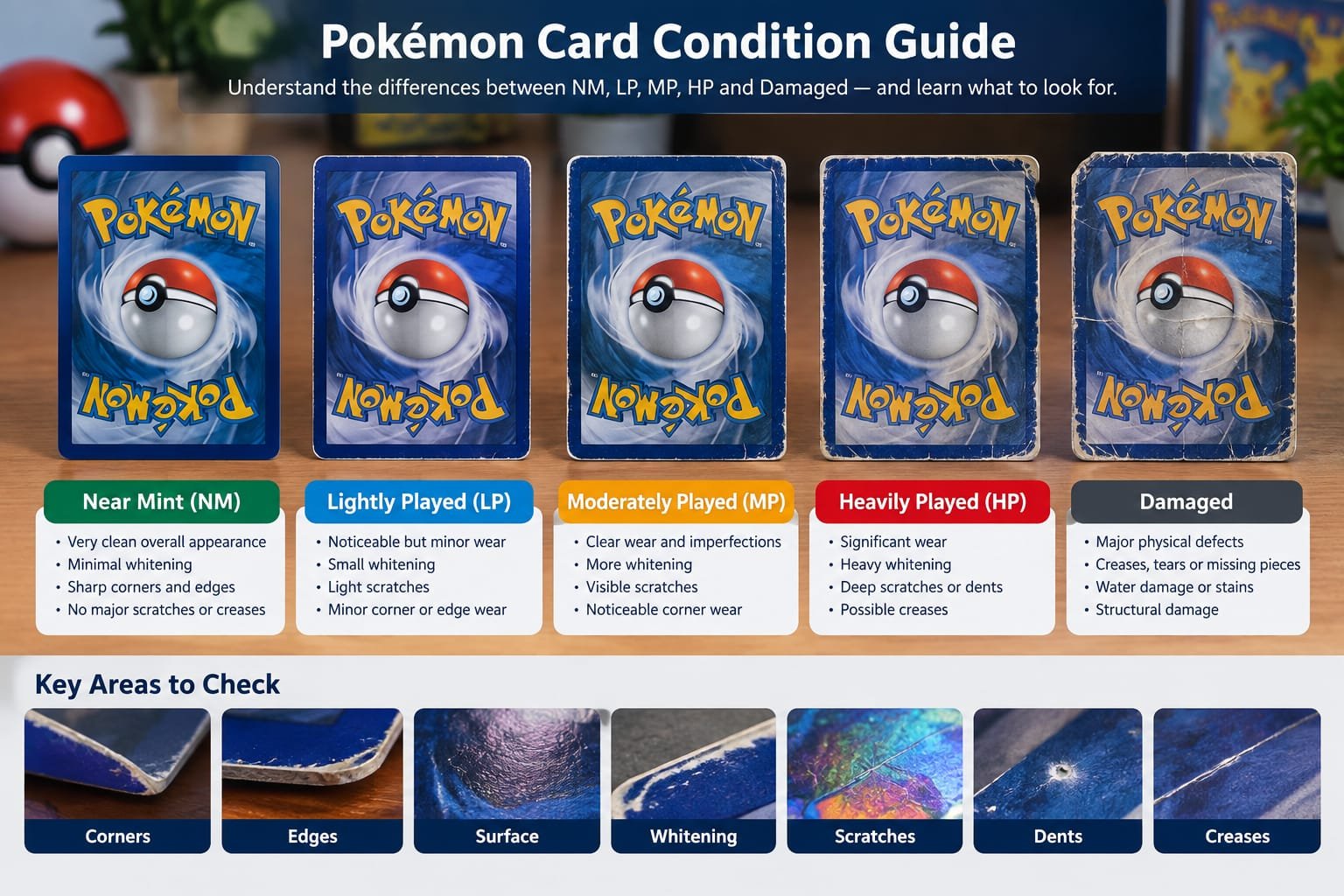
If you have ever looked at a Pokémon card listing and wondered whether the seller’s “Near Mint” description actually matches the card, you are not alone. Two cards can look very similar at first glance while having noticeably different levels of wear once you inspect the corners, edges, surface, and back.
Card condition is one of the most important factors when buying, selling, trading, or considering professional grading for a Pokémon card. A rare card in excellent condition can be worth considerably more than the same card with visible wear, while a card with seemingly minor damage can fall into a completely different condition category.
The challenge is that condition descriptions such as Near Mint, Lightly Played, Moderately Played, and Heavily Played can sometimes feel subjective. What one seller considers “NM” may be viewed differently by another collector, especially when imperfections are small or difficult to see in listing photos.
This guide explains how Pokémon card condition is commonly evaluated and what separates NM, LP, MP, HP, and Damaged cards. We will look at the front and back of the card, corners, edges, whitening, scratches, dents, creases, surface defects, and other imperfections that can affect how a card should be described.
If you have ever looked at a Pokémon card listing and wondered whether the seller’s “Near Mint” description actually matches the card, you are not alone.
Condition is one of the most important factors in the Pokémon TCG market. Two copies of the exact same card can look similar in a listing thumbnail yet have very different values once you inspect their corners, edges, surface, centering, and overall wear.
This becomes especially important with valuable vintage cards, high-demand chase cards, and cards that may be candidates for professional grading.
A card does not need to be professionally graded to have a condition. Raw cards are routinely described using condition labels such as NM, LP, MP, HP, and Damaged. Professional grading services then use their own numerical grading systems and detailed criteria to evaluate the physical characteristics of a card.
In this guide, we will break down Pokémon card condition from Near Mint to Damaged, explain exactly what to inspect, show you which defects matter most, and give you a practical inspection system you can use before buying, selling, trading, or submitting a card for grading.
Pokémon Card Condition at a Glance
| Condition | What It Generally Means | Common Signs | Typical Use |
|---|---|---|---|
| Near Mint (NM) | Very little visible wear and an overall nearly unplayed appearance. | Very minor edge wear, tiny imperfections, minimal surface marks. | Higher-condition raw collecting and potential grading candidates. |
| Lightly Played (LP) | Minor visible wear that does not significantly affect the card’s structure. | Small scratches, light whitening, minor edge or corner wear. | Cards that have noticeable but limited handling or play wear. |
| Moderately Played (MP) | Clearly visible wear across one or more areas. | More obvious whitening, scratches, scuffs, bends or moderate surface wear. | Cards with meaningful wear but still suitable for many collecting or playing purposes. |
| Heavily Played (HP) | Significant wear that is immediately noticeable. | Heavy whitening, major scratches, creases, dents, rounded corners or substantial surface wear. | Heavily worn cards, often valued primarily for the card itself rather than condition. |
| Damaged | Severe physical damage or defects that materially affect the card. | Major creases, tears, severe surface damage, water damage, significant structural problems. | Cards with substantial condition problems. |
These labels are useful shorthand, but condition is not determined by simply counting defects. A single serious defect can matter more than several tiny imperfections.
What Actually Determines Pokémon Card Condition?
When evaluating a raw Pokémon card, think of the card as a collection of separate inspection zones rather than judging it from one quick glance.
A useful inspection system divides the card into six major areas:
- Centering — How evenly the artwork and borders are positioned.
- Corners — Sharpness, whitening, dents, rounding, and structural damage.
- Edges — Chipping, whitening, rough cuts, notching, and fraying.
- Surface — Scratches, scuffs, dents, print lines, stains, and other marks.
- Back — Whitening and wear that may be much easier to see on the blue Pokémon back.
- Structural integrity — Bends, creases, dents, warping, water exposure, and other physical problems.
Professional grading companies also focus heavily on characteristics such as centering, corners, edges, and surface. PSA specifically advises collectors to examine the surface, edges, folds or creases, stains, damage, and centering when assessing a card for grading. 1
NM vs LP vs MP vs HP vs Damaged: The Biggest Difference
Near Mint (NM)
A Near Mint card should have an overall appearance that is very close to an unplayed or carefully handled card. Small imperfections can exist, but they should be limited and relatively minor.
Lightly Played (LP)
Lightly Played cards have noticeable signs of handling or use, but the wear remains relatively limited. Minor scratches, edge wear, small amounts of whitening, or light scuffing can move a card away from NM.
Moderately Played (MP)
Moderately Played means the wear is clearly visible. You may see multiple areas of whitening, scratches, scuffs, bends, or other moderate imperfections.
Heavily Played (HP)
Heavily Played cards have substantial visible wear. The card may have extensive whitening, heavy surface scratching, rounded corners, creases, dents, or other obvious defects.
Damaged
Damaged is reserved for cards with significant physical problems. Severe creasing, major surface loss, tears, substantial water exposure, or other serious defects can place a card into this category.
TCGplayer’s current conditioning system similarly uses the five categories NM, LP, MP, HP, and Damaged, with condition determined by the type and severity of imperfections rather than simply by the age of a card. 2
1. Near Mint Pokémon Cards: What Does NM Really Mean?
“Near Mint” is probably the most misunderstood condition label in the Pokémon card market.
Many sellers interpret NM as “looks good,” but a buyer examining a card under strong lighting may discover whitening, scratches, dents, or other imperfections that were not obvious in a normal photograph.
A genuinely strong NM copy should present an overall clean appearance with only minimal imperfections.
What You Might See on an NM Card
- Very minor edge whitening.
- A tiny imperfection from manufacturing.
- Extremely light surface marks that are difficult to notice.
- Minor centering variation.
- Small imperfections that do not materially change the overall appearance.
What Should Make You Question an NM Label?
- Clearly visible whitening on several corners.
- Obvious scratches across the holo or artwork.
- Visible dents.
- Creases or folds.
- Significant edge chipping.
- Large areas of surface wear.
2. Lightly Played (LP): When Wear Becomes Noticeable
LP is where condition evaluation becomes more subjective because a card can have several small imperfections while still looking attractive overall.
A Lightly Played Pokémon card may show minor edge wear, small scratches, scuffs, or other signs of handling. The important distinction is that the imperfections are limited rather than severe or widespread.
For example, imagine a vintage holo card with excellent color and a clean front but a few small white spots along the back edge. Depending on the extent of the wear, that may be more consistent with LP than NM.
Likewise, a card with several very light surface scratches may still look attractive from normal viewing distance but should not automatically be described as NM.
Typical LP Characteristics
- Small amounts of whitening.
- Minor corner wear.
- Light surface scratches.
- Minor scuffing.
- Small imperfections visible under close inspection.
TCGplayer describes LP cards as potentially having minor edge wear, scuffs, or scratches while lacking significant imperfections or structural issues. 3
3. Moderately Played (MP): Clearly Visible Wear
MP is a major step away from the cleaner end of the condition scale.
At this point, you should not need perfect lighting or magnification to notice that the card has been handled, played, or stored in less-than-ideal conditions.
You may see multiple areas of whitening, more substantial scratching, scuffing, bends, or other visible imperfections.
An important point is that MP does not necessarily mean the card is unattractive or worthless. A rare vintage Pokémon card can still be desirable despite significant wear, especially when the card itself is scarce or historically important.
This is one reason condition and card identity should always be evaluated separately.
4. Heavily Played (HP): Significant Wear
HP cards have obvious and substantial condition problems.
You might see extensive whitening, heavy surface scratches, rounded corners, major edge wear, dents, creases, or combinations of several defects.
A heavily played card can still be perfectly legitimate and collectible. In fact, for some vintage cards, an HP copy may be one of the more accessible ways for a collector to own the card without paying the premium associated with high-condition examples.
However, HP should not be used as a vague description for every card that is “not NM.” There is a substantial difference between LP, MP, and HP.
5. Damaged Pokémon Cards: When the Problem Is Structural
Damaged is the lowest condition category in the common raw-card terminology discussed in this guide.
The term generally applies when defects become severe enough that they materially affect the card’s physical condition.
Examples can include severe creases, tears, major surface loss, significant water damage, substantial staining, or serious structural deterioration.
TCGplayer’s published conditioning material treats major defects such as sufficiently extensive surface damage as Damaged, illustrating why the severity and size of a defect can matter as much as its existence. 4
Front vs Back: Why You Must Inspect Both Sides
One of the most common mistakes when evaluating Pokémon cards is judging the front and barely looking at the back.
This is particularly dangerous with modern cards because the front may look almost flawless while the blue Pokémon back reveals whitening around several corners or edges.
When buying an expensive raw card, always inspect:
- Top-left corner
- Top-right corner
- Bottom-left corner
- Bottom-right corner
- Entire left edge
- Entire right edge
- Top edge
- Bottom edge
- Entire front surface
- Entire back surface
A good seller should ideally provide photographs that allow the buyer to inspect these areas rather than relying on a single front-facing photograph.
Pokémon Card Whitening: What Is It and Why Does It Matter?
Whitening is one of the most common condition issues found on Pokémon cards.
It usually appears as small white areas where the colored surface or edge material has worn away and the lighter underlying material becomes visible.
The corners and edges of the Pokémon card back are especially useful areas to inspect for whitening.
A single tiny white dot is very different from extensive whitening running along multiple edges.
How to Inspect Whitening
- Hold the card under a strong neutral light.
- Tilt the card slightly instead of viewing it completely flat.
- Inspect all four corners individually.
- Trace your eyes along every edge.
- Compare the amount of whitening on the front and back.
- Look for whitening that extends beyond the immediate edge area.
Corner Condition: One of the First Things to Check
Corners are easy to overlook because they occupy a very small portion of the card, but they can have a disproportionate effect on perceived condition.
A high-condition card should have corners that remain sharp and clean.
As wear increases, you may notice:
- Whitening at the corner tip.
- Rounded corners.
- Small dings.
- Indentations.
- Layering or separation.
- Creases extending from the corner.
Do not automatically classify a card based on one corner alone. Instead, consider how serious the defect is and whether similar wear appears elsewhere.
Edge Wear and Chipping
The edges of a Pokémon card can reveal a surprising amount about its history.
Cards that have been played without adequate protection may develop whitening or chipping around their edges. Older cards can also develop edge wear simply through years of handling and storage.
Look closely at:
- Top edge
- Bottom edge
- Left edge
- Right edge
Pay special attention to whether the edge is simply slightly discolored or whether the cardstock itself appears chipped, rough, frayed, or layered.
Surface Scratches: The Problem You May Not See Immediately
Surface scratches are particularly important on holo and foil Pokémon cards.
A card can look fantastic in a straight-on photograph but reveal scratches when tilted under a light source.
This is why a good inspection should never rely on a single viewing angle.
How to Find Surface Scratches
- Place the card under a strong light.
- Keep the card at a shallow angle.
- Slowly tilt it left and right.
- Look for lines that appear and disappear as the light moves.
- Inspect both the artwork and border areas.
- Pay particular attention to holographic surfaces.
Very fine scratches can sometimes be difficult to distinguish from normal printing texture or manufacturing characteristics, which is why experienced collectors inspect cards from several angles.
Holo Scratches and Print Lines Are Not Always the Same Thing
This distinction is especially useful when evaluating vintage and modern holo cards.
A scratch is generally a mark caused by contact or wear, while a print line may be associated with the manufacturing process.
That does not mean every visible line should be ignored. A buyer or grader may still consider the overall surface appearance, depending on the nature and severity of the mark.
If you are uncertain, photograph the card under multiple lighting angles rather than assuming that every line is either “damage” or “just a print line.”
Pokémon Card Dents: A Small Defect With a Big Impact
Dents are among the defects you should actively search for before buying or grading a card.
A dent may appear as a small indentation without looking like a traditional scratch. Under normal viewing, it may be almost invisible.
Tilt the card under light and inspect the surface for unusual reflections or depressions.
Run your eyes across the card rather than touching the surface unnecessarily.
Creases and Bends: One of the Most Important Defects
Creases are significantly more serious than ordinary surface scratches.
A crease changes the physical structure of the card and may remain visible even when the card is inside a sleeve or holder.
Look for:
- Long lines running across the card.
- Diagonal folds.
- Corner creases.
- Small pressure creases.
- Repeated bending marks.
- Areas where the card no longer lies naturally flat.
A tiny crease can be easy to miss in listing photographs, which is why expensive raw purchases deserve careful inspection.
Surface Wear vs Surface Scratching
Not every surface defect is simply a “scratch.”
Surface wear can involve the loss or abrasion of the card’s finish to the point where the underlying material becomes visible.
This is generally more serious than a very fine superficial mark.
TCGplayer’s detailed conditioning standards distinguish between different types and severities of surface imperfections, including scratches, scuffing, surface wear, indentations, and other defects. 5
Manufacturing Defects vs Damage
One of the more complicated areas of Pokémon card condition is distinguishing manufacturing characteristics from damage caused by handling.
Examples can include:
- Off-centering.
- Print spots.
- Miscuts.
- Print lines.
- Ink or registration imperfections.
- Factory-related surface characteristics.
A manufacturing defect does not automatically mean the card was damaged after production.
However, manufacturing imperfections can still affect how a card is evaluated for condition or professional grading.
This is especially important when comparing raw condition with a professional grade. A card can be authentic and never have been played while still receiving a lower grade because of manufacturing-related imperfections.
Centering: Does Off-Centering Mean the Card Is Damaged?
No.
Centering and physical condition are related to the overall grading process, but an off-center card is not necessarily a damaged card.
A card can be completely clean with sharp corners and an excellent surface while still being noticeably off-center.
This is one reason raw condition and professional grading should not be treated as exactly the same thing.
Professional graders consider centering as one component of the overall evaluation. PSA and Beckett both publish centering criteria as part of their grading standards. 6
Why the Back of a Pokémon Card Can Change Your Evaluation
Imagine a Charizard, Lugia, Umbreon, or another highly collectible card with a beautiful front.
You inspect the holo and see almost no scratches.
The corners look sharp.
The centering looks attractive.
You might immediately think: “This is NM.”
Then you turn it over.
The bottom edge has several white chips.
One corner has noticeable whitening.
Suddenly, the overall condition needs to be reconsidered.
This is why professional and marketplace condition evaluation should never be based exclusively on the front of a card.
A 60-Second Pokémon Card Condition Inspection
If you are standing at a card show or looking at a card in person, you do not always have ten minutes to inspect it.
Use this quick sequence:
- Front: Check overall appearance and obvious damage.
- Back: Look for whitening and edge wear.
- Corners: Inspect all four individually.
- Edges: Scan all four edges.
- Surface: Tilt under light.
- Centering: Compare border widths.
- Structure: Look for dents, bends, or creases.
How Condition Affects Pokémon Card Value
Condition can have a major effect on the price of collectible Pokémon cards, but the relationship is not linear.
A card worth $20 in LP condition does not automatically become $40 in NM condition. Likewise, a vintage card worth hundreds of dollars in one condition can have a dramatically different market value in another.
The impact depends on several factors:
- Card rarity.
- Historical significance.
- Collector demand.
- Set popularity.
- Print version.
- Raw vs graded market demand.
- Severity of the condition difference.
- Availability of comparable copies.
This is especially noticeable with vintage Pokémon cards, where the difference between a clean copy and a heavily worn copy can represent a significant difference in market price.
Raw Condition vs Professional Grade
One of the biggest mistakes newer collectors make is assuming that NM automatically means PSA 9 or PSA 10.
It does not.
NM is a marketplace condition description. A professional grade is the result of a grading company’s examination under its own standards.
PSA, for example, uses a 1–10 numerical scale, while Beckett evaluates centering, corners, edges, and surface and reports subgrades as part of its grading system. 7
NM ≠ guaranteed PSA 10.
A raw seller’s condition description is not a prediction of a professional grading result.
Can an LP Card Still Be Worth Grading?
Yes.
The decision depends on the card, the severity of the flaws, the reason you want it graded, and the potential benefit of authentication and encapsulation.
A vintage card can remain collectible even in a lower grade. PSA itself notes that older cards may still be worth grading despite lower condition because rarity, scarcity, or sentimental value can matter independently of condition. 8
However, you should not submit every valuable card simply because it is valuable.
Before grading, inspect the card carefully and compare the potential outcome with the cost and purpose of grading.
For a detailed pre-submission inspection, see our Pokémon Card Pre-Grading Guide.
How to Inspect a Pokémon Card Before Selling It
If you are the seller, your job is not to convince the buyer that your card is better than it is.
Your job is to describe the card accurately.
Before listing a valuable card, inspect:
- Front corners.
- Back corners.
- Front edges.
- Back edges.
- Holo or foil surface.
- Non-holo surface.
- Whitening.
- Scratches and scuffs.
- Dents and indentations.
- Creases and bends.
- Stains or discoloration.
- Centering.
Then photograph the card clearly enough that the buyer can verify your description.
Common Pokémon Card Condition Description Mistakes
1. Calling Every Clean-Looking Card NM
A card can look good at first glance and still have enough visible wear that LP is a more accurate description.
2. Photographing Only the Front
The back often reveals whitening that is invisible from the front.
3. Using Dark Lighting
Poor lighting can hide scratches, dents, and surface wear.
4. Ignoring Holo Scratches
Holo surfaces can reveal scratches when tilted under direct light.
5. Treating Centering as the Only Factor
Perfect centering cannot compensate for a damaged surface, creased corner, or significant whitening.
6. Confusing Age With Condition
A 1999 Pokémon card is not automatically LP simply because it is old. Likewise, a modern card is not automatically NM because it came out recently.
7. Assuming “Pack Fresh” Means Perfect
A freshly opened card can still have manufacturing imperfections, print defects, centering issues, or surface problems.
How to Inspect a Pokémon Card for Grading
If your goal is professional grading rather than simply selling the card raw, your inspection should become more demanding.
Start with the four major areas commonly emphasized by grading services:
| Area | What to Inspect | Common Problems |
|---|---|---|
| Centering | Border proportions on front and back. | Left/right or top/bottom imbalance. |
| Corners | Sharpness and structural integrity. | Whitening, rounding, dings, creases. |
| Edges | Cleanliness and consistency around the perimeter. | Whitening, chipping, roughness, fraying. |
| Surface | Front and back under angled light. | Scratches, dents, stains, print defects, scuffing. |
Beckett explicitly describes its grading process around centering, corners, edges, and surface, while PSA’s published standards similarly emphasize corners, focus, gloss, centering, stains, and surface condition. 9
For centering specifically, you can also use our Pokémon Card Centering Guide before deciding whether a card deserves a closer grading inspection.
Condition Checklist Before Buying a Raw Pokémon Card
Buyer Checklist
- ☐ Front photograph available
- ☐ Back photograph available
- ☐ All four corners visible
- ☐ Edges clearly visible
- ☐ Surface photographed under useful lighting
- ☐ Holo scratches checked
- ☐ Whitening checked
- ☐ Dents checked
- ☐ Creases checked
- ☐ Seller’s condition description matches the photographs
- ☐ Asking price compared with actual comparable sales
Condition Checklist Before Selling a Pokémon Card
Seller Checklist
- ☐ Inspect front and back
- ☐ Check every corner
- ☐ Check every edge
- ☐ Inspect surface under angled light
- ☐ Check for dents and creases
- ☐ Check for whitening
- ☐ Identify manufacturing imperfections
- ☐ Choose a conservative condition description
- ☐ Photograph notable defects
- ☐ Avoid hiding condition issues in the listing
Condition Matters Even More With Expensive Cards
The more expensive the card, the more important it becomes to understand exactly what you are buying.
A small difference in condition may be relatively unimportant on a low-value common card. On a rare vintage holo or highly sought-after chase card, however, the same defect can become much more meaningful.
This is why condition analysis should always be performed together with card identification, authenticity, market demand, and recent sales.
For example, when researching a valuable vintage Pokémon card, you should not simply search for the card name and take the highest visible price as its value. You need to compare similar copies with similar condition and printing.
That principle is especially important when looking at cards such as vintage Charizard, Blastoise, Venusaur, Lugia, and other high-demand Pokémon cards.
Condition Is Not the Same as Value
A common misconception is that the best-condition card is automatically the best purchase.
That depends entirely on the collector’s objective.
One collector may want a high-grade display piece. Another may simply want an authentic vintage card at a lower entry price. Another may prioritize artwork, set completion, or personal nostalgia.
Condition should therefore be treated as one part of the overall collecting decision rather than the only factor.
Frequently Asked Questions
What does NM mean on a Pokémon card?
NM means Near Mint. It generally describes a card with very little visible wear and an overall nearly unplayed appearance, although minor imperfections may still be present.
What does LP mean on Pokémon cards?
LP means Lightly Played. The card has noticeable but relatively minor wear such as small scratches, edge wear, scuffs, or limited whitening.
What does MP mean on Pokémon cards?
MP means Moderately Played. Wear is more clearly visible and may include multiple areas of whitening, scratching, scuffing, bends, or other moderate imperfections.
What does HP mean on Pokémon cards?
HP means Heavily Played. The card has substantial visible wear, which may include heavy whitening, significant scratches, creases, dents, rounded corners, or other obvious defects.
What does Damaged mean on a Pokémon card?
Damaged generally describes a card with severe physical defects or structural problems such as major creases, tears, extensive surface damage, or significant water damage.
Is whitening bad on Pokémon cards?
Whitening is a form of visible wear and can affect the card’s condition classification. The impact depends on how much whitening is present, where it occurs, and how severe it is.
Can a Pokémon card be NM with a tiny scratch?
Potentially, depending on the nature and severity of the imperfection and the standard being applied. Condition should be evaluated based on the overall card rather than one isolated rule.
Does off-centering make a Pokémon card damaged?
No. Off-centering is a centering characteristic rather than automatically being physical damage. It can, however, affect professional grading.
Can an LP Pokémon card still be valuable?
Absolutely. Card rarity, demand, printing, historical importance, and collector interest can all matter independently of condition.
Should I grade an LP Pokémon card?
It depends on the specific card and your reason for grading. Authentication, encapsulation, rarity, sentimental value, and the potential usefulness of a professional grade can all be relevant considerations.
Is a pack-fresh Pokémon card automatically NM?
Not necessarily. A newly opened card can still have manufacturing imperfections, centering issues, print defects, or surface problems.
Related Pokémon TCG Guides
Once you understand condition, the next step is learning how condition interacts with professional grading and card value.
- Pokémon Card Pre-Grading Guide
- How to Measure Pokémon Card Centering
- How to Spot Fake Pokémon Cards
- Grading & Authenticity Guides
- Pokémon Card Value Guides
Final Takeaway: Learn to See the Card, Not Just the Label
The biggest improvement you can make as a Pokémon TCG collector is learning to evaluate the physical card instead of blindly trusting a condition label.
NM, LP, MP, HP, and Damaged are useful descriptions, but they are only meaningful when the person assigning the label understands what they are looking at.
Inspect the front.
Inspect the back.
Check every corner.
Trace every edge.
Tilt the card under light.
Look for whitening, scratches, dents, creases, scuffing, stains, and structural problems.
And most importantly, remember that condition is a spectrum of physical characteristics, not simply a number or a seller’s opinion.
The better you become at identifying those characteristics, the easier it becomes to compare raw cards, understand price differences, decide when professional grading makes sense, and avoid unpleasant surprises when buying or selling Pokémon cards.