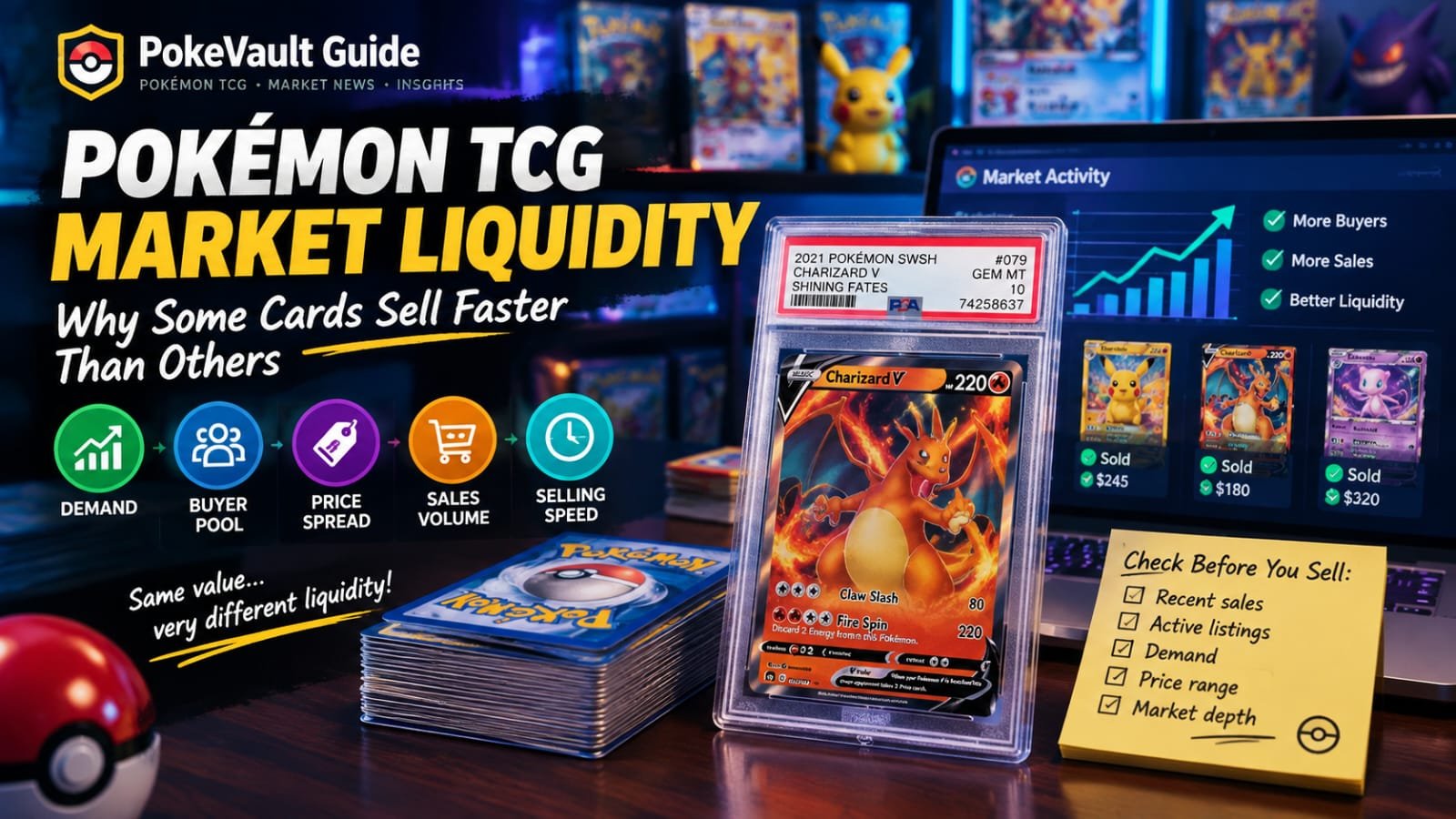
Pokémon TCG Market Liquidity: Why Some Cards Sell Faster Than Others
The difference often comes down to market liquidity — a concept that helps explain how easily a Pokémon card can move from one owner to another without requiring a major price adjustment.
When collectors talk about Pokémon card prices, the conversation usually focuses on one number: how much a card is worth. But price is only one part of the secondary market.
Another important question is much simpler: How easy would it be to sell this card if you needed to?
That question is where liquidity becomes useful.
In the Pokémon TCG market, some cards have hundreds of active listings, frequent sales, multiple interested buyers, and a steady stream of completed transactions. Other cards may have a high listed price but very few actual buyers.
Understanding that difference can help collectors read market activity more carefully, compare cards more realistically, and avoid confusing a high asking price with strong demand.
What Does Liquidity Mean in the Pokémon TCG Market?
Liquidity describes how easily an asset can be bought or sold without causing a significant change in its market price.
In the Pokémon TCG, a highly liquid card generally has several characteristics: buyers are actively looking for it, sellers regularly list it, transactions happen frequently, and there is enough market activity to establish a relatively clear price range.
A less liquid card can still be rare and valuable. The difference is that finding a buyer may take longer, and the seller may have to adjust the price to complete the transaction.
| Market Characteristic | Higher Liquidity | Lower Liquidity |
|---|---|---|
| Sales Frequency | Frequent completed sales | Few completed transactions |
| Buyer Interest | Many active buyers | Smaller buyer pool |
| Price Discovery | Clearer market range | Harder to establish a reliable range |
| Time to Sell | Often shorter | Often longer |
| Price Flexibility | Smaller adjustment may be needed | Larger discount may be required |
Liquidity should therefore be viewed as a market characteristic, not as a measure of whether a card is good or bad.
Why Liquidity Matters More Than a Price Tag Suggests
Imagine two Pokémon cards are both listed for $500.
The first card has dozens of recent sales, multiple sellers, and collectors searching for it every day. The second card has only a handful of transactions and several sellers who have kept their copies listed for months.
Although both cards have a $500 asking price, the market around them is very different.
If you suddenly need to sell the first card, there may be several realistic ways to find a buyer. With the second card, you may have to wait or lower your asking price.
Liquidity vs. Value: They Are Not the Same Thing
One of the biggest mistakes new collectors make is assuming that a more expensive card must automatically be easier to sell.
That isn’t necessarily true.
Value measures the price level associated with a card. Liquidity describes how easily the market can absorb that card at a reasonable price.
A common modern chase card can sometimes have stronger liquidity than a much rarer vintage card simply because many more collectors recognize it, search for it, and transact around it.
| Factor | What It Measures |
|---|---|
| Market Value | The price associated with recent or current transactions |
| Liquidity | How easily the card can be sold in the market |
| Rarity | How limited the card or available supply is |
| Demand | How many buyers actively want the card |
| Volatility | How quickly and significantly the market price changes |
The Five Main Factors That Influence Pokémon Card Liquidity
1. Number of Active Buyers
The most obvious liquidity driver is the size of the buyer pool.
A Pokémon card connected to a popular character, iconic artwork, competitive strategy, or major collecting theme can attract buyers from several different groups at the same time.
For example, a card might appeal to character collectors, set builders, competitive players, investors, and graded-card collectors. A wider potential audience can create more opportunities for transactions.
2. Frequency of Completed Sales
Sales frequency is one of the most useful clues when evaluating liquidity.
If a card regularly appears in completed-sales data, the market has more information about what buyers are actually willing to pay.
By contrast, if months pass between meaningful transactions, the last recorded sale may not represent what the card could realistically sell for today.
3. Number of Available Sellers
Liquidity is not only about buyers. Sellers matter too.
A market with several active sellers provides buyers with choices. This can make price discovery more competitive because buyers can compare condition, grading, language, seller reputation, and asking price.
4. Price Spread
The difference between what sellers want and what buyers are prepared to pay can also reveal information about market depth.
A narrow difference between competitive listings and recent transaction prices can indicate a more established market. A large gap may indicate uncertainty, limited demand, or simply that sellers are testing higher prices.
5. Condition and Grading
Condition can dramatically change liquidity.
Raw copies, PSA-graded copies, other graded slabs, damaged examples, and near-mint copies can all have different buyer pools.
A collector searching specifically for a PSA 10 may have little interest in a raw copy even if both cards feature the same artwork.
How to Measure Pokémon TCG Liquidity
You do not need complicated financial software to get a useful picture of a Pokémon card’s liquidity. A basic market check can reveal a surprising amount of information.
The key is to look at several signals together instead of relying on one number.
Sales Volume
Start by checking how many copies have actually sold recently.
A card with frequent completed transactions provides more evidence about current demand than a card that has only one recent sale.
High sales volume does not automatically mean that prices will increase. It simply tells you that buyers and sellers are actively interacting in that market.
Recent Sale Frequency
Next, look at how regularly transactions occur.
If you can see multiple completed sales across recent days or weeks, the card has a more active market than one that appears to trade only occasionally.
This becomes particularly important for expensive cards. A $2,000 card that sells every few days has a very different liquidity profile from a $2,000 card that sells once every few months.
Active Listings
Count the number of available copies, but don’t stop there.
Ten listings do not necessarily mean ten serious sellers. Some listings may be priced far above recent transactions and may remain unsold for long periods.
Compare asking prices with completed sales whenever possible.
Price Consistency
Look at recent transactions and identify the general price range rather than focusing on one unusually high or low sale.
A consistent transaction range makes it easier to understand what the market currently accepts.
When recent sales are extremely scattered, the market may be reacting to differences in condition, grading, language, seller reputation, or simply low transaction volume.
| Signal | What to Look For | Why It Matters |
|---|---|---|
| Recent Sales | Multiple completed transactions | Shows actual buyer activity |
| Sales Frequency | Regular transactions | Shows market activity over time |
| Listings | Multiple active sellers | Shows available supply |
| Price Range | Relatively consistent sales | Improves price discovery |
| Buyer Pool | Multiple collector groups | Can support stronger demand |
What Is Market Depth?
Market depth describes how much buying and selling activity exists around different price levels.
In a deep market, there may be many participants willing to transact around the current price. In a shallow market, a small number of transactions can have a much larger effect on the visible market price.
This concept is useful when looking at rare Pokémon cards.
Suppose a card has only a few known copies available for sale. One seller lists a copy at $10,000, and another lists one at $12,000. That does not necessarily mean the market value is $11,000.
There may simply not be enough transactions to establish a strong market range.
A deep market has many participants and frequent transactions.
A shallow market has fewer participants, fewer transactions, and greater uncertainty around the price.
Why Rare Does Not Always Mean Liquid
Rarity and liquidity are often confused because both are important to collectors, but they describe different things.
A card can be extremely scarce while having a relatively small group of potential buyers.
This can happen with unusual promotional cards, obscure variants, low-population graded cards, regional releases, or cards with very specialized collector interest.
On the other hand, a card with a much larger supply can still have strong liquidity if thousands of collectors actively want it.
This creates an important distinction:
| Market Type | Supply | Buyer Pool | Potential Liquidity |
|---|---|---|---|
| Rare + Popular | Low | Large | Can be highly active |
| Rare + Niche | Low | Small | Can be slower |
| Common + Popular | High | Large | Can still be highly active |
| Common + Low Demand | High | Small | Often slower |
How Grading Changes Liquidity
Grading creates separate markets within the same Pokémon card.
Consider a hypothetical chase card available as a raw near-mint copy, PSA 9, and PSA 10. These three versions may attract different buyers.
Some collectors prefer raw cards because they want to inspect them personally. Others specifically search for PSA 10 copies. Some buyers may target PSA 9 cards because they want a graded example without paying the premium associated with the highest grade.
As a result, grading doesn’t simply change the price. It can change the audience for the card.
Modern Cards vs. Vintage Cards: Different Liquidity Profiles
Modern and vintage Pokémon cards can behave very differently in the secondary market.
Modern cards often benefit from large online communities, frequent new listings, active set collectors, and easily accessible market data. This can produce frequent transactions even when supply is relatively high.
Vintage cards can have stronger scarcity but a smaller number of available copies. High-end examples may trade less frequently because fewer buyers can participate at the required price.
That does not mean one category is automatically more liquid than the other. Liquidity depends on the specific card, price level, condition, grading, language, and current collector interest.
How Set Popularity Can Influence Liquidity
A Pokémon card does not exist in isolation. The popularity of its set can affect how many collectors search for it.
Cards from sets with strong collector recognition may benefit from multiple sources of demand. Master-set builders, character collectors, investors, and players can all contribute to the market.
But popularity can also change quickly. New releases, reprints, competitive rotation, special products, and collector trends can shift attention from one set to another.
This is why liquidity should be monitored as a moving market characteristic rather than treated as a permanent label.
How Reprints Can Change Liquidity
Reprints are one of the clearest examples of how supply can affect market activity.
When additional product enters the market, the number of available copies can increase. That can create more listings, more transactions, and potentially greater competition between sellers.
The effect is not necessarily identical across every card in a set.
Some cards may experience a significant increase in supply, while others remain difficult to pull. Graded copies can also behave differently from raw copies because the supply of already graded cards depends on the grading process and existing population.
This is why looking only at a set’s total print volume does not tell you the entire liquidity story for every individual card.
Why High Listing Counts Can Be Misleading
Imagine searching for a Pokémon card and finding 200 listings.
At first glance, that might look like an extremely active market. But what if 150 of those listings are priced substantially above recent completed sales?
The number of listings alone cannot tell you how quickly cards are actually moving.
This is one of the most important concepts when researching Pokémon TCG markets: supply for sale is not the same thing as supply that is actually selling.
Active listings = what sellers are asking.
Completed sales = what buyers actually paid.
What Makes a Pokémon Card Easier to Sell?
There is no single formula that guarantees a quick sale, but several characteristics can make a card easier for buyers to understand and compare.
- Recognizable Pokémon: Popular characters can attract a broader collector audience.
- Strong artwork: Visually distinctive cards can generate interest beyond competitive play.
- Established market history: Frequent transactions make pricing easier to understand.
- Clear condition: Buyers can compare the card more easily when condition is well documented.
- Widely recognized grading: Established slab categories can make comparison easier.
- Competitive pricing: A realistic asking price can reduce the time needed to find a buyer.
- Good marketplace visibility: Clear photographs and accurate descriptions help buyers evaluate the listing.
How Sellers Can Improve Their Chances of a Faster Sale
Liquidity is a market characteristic, but sellers can still influence how efficiently their individual listing performs.
Use Clear Photos
Show the front, back, corners, edges and any relevant condition issues. For graded cards, include a readable photograph of the entire slab label.
Describe the Exact Version
Specify the card number, set, language, condition and grading company when applicable. This makes it easier for buyers to compare your listing with other copies.
Check Completed Sales Before Setting a Price
Don’t base your asking price entirely on the highest active listing. Look at recent completed transactions and compare cards with similar condition and grade.
Understand the Difference Between Asking Price and Sale Price
A seller can list a card for any amount. A completed transaction provides stronger evidence that a buyer actually accepted a particular price.
Price According to the Market Segment
A raw near-mint card should generally be compared with similar raw near-mint sales, while a PSA 10 should be compared with other PSA 10 transactions.
A Simple Pokémon TCG Liquidity Checklist
✓ How many copies sold recently?
✓ How frequently are sales happening?
✓ How many active listings exist?
✓ What prices are those listings asking?
✓ What prices were actually paid?
✓ Is the card raw or graded?
✓ How large is the potential buyer pool?
✓ Are recent prices relatively consistent or widely scattered?
Liquidity Does Not Predict Future Price
One important distinction deserves special attention: liquidity and price direction are different concepts.
A highly liquid card can fall in price. A highly liquid card can also rise in price. Likewise, a rare card with very little trading activity can experience a large price change when a transaction finally occurs.
Liquidity tells you about the ease and frequency of transactions. It does not tell you whether the next transaction will be higher or lower.
This distinction is especially important when reading Pokémon TCG market news. A rise in sales volume does not automatically mean prices must rise, and a decline in transaction volume does not automatically mean prices must fall.
Liquidity vs. Volatility
These two terms are often mentioned together but describe different things.
| Concept | Question It Answers |
|---|---|
| Liquidity | How easily can the card be bought or sold? |
| Volatility | How much can the price move over time? |
| Demand | How strongly do buyers want the card? |
| Supply | How many copies are available? |
| Market Depth | How much buying and selling activity exists around current prices? |
A card can therefore have high liquidity and high volatility at the same time. It may trade frequently while its price changes rapidly.
Related Pokémon TCG Market Guides
Liquidity is closely connected to several other market concepts covered on PokeVault Guide. These resources can help you understand the bigger picture:
- Pokémon TCG Market Update: Modern Set Valuations and Investor Trends
- Pokémon TCG Print Runs & Out-of-Print (OOP) Market Impact Guide
- Pokémon TCG Market Trends: Eeveelutions & Mega Evolution Cards Price Surge Analysis
- Pokémon TCG Market Report: Sealed Product Trends & Card Value Shifts
Frequently Asked Questions
What does liquidity mean in Pokémon TCG?
Liquidity describes how easily a Pokémon card can be bought or sold without requiring a major adjustment to its market price. Frequent sales, active buyers and sellers, and clear price discovery generally indicate a more active market.
How can I tell if a Pokémon card is liquid?
Check recent completed sales, transaction frequency, active listings, price ranges, and the size of the potential buyer pool. Don’t rely on the number of listings alone.
Does a high Pokémon card value mean high liquidity?
No. A valuable card can have a small buyer pool and infrequent transactions. Price and liquidity measure different characteristics of the market.
Are popular Pokémon cards more liquid?
Popular Pokémon can attract a larger potential audience, which can support more active markets. However, liquidity still depends on the specific card, version, grade, condition and current demand.
Does rarity increase liquidity?
Not necessarily. Rarity limits supply, but liquidity also depends on demand and transaction frequency. A very rare card with a small buyer pool can be less liquid than a widely available card with strong demand.
Are graded Pokémon cards more liquid than raw cards?
There is no universal rule. Graded and raw cards serve different buyer groups. A particular grade may have strong demand in one market segment while raw copies may trade more frequently in another.
Should I use active listings to determine a Pokémon card’s value?
Active listings can provide useful context, but completed sales are generally more informative when trying to understand what buyers have actually paid. Sellers can list cards at prices that do not result in transactions.
Can liquidity change over time?
Yes. Pokémon TCG liquidity can change as collector interest, set popularity, new releases, reprints, competitive demand, grading populations and available supply change.
Final Takeaway
The Pokémon TCG market is not just about asking prices. To understand how a card actually behaves in the marketplace, you also need to look at liquidity, sales frequency, demand, supply, market depth and completed transactions.
A card with frequent sales and a large buyer pool can be easier to move than a rarer card with very limited demand. Likewise, a high number of listings does not automatically mean that a card has strong liquidity if those listings are not converting into actual sales.
The simplest approach is to look beyond the headline price.
Check what is selling, how often it is selling, who is buying it, and how closely actual transactions cluster around the current market range.
Once you start viewing Pokémon cards through both value and liquidity, market reports become easier to interpret and price movements become easier to put into context.