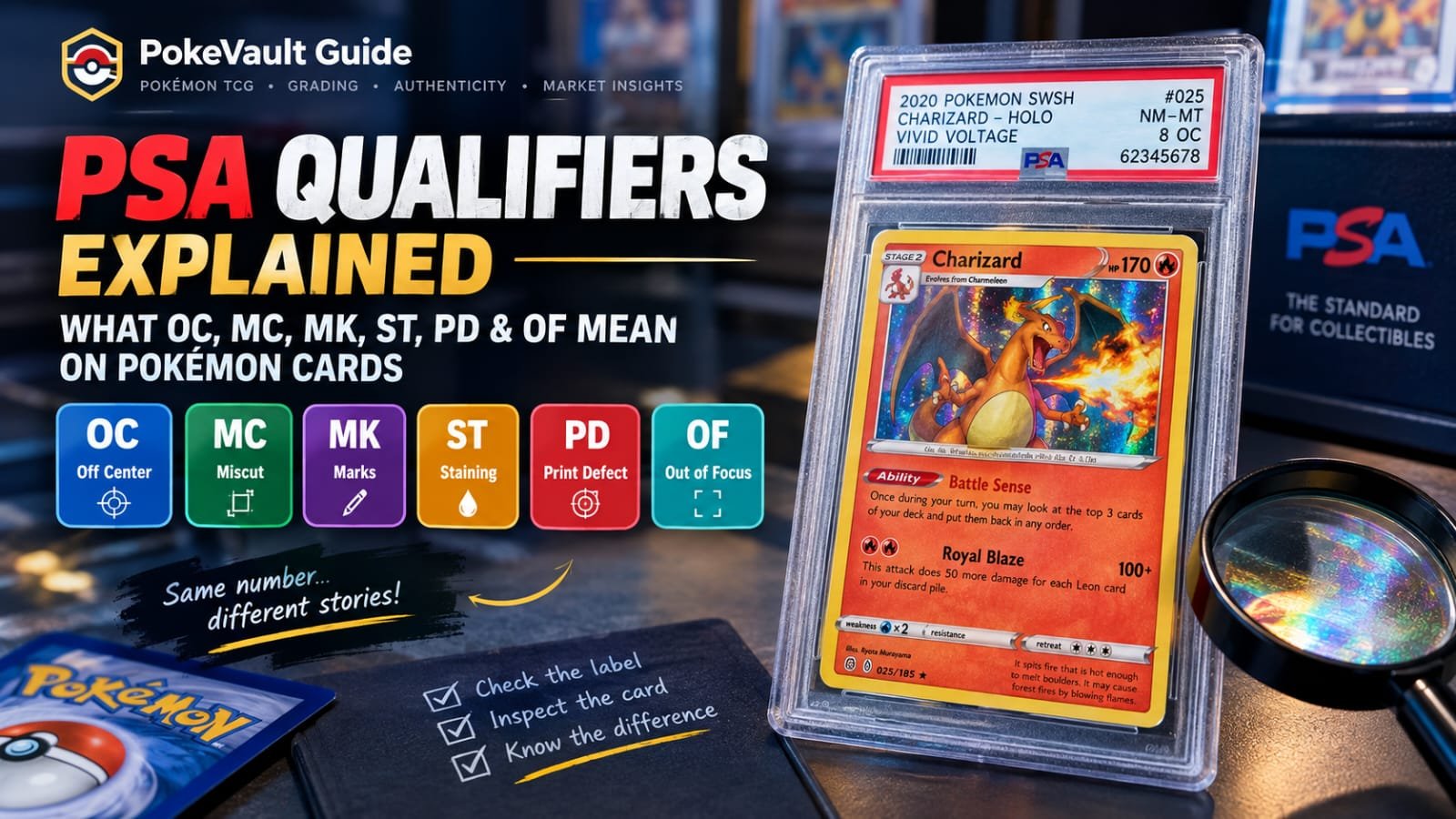
PSA Qualifiers Explained: What OC, MC, MK, ST, PD & OF Mean on Pokémon Cards
This article explains what each PSA qualifier means, how it can appear on a Pokémon card, what to inspect before submission, and why two cards carrying the same number can still have very different condition profiles.
Seeing a number such as PSA 9 is straightforward. But once letters appear next to the grade, many collectors are unsure what they are looking at. A label such as 8 OC does not simply mean “a worse PSA 8.” The letters identify a specific condition issue that needs to be understood separately from the numerical grade.
This becomes especially important when buying older Pokémon cards, factory-error cards, unusual cuts, or cards that have visible defects. A qualifier can explain something that the numerical grade alone does not communicate.
OC = Off Center
MC = Miscut
MK = Marks
ST = Staining
PD = Print Defect
OF = Out of Focus
What Is a PSA Qualifier?
A PSA qualifier is an additional designation used when a card meets the general characteristics of a particular numerical grade but has a significant issue in one specific area.
For example, imagine a vintage Pokémon card with clean corners, strong edges, and a very clean surface, but the printing is noticeably shifted toward one side. Instead of the number alone telling the whole story, a qualifier can identify the centering issue.
The important distinction is that qualifiers are not the same thing as numerical grades. The number describes the overall grade level, while the letters provide additional information about a particular characteristic or defect.
| Code | Meaning | What It Usually Points To |
|---|---|---|
| OC | Off Center | Uneven card borders or centering |
| MC | Miscut | Unusual factory cut, sometimes showing part of another card |
| MK | Marks | Writing, ink, pencil or evidence of marking |
| ST | Staining | Visible staining or discoloration |
| PD | Print Defect | Manufacturing or printing imperfections |
| OF | Out of Focus | Printing that lacks proper focus or registration |
Why Pokémon Collectors Should Understand Qualifiers
Qualifiers matter because a graded card is not defined by its number alone. When you’re comparing raw and graded Pokémon cards, understanding the exact reason behind a grade can help you avoid misreading a listing.
For example, a collector may see a PSA 8 and assume that the card has ordinary wear consistent with a PSA 8. But a PSA 8 with an additional qualifier may have a very different condition profile from a standard PSA 8.
This is particularly useful when shopping for vintage Pokémon cards. Older cards can have factory cutting variations, print inconsistencies, staining, or other characteristics that are less obvious from a single photograph.
PSA Qualifiers vs. Normal Numerical Grades
A numerical grade such as PSA 6, PSA 8, or PSA 10 communicates the card’s overall condition according to PSA’s grading process. A qualifier adds another layer of information.
That distinction is useful when reading auction listings. A seller might describe a card as “PSA 8” while the label actually contains an additional designation. Always look at the complete slab label rather than relying only on the headline of a listing.
For buyers, this is one reason high-resolution photographs of the actual slab are valuable. The label can reveal information that a generic product description leaves out.
PSA Qualifiers at a Glance
| Qualifier | Main Question to Ask | Where to Inspect the Card |
|---|---|---|
| OC | Are the borders noticeably uneven? | Front and back borders |
| MC | Does the factory cut look abnormal? | Edges and corners |
| MK | Does the card show writing or marking? | Entire card surface |
| ST | Is there visible staining or discoloration? | Front, back and edges |
| PD | Does the printing contain a noticeable defect? | Artwork, text and holo areas |
| OF | Does the printed image look out of focus? | Text, artwork and print registration |
In the next section, we’ll break down each qualifier individually and explain the practical signs collectors can look for before buying or submitting a Pokémon card.
OC — Off Center
OC means Off Center. It refers to a card whose printed borders are noticeably uneven from one side to another. Centering is one of the most familiar condition factors in Pokémon TCG grading, but an OC designation is specifically important because it identifies a centering issue on the graded card.
For example, a card might have a much wider left border than its right border. The same can happen vertically, with a larger top border and a smaller bottom border.
Before sending an expensive card for grading, measure both the front and back rather than judging centering only by eye. A card can look centered when held at an angle but reveal a meaningful difference when placed against a straight edge or centering tool.
MC — Miscut
MC means Miscut. This is different from ordinary off-centering. A miscut involves an atypical factory cut. In some cases, the cut can reveal part of another card, an unusual border shape, or a portion of the neighboring card on an original print sheet.
That distinction is important for collectors. A card that is simply shifted toward one side is a centering issue. A card showing evidence of an unusual cutting process can fall into the miscut category.
Miscut Pokémon cards can also attract collectors specifically because the manufacturing error itself becomes part of the card’s identity. However, you should not assume that every unusual edge automatically qualifies as MC. Factory variation, rough cuts and actual miscuts are not necessarily identical.
| Appearance | Possible Issue | What to Check |
|---|---|---|
| One border slightly wider | Centering | Measure opposite borders |
| Part of neighboring card visible | Potential miscut | Inspect the cut and print sheet alignment |
| Unusual edge shape | Potential manufacturing variation | Compare with known examples from the same set |
| Rough or uneven factory edge | Factory cutting issue | Check whether the issue affects the entire edge |
MK — Marks
MK means Marks. PSA uses this designation for cards showing writing, ink marks, pencil marks, or evidence of an impression left by writing.
This is one of the easiest qualifiers to understand because the defect can often be seen directly. A previous owner may have written initials, numbers or notes on the card, while older cards can sometimes have marks associated with previous storage or handling.
However, not every dark spot on a Pokémon card should automatically be called a mark. Printing defects, stains, ink transfer and surface damage can look similar in photographs. When buying online, request clear close-up photographs instead of relying on a seller’s description.
ST — Staining
ST means Staining. Stains can result from contact with liquids, moisture, storage conditions, grime or other substances that leave visible discoloration.
Staining can be particularly difficult to judge in online photographs because lighting can hide or exaggerate discoloration. A card may appear clean under bright white lighting but show a darker patch under a different angle.
When checking a raw Pokémon card, inspect the front and back separately. Look around the edges, corners, holo areas and lighter sections of the artwork where discoloration can be easier to notice.
Also remember that natural aging and actual staining are not always visually identical. Vintage Pokémon cards can show changes in color because of age, storage or exposure to light. Comparing the card with other authentic examples from the same set can help you understand whether what you’re seeing is normal variation or a specific condition issue.
PD — Print Defect
PD means Print Defect. This category relates to imperfections introduced during the printing process rather than ordinary wear caused by handling.
Pokémon cards can sometimes leave the factory with visible printing imperfections. These may include ink irregularities, print spots, alignment problems, missing or unusual printed details, or other manufacturing inconsistencies.
This is especially relevant to collectors who assume that a freshly opened card must automatically be a perfect grading candidate. A pack-fresh card can still contain a manufacturing defect.
| Possible Print Issue | What It Can Look Like |
|---|---|
| Ink spot | Small unwanted dot or colored area |
| Color irregularity | Unexpected shade or uneven ink coverage |
| Registration issue | Printed elements appear slightly misaligned |
| Missing print detail | Part of an expected printed element appears absent |
| Factory print line | Visible line running through a printed or holo area |
OF — Out of Focus
OF means Out of Focus. This refers to a card where the printed image does not meet the expected focus or registration standard.
At first glance, this can be difficult to identify because the card itself may be perfectly flat and physically clean. The issue is with the printed image rather than a scratch, dent or corner problem.
Look closely at small text, Pokémon names, attack descriptions, energy symbols and fine artwork details. If those elements appear unusually soft or improperly registered compared with another copy of the same card, the card may have a printing-related issue.
Which Qualifiers Are Required and Which Are Optional?
PSA currently separates its qualifiers into two groups. MK and MC are required qualifiers, while OC, ST, PD and OF are optional qualifiers. PSA explains that some of the optional conditions can instead be reflected directly in the numerical grade, depending on the grading assessment.
This means collectors should not assume that every off-center or print-defect card will necessarily receive the corresponding letters on its label. The final result depends on PSA’s grading process and the specific condition of the card.
This is an important distinction from simple online grading calculators. A calculator can help you inspect a card, but it cannot reproduce every decision made during an actual professional grading review.
How to Inspect a Pokémon Card for Qualifiers Before Grading
Before submitting a valuable Pokémon card, use a repeatable inspection process. The goal is not to predict the exact PSA result. Instead, you’re trying to identify characteristics that could affect how the card is evaluated.
1. Inspect the Front Under Direct Light
Start with the front of the card under bright, even lighting. Tilt the card slowly rather than staring at it from one fixed angle. Look for stains, print irregularities, scratches, unusual lines and registration problems.
2. Check the Back Separately
Turn the card over and repeat the inspection. The Pokémon card back can reveal centering differences, stains, marks and edge issues that are not obvious from the front.
3. Use Magnification for Small Defects
A simple magnifying lens can help identify small ink spots, print irregularities and surface problems. Magnification should be used to inspect the card, not to physically manipulate the surface.
4. Compare With Another Copy
This is one of the most useful techniques for identifying manufacturing defects. If you have another copy of the same Pokémon card, compare the two side by side.
If the same unusual feature appears on both copies in exactly the same location, it may be part of the printing process rather than damage to one individual card.
5. Photograph the Card Before Submission
Take clear photographs of the front, back and any unusual areas before sending a valuable card away. This creates a useful record of the card’s condition at the time of submission.
✓ Check front centering
✓ Check back centering
✓ Inspect all four edges
✓ Inspect all four corners
✓ Look for writing or marks
✓ Look for stains or discoloration
✓ Check for print defects
✓ Compare unusual features with another copy
How Qualifiers Affect the Way You Read a Graded Card
When buying a graded Pokémon card, don’t stop at the number. Read the complete label.
A standard numerical grade communicates one part of the evaluation. A qualifier can provide additional context about a specific issue. This is particularly useful when comparing cards from the same set.
| Label Example | What You Should Ask |
|---|---|
| PSA 9 | What condition characteristics support the grade? |
| PSA 8 OC | How noticeable is the centering issue? |
| PSA 7 MC | What does the factory miscut look like? |
| PSA 6 MK | Where is the mark and how obvious is it? |
| PSA grade with ST | Where is the staining and how extensive is it? |
This is why two cards with similar numbers should not automatically be treated as identical condition examples. The complete grading designation gives you more information than the number alone.
Qualifiers and Pokémon Card Buying Decisions
If you’re buying a graded card online, qualifiers are particularly important because photographs can hide condition details. Always zoom in on the slab label and read every character.
For example, a seller may advertise a card prominently as a “PSA 8,” but the actual label could contain an additional designation. That doesn’t automatically make the card undesirable. It simply means you should understand exactly what the designation refers to before comparing it with another copy.
The same principle applies to auction listings. Search results can group cards primarily by their numerical grades, while the complete label provides the more precise description.
Related PokeVault Guide Resources
If you’re preparing a Pokémon card for grading, these related resources can help you build a more complete inspection process:
- Pokémon Card Pre-Grading Guide: How to Inspect Your Cards Before Submitting
- How to Measure Pokémon Card Centering: The PSA 10 Submission Guide
- Pokémon Card Grading Guide: PSA vs. BGS vs. CGC
- How to Spot Fake Pokémon Cards: The Authenticity Guide
Frequently Asked Questions
What does OC mean on a PSA Pokémon card?
OC stands for Off Center. It identifies a centering issue where the card’s borders are uneven. PSA may use the OC designation or reflect the centering issue in the numerical grade depending on its grading assessment.
What does MC mean on a PSA card?
MC stands for Miscut. It refers to an atypical factory cut. A miscut can sometimes expose part of another card or create an unusual border or edge pattern.
What does MK mean on a PSA label?
MK stands for Marks. PSA uses it for cards with writing, ink marks, pencil marks, or evidence of an impression caused by writing.
What does ST mean in Pokémon card grading?
ST stands for Staining. It identifies staining on the card. Stains can sometimes be difficult to see in online photographs, so close-up images are useful when buying a graded or raw card.
What does PD mean on a PSA card?
PD stands for Print Defect. It refers to a printing-related imperfection rather than ordinary wear from handling.
What does OF mean on a PSA label?
OF stands for Out of Focus. It refers to a card where the printed image does not meet the expected focus or registration standard.
Does a PSA qualifier mean the card is fake?
No. A qualifier describes a condition or manufacturing characteristic. Authentication and condition grading are separate parts of the evaluation process. A qualified card can still be an authentic Pokémon card.
Can a pack-fresh Pokémon card receive a qualifier?
Yes. Opening a card directly from a booster pack does not guarantee perfect manufacturing quality. Centering differences, print defects, unusual cuts and other factory issues can exist before a card has ever been handled by a collector.
Final Takeaway
PSA qualifiers are easy to overlook, but they can tell you something important that the numerical grade alone does not explain.
OC points to off-centering, MC to an unusual cut, MK to marks, ST to staining, PD to a print defect and OF to an out-of-focus or registration issue.
For collectors, the practical rule is simple: read the entire slab label, not just the number. When buying or submitting a valuable Pokémon card, inspect the front and back under good lighting, compare unusual features with another copy, and document the card’s condition before submission.
Understanding these designations won’t tell you exactly what grade a card will receive, but it will make graded-card listings easier to interpret and help you ask better questions before spending money on a card.