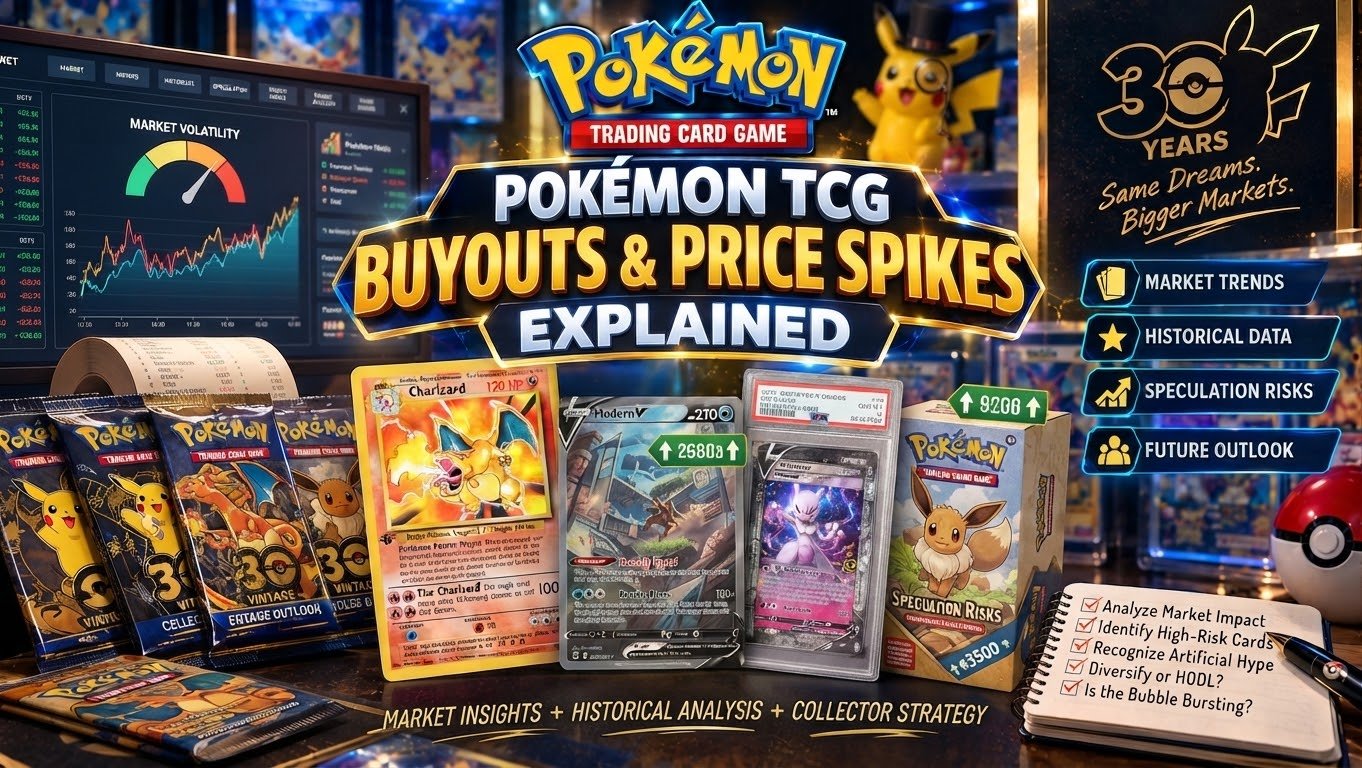
Pokémon TCG Buyouts Explained: How Hype, Scarcity & FOMO Move Prices
The Pokémon TCG market can sometimes change much faster than the cards themselves. A card that has been sitting quietly at $20 can suddenly appear at $40, $60, or even higher within a matter of days. In some cases, that increase reflects genuine new demand. In others, a temporary shortage of available copies can create a price spike that looks much stronger than the underlying demand actually is.
This is where Pokémon TCG buyouts, speculation, scarcity, tournament results, collector hype, and fear of missing out become important.
A price spike is not automatically evidence that a card has permanently become more valuable. Likewise, a sudden increase in sales is not automatically proof of market manipulation. The real challenge is understanding what caused the movement, whether buyers are continuing to support the new price, and whether enough supply exists to make that price sustainable.
This distinction matters because Pokémon cards do not trade like stocks. Every card has a physical supply, different conditions, different printings, different grades, and different groups of buyers. A market can therefore move sharply when only a relatively small number of copies change hands.
In this guide, we will examine how Pokémon TCG price spikes develop, how buyouts work, how genuine demand differs from speculative demand, why some spikes survive while others collapse, and which market signals collectors should examine before treating a new price as established value.
What Is a Pokémon TCG Buyout?
In simple terms, a buyout happens when buyers purchase a significant amount of the available inventory for a particular card, especially at the lower end of the market.
Imagine that a card has the following listings:
| Available Copies | Price |
|---|---|
| 8 copies | $18 |
| 12 copies | $20 |
| 15 copies | $22 |
| 20 copies | $25 |
If a group of buyers purchases most of the $18 and $20 copies, the cheapest visible listing may suddenly become $22 or $25. Other sellers may notice the change and raise their own asking prices.
Nothing about the physical card changed.
The artwork did not change. The card did not become rarer overnight. The printing did not change. What changed first was the available supply at the lower price levels.
That is the basic mechanism behind many sudden market spikes.
Buyout vs. Genuine Demand
One of the most important concepts in Pokémon TCG market analysis is that a large increase in buying activity can have different causes.
| Market Event | Typical Cause | What to Watch |
|---|---|---|
| Organic demand | More collectors or players genuinely want the card | Sustained sales over time |
| Competitive demand | Card becomes important in tournament decks | Playability, deck results and repeated purchases |
| Speculation | Buyers expect future appreciation | Unusually high copies per buyer |
| Buyout | Large amount of available inventory purchased | Sudden supply reduction and price jump |
| News-driven demand | Announcement, new set, character spotlight or reprint news | Timing of the spike relative to the announcement |
These categories can overlap. A card can experience genuine collector demand while also being targeted by speculators. A playable card can become popular with competitive players and simultaneously attract buyers who expect its price to increase.
That is why the word “buyout” should be used carefully. Seeing a price rise is not enough to prove that someone intentionally attempted to manipulate the market.
Why Small Markets Can Move So Quickly
The physical nature of trading cards makes the market especially sensitive to supply changes.
Consider a modern card with only 50 copies currently listed in a particular condition. If ten buyers each purchase several copies, a large percentage of the visible supply can disappear very quickly.
The same event would have a much smaller effect on a card with thousands of active listings.
This creates a simple relationship:
However, a thin supply does not automatically mean the card deserves the new price. It only means that relatively few transactions may be required to change the visible asking-price structure.
The Difference Between a Price Spike and a Real Market Repricing
This distinction is essential.
A price spike is a rapid increase in the observed market price.
A market repricing occurs when buyers continue to transact around the new price range, creating evidence that the market has actually accepted the higher valuation.
For example, imagine a card moves from $30 to $70 after a single day of unusually large purchases.
If sales then fall dramatically and buyers refuse to pay $70, the market may eventually return toward the previous range.
But if the card continues selling at $65–$75 for weeks, new supply enters the market at those levels, and buyers continue absorbing it, the higher range has stronger evidence behind it.
| Signal | Short-Term Spike | More Established Repricing |
|---|---|---|
| Sales | One or few unusually large bursts | Repeated transactions |
| Copies per buyer | May suddenly become very high | More normal purchasing pattern |
| Listings | Can disappear quickly | New supply appears and is absorbed |
| Price | Moves rapidly | Stabilizes around a new range |
| Longer-term evidence | Weak | Stronger |
Why TCGplayer’s Sales Data Matters
One useful source when researching Pokémon TCG price movement is TCGplayer’s Market Price data. TCGplayer explains that its Market Price is based on recent completed sales rather than simply the prices sellers are asking. Its price metrics also include information such as recent sales and market-price volatility.
This is important because an active listing is only an offer. A completed sale demonstrates that a buyer actually accepted a particular price.
For market research, that creates a useful hierarchy:
- Completed sales
- Frequency of completed sales
- Sale-price range
- Active listings
- Highest asking prices
None of these signals should be viewed alone, but together they can provide a much clearer picture of what is happening.
Related Reading
If you want to understand the next layer of Pokémon TCG market behavior, continue with these PokeVault Guide articles:
How a Pokémon TCG Buyout Usually Develops
Most buyouts do not begin with a dramatic headline. They often begin quietly.
A card may already have several characteristics that make it attractive to speculators or collectors: limited supply, a popular Pokémon, strong artwork, an older set, a competitive connection, an upcoming product release, or a recent increase in attention.
Once several buyers begin purchasing copies, the lower-priced inventory can disappear. Other sellers then notice that the cheapest available copies have moved upward. Some sellers respond by raising their prices.
At this stage, the market can enter a feedback loop.
New attention → increased buying → lower-priced listings disappear → visible price rises → more attention → additional buying → sellers adjust prices
The critical question is what happens next.
If genuine demand exists at the new price, the market may stabilize. If demand was primarily speculative, the market may eventually struggle to support the higher level.
Stage 1: The Quiet Accumulation Phase
Before a visible spike, buyers may begin purchasing copies gradually.
For example, instead of one person buying 100 copies in a single transaction, several buyers may purchase three, five, or ten copies over multiple days.
This can be difficult to identify from a simple price chart because the price may barely move at first.
The important signal is often the relationship between sales volume and the number of copies purchased per buyer.
If a card normally sells one or two copies per buyer and suddenly several buyers begin purchasing large quantities, the market deserves closer examination.
Stage 2: The Cheap Listings Disappear
Once enough inventory has been purchased, the lowest listings can disappear.
Suppose the market previously had copies at $25, $27, $29 and $30. If the first three price levels are bought, the next visible copy might suddenly be $35.
From the outside, the card appears to have “jumped” from $25 to $35.
But the physical card itself did not become more valuable overnight. The market simply moved through the available inventory.
This is why supply depth matters so much when interpreting price charts.
| Before Buying Pressure | After Low Listings Are Purchased |
|---|---|
| $20 – 10 copies | Sold |
| $22 – 15 copies | Sold |
| $25 – 20 copies | Sold |
| $28 – 25 copies | Becomes cheapest visible supply |
Stage 3: The Market Notices
Once a card’s visible price rises sharply, more collectors notice it.
This is where psychology can become an important part of the market.
Collectors who were previously unaware of the card may suddenly search for it. Existing owners may become reluctant to sell. Other buyers may decide they need to acquire a copy before the price moves even higher.
This can create additional demand that was not present before the original spike.
At the same time, some owners may see the price increase as an opportunity to sell.
The result is a competition between two forces:
- New buyers trying to acquire copies.
- Existing owners deciding whether the new price is attractive enough to sell.
This is one reason a spike can sometimes continue even after the initial buyout activity has ended.
Stage 4: The Market Tests the New Price
This is the most important stage.
Once the cheap copies are gone, the market has to determine whether buyers are actually willing to pay the new price.
If sellers list copies at $60 but buyers only want to pay $40, the $60 number has limited meaning.
If copies repeatedly sell at $55–$60, the market has much stronger evidence that buyers have accepted the new range.
Stage 5: Correction or Stabilization
After the initial excitement, the market can move in several directions.
| Outcome | What It Can Mean |
|---|---|
| Price holds | Demand continues around the higher range |
| Small correction | Initial hype fades but the card retains some gains |
| Large correction | The initial spike was not fully supported by continuing demand |
| Slow decline | Supply returns while buyer interest weakens |
| Second spike | A new catalyst creates additional demand |
Real 2026 Example: Gouging Fire ex
TCGplayer’s June 2026 price-trends report provides a useful example of how transaction behavior can reveal unusual buying activity.
According to TCGplayer, Gouging Fire ex experienced a sales day on May 28 with roughly eight times its daily average for the year. The average number of copies purchased per buyer also reached about 13. TCGplayer described this pattern as suggesting a deliberate buyout.
Importantly, the story did not end with the initial spike. TCGplayer noted that the card continued gaining value afterward because supply remained low, while only a small number of listings were below its Market Price at the time of the report.
This example illustrates why a buyout and organic demand are not always mutually exclusive.
An initial unusual purchase pattern can reduce supply. Once supply is reduced, genuine buyers may enter the market and keep the price elevated.
Real 2026 Example: Iron Valiant ex
Iron Valiant ex provided another example in the same TCGplayer report.
TCGplayer reported that the card appeared to have been bought out on May 28, with the average number of copies per buyer reaching 10. That activity helped trigger a rapid price increase.
But the report also showed that the market still had listings below Market Price later on.
This is an important lesson: a price spike is an event, not a conclusion.
To determine whether the new price is durable, you need to observe what happens after the initial buying burst.
Real 2026 Example: Pikachu & Zekrom-GX
Another particularly interesting case involved Pikachu & Zekrom-GX.
TCGplayer reported that after information about the 30th anniversary set revealed that the card would be reprinted in a Classic Collection subset, buyers purchased more copies in one day than the card normally sold in a month.
The resulting price spike did not last. TCGplayer reported that the card subsequently lost around $40 from its peak and continued declining at the time of the report.
This is a powerful example because it demonstrates that a huge increase in transaction activity does not automatically create permanent value.
In fact, the market can react to news in the opposite direction of what a casual observer might expect. Information about a reprint can cause buyers to rush into the existing supply before new product becomes available, while the eventual increase in supply can later put downward pressure on the price.
Real 2026 Example: Rayquaza V Alternate Full Art
Rayquaza V’s Alternate Full Art provides an even more complicated example.
TCGplayer reported that the card experienced a buyout in August 2025, when the number of copies purchased in a single day exceeded the number sold during the previous five months, with an average of 33.1 copies per buyer.
The card initially spiked, then settled back down before rising again in 2026.
What makes this example especially useful is that TCGplayer noted that the later rise was not accompanied by another comparable buyout.
That means the market cannot be explained simply by saying “a buyout happened, therefore the price rose.”
It demonstrates the importance of separating:
- the original supply shock,
- the initial price reaction,
- the later market behavior,
- and the underlying level of collector demand.
Buyouts and Competitive Pokémon TCG
Not every spike is driven by collectors.
Competitive play can create extremely strong demand for cards because players often need multiple copies rather than one.
A collector may want one copy of an illustration rare. A competitive player may need a playset.
This difference can dramatically change the demand equation.
When a card becomes important in a successful deck, demand can increase rapidly because hundreds or thousands of players may suddenly want copies at the same time.
TCGplayer’s 2026 sales reports have repeatedly illustrated this relationship between playability and demand. For example, its July report identified Meowth ex as an important playable from Perfect Order and noted that players require playsets. TCGplayer also highlighted other cards whose demand was connected to competitive use.
| Collector Demand | Player Demand |
|---|---|
| Often wants 1–2 copies | May need a playset |
| Artwork can be the main attraction | Functionality matters heavily |
| Demand may be long-term | Demand can change with the metagame |
| Character popularity matters | Tournament performance can matter |
Rotation Can Create Strange Price Behavior
Standard rotation is another market catalyst that collectors should understand.
Official Pokémon rules explain that cards rotate out of Standard based on their regulation mark, while certain reprints with current regulation marks can remain legal.
In 2026, Pokémon TCG Live moved cards with the G regulation mark out of Standard beginning March 26, while the relevant competitive transition for physical play followed the 2026 rotation schedule.
Rotation can affect prices in several different ways.
A card that loses competitive demand may decline because players no longer need it for Standard decks. At the same time, a card leaving Standard can sometimes become more attractive to collectors if the market expects less future reprinting or if the card becomes associated with a completed era.
Therefore, rotation should not be treated as an automatic “price goes down” event.
Related Reading
For more context on the forces behind these price movements, see:
How to Tell a Healthy Price Increase From a Speculative Spike
One of the hardest questions in the Pokémon TCG market is whether a rising card is experiencing genuine long-term demand or simply temporary speculation.
There is no perfect formula. Markets are messy, and the same card can move for several reasons simultaneously.
However, there are several signals that can help collectors separate stronger evidence from weaker evidence.
Signal 1: Sales Continue After the Initial Spike
This is one of the most useful signals.
If a card suddenly jumps from $30 to $70 but barely sells afterward, the new price has not been strongly validated.
If the card continues generating transactions at $60–$70 for several weeks, the evidence is stronger that buyers genuinely accept the higher range.
Signal 2: New Supply Is Being Absorbed
A strong market does not necessarily require a permanently empty marketplace.
In fact, one of the healthiest signs of sustained demand can be the opposite: new sellers continue listing copies, and buyers continue purchasing them.
This creates an ongoing cycle:
By contrast, if sellers continue adding inventory while buyers disappear, downward pressure can develop.
Signal 3: The Buyer Base Is Diverse
A card supported by multiple types of collectors can have a more complicated but potentially more resilient demand structure.
For example, a card may appeal to:
- competitive players,
- character collectors,
- master-set builders,
- graded-card collectors,
- sealed-product collectors,
- Pokémon investors and speculators.
When demand comes from several groups, a decline in one group may not completely eliminate demand.
Signal 4: The Card Has a Clear Reason for Increased Demand
A price increase becomes easier to understand when there is a visible catalyst.
Examples include:
- a successful competitive deck,
- a major tournament result,
- a new Pokémon game or product bringing attention to a character,
- a new set interacting with an older card,
- a confirmed reprint or scarcity event,
- a major anniversary or collector milestone,
- new grading or collecting interest.
The existence of a catalyst does not guarantee that the new price will last. It simply provides a plausible explanation that can be tested against subsequent sales data.
What Is FOMO in the Pokémon TCG Market?
FOMO means fear of missing out.
In a trading-card market, FOMO can occur when buyers see a card rising rapidly and become concerned that waiting will make the card unaffordable.
The buyer may therefore purchase the card not because they previously wanted it at $30, but because they are afraid it will cost $50 tomorrow.
This can add another layer of demand to an already rising market.
Price rises → attention increases → buyers fear further increases → additional purchases → supply falls → price rises again
FOMO does not mean that every buyer is irrational. A collector may have a genuine reason to buy a card today. The important point is that rapidly rising prices can change buyer behavior and accelerate market activity.
Why Social Media Can Accelerate a Spike
Pokémon TCG cards are highly visible online. A card can receive sudden attention from YouTube videos, social media posts, marketplace discussions, tournament coverage, collecting communities, or popular Pokémon content.
When thousands of collectors receive the same information around the same time, the demand response can be much faster than the physical supply response.
A card cannot suddenly produce 10,000 additional copies simply because social media attention increased.
That mismatch between fast information and slow physical supply is one reason collectible markets can move sharply.
However, social attention alone does not prove that a price will continue rising.
Why the Highest Listing Is Usually a Bad Market Signal
Suppose the cheapest copies of a card are $50, but one seller lists a copy for $500.
It would be misleading to say that the card is worth $500 simply because that listing exists.
The same problem occurs after buyouts.
Once low-priced copies disappear, the remaining sellers may list their cards at much higher prices. The visible market price can therefore move faster than actual completed sales.
This is why completed transactions are so important.
| Data Point | What It Tells You | Limitation |
|---|---|---|
| Highest listing | What one seller wants | May never sell |
| Lowest listing | Cheapest visible supply | May disappear quickly |
| Most recent sale | Latest observed transaction | One sale can be unusual |
| Multiple recent sales | Stronger evidence of market activity | Still depends on condition and version |
| Sales over time | Shows whether demand persists | Requires patience |
How eBay Data Can Help Confirm a Spike
TCGplayer is not the only useful source of transaction information.
eBay’s Product Research tools provide historical sales information across millions of items, including average sale price, sold-price ranges, seller counts and sell-through information. eBay states that its Product Research can access up to three years of sales data.
This can be useful because a Pokémon card may behave differently across marketplaces.
For example, a card may show a sharp increase on one platform while eBay transactions remain relatively quiet. That does not automatically mean one source is wrong. Different marketplaces have different buyer populations, fees, geographic reach, inventory and transaction patterns.
The stronger approach is to treat marketplace data as separate windows into the same market.
Using Cardmarket for European Market Context
For collectors in Europe, Cardmarket can provide an additional market reference.
Cardmarket describes itself as Europe’s largest marketplace for trading card games and provides Pokémon listings, trends, products and individual card pricing.
Its price information can be particularly useful when researching European market conditions rather than relying exclusively on US-dollar prices.
This is especially important because currency, shipping costs, taxes, seller locations, availability and regional demand can all influence the final price a collector actually pays.
Why Marketplace Differences Matter During a Spike
A price spike on one marketplace should not automatically be treated as a universal global price.
Suppose a card is $80 on one platform and €65 on another. The difference could involve currency conversion, condition, language, shipping, seller location, marketplace fees, or simply different supply and demand.
When researching a suspected buyout, compare:
- the same card number,
- the same printing,
- the same language,
- the same condition,
- the same grade when applicable,
- recent completed sales,
- and the same approximate time period.
This prevents one unusually expensive listing from becoming the foundation of an inaccurate market estimate.
PSA Population Data Adds Another Layer
For graded Pokémon cards, population data can provide useful context.
PSA’s Population Report provides counts of cards graded by PSA and allows users to examine the number of copies receiving different grades. PSA states that its population data is updated daily.
Population data should not be confused with total population in existence. A PSA population of 500 does not mean that only 500 copies of the card exist.
It means that PSA has recorded that number of graded examples in its database.
This distinction becomes particularly important when evaluating low-population cards.
A low grading population may reflect limited grading activity, not necessarily extreme scarcity. Likewise, a high population can indicate that many collectors have submitted the card, not that every existing copy is graded.
How Grading Can Magnify a Price Spike
Raw and graded markets can respond differently to the same event.
Suppose a raw card rises from $50 to $100. PSA 10 copies may react differently because the supply of existing PSA 10 slabs is more constrained than the supply of raw copies.
At the same time, a grading boom can eventually increase the number of high-grade copies available.
This creates another feedback cycle:
Raw price rises → more owners submit cards → graded population increases → graded supply expands → premium may change.
The timing can be slow because grading takes time. Therefore, the supply response to a sudden raw-card spike may not appear immediately.
What Happens When Speculators Start Selling?
A speculative spike can eventually encounter the opposite problem that created it.
During the buying phase, buyers remove supply from the market.
During the selling phase, those same copies can return to the market.
If many sellers attempt to exit at approximately the same time, available supply can increase quickly.
| Buying Phase | Selling Phase |
|---|---|
| Listings disappear | Listings increase |
| Buyers compete for copies | Sellers compete for buyers |
| Price can rise | Price can fall |
| FOMO may increase demand | Fear of losses may increase selling |
This does not mean every price correction is a crash or that every seller is a speculator. Collectors sell for many reasons. The point is simply that a market can move in both directions when the balance between available supply and active demand changes.
A Practical 10-Step Method for Investigating a Pokémon TCG Price Spike
- Identify the exact card. Confirm set, card number, printing and language.
- Check condition. Do not compare raw NM with damaged or graded copies.
- Look at recent completed sales. Establish what buyers actually paid.
- Check the sales frequency. Determine whether transactions are regular or rare.
- Look for unusual copies-per-buyer behavior. Large purchases can be an important signal.
- Check active listings. See whether low-priced inventory disappeared.
- Find the catalyst. Look for tournaments, announcements, new sets, reprints or collector interest.
- Compare marketplaces. Check whether the same movement appears elsewhere.
- Wait for confirmation. Observe whether buyers continue accepting the higher price.
- Separate facts from predictions. A price increase is data; predicting what happens next is a different question.
Common Mistakes When Reading Pokémon TCG Spikes
Mistake #1: Assuming the Highest Listing Is the Market Price
It isn’t. A seller can request any amount. The market becomes more meaningful when buyers actually complete transactions.
Mistake #2: Assuming Every Spike Is Manipulation
Unusual purchasing patterns can suggest a buyout, but transaction data usually cannot establish the intentions of every buyer. TCGplayer itself has distinguished between patterns that suggest buyouts and situations where the evidence was insufficient to call activity coordinated.
Mistake #3: Ignoring Supply
A card with only a handful of available copies can move dramatically on relatively little buying activity.
Mistake #4: Ignoring Playability
A card can rise because players need it, not because collectors suddenly decided it was an investment piece.
Mistake #5: Treating One Sale as Proof
One expensive transaction can be an outlier. Multiple comparable sales provide stronger evidence.
Mistake #6: Ignoring Condition
Near Mint, Lightly Played, damaged, PSA 9 and PSA 10 copies can represent completely different markets.
Mistake #7: Assuming a Spike Must Continue
A rapid rise is not a guarantee of future performance. Some spikes stabilize, some partially retrace, and some lose most of their gains.
The Bigger Picture: Pokémon TCG Prices Are a Conversation Between Supply and Demand
Every market movement ultimately comes down to the relationship between available supply and buyer demand, but Pokémon TCG markets add several layers of complexity.
There is physical supply, graded supply, regional supply, language-specific supply, condition-specific supply and marketplace-specific supply.
There is also collector demand, competitive demand, character demand, set-completion demand and speculative demand.
That is why a simple price chart can never tell the whole story.
A card can rise because supply disappeared.
It can rise because demand increased.
It can rise because both happened at the same time.
It can also rise temporarily because buyers expect it to rise.
Understanding which of these mechanisms is operating is much more useful than simply watching the number on a price tracker.
PokeVault Market Rule
Don’t ask only, “How much is this card worth?”
Ask, “Who is buying it, how often are they buying it, how much supply is available, and are buyers still accepting the new price?”
Final Takeaway
Pokémon TCG buyouts are one of the most interesting mechanisms in the modern secondary market because they show how quickly a physical collectible can react to changes in attention and available supply.
A buyout can remove inexpensive listings, create a sudden price spike, attract additional attention and trigger more buying. But that first jump is only the beginning of the analysis.
The more important question is what happens afterward.
Do buyers continue purchasing?
Does new supply appear?
Do completed sales remain near the new price?
Does the card have genuine collector or competitive demand?
Does the catalyst remain relevant?
Do other marketplaces show similar activity?
And does the market continue functioning normally once the initial excitement disappears?
These questions help separate a temporary price event from a more established change in market conditions.
The Pokémon TCG market will always contain hype, speculation, scarcity and emotional buying. That does not make every price increase artificial, and it does not make every correction a failure of demand.
The best way to understand the market is to look at the evidence underneath the headline price: completed sales, transaction frequency, available supply, buyer behavior, competitive demand, grading populations and the events that changed collector attention.
Once those signals are viewed together, a sudden Pokémon card price spike becomes much easier to understand.
Related Pokémon TCG Market Guides
Continue your market research:
→ Pokémon TCG Market Liquidity: Why Some Cards Sell Faster
→ Pokémon TCG Print Runs & Out-of-Print (OOP) Market Impact Guide
→ Pokémon TCG Market Report: Sealed Product Trends & Card Value Shifts
→ Pokémon TCG Market Update: Modern Set Valuations and Investor Trends
Sources & Market Data References
- TCGplayer — Pokémon Price Trends, June 2026
- TCGplayer — Top Selling Pokémon Cards, March 2026
- TCGplayer — Top Selling Pokémon Cards, July 2026
- TCGplayer — Market Price Methodology
- eBay — Product Research and Sales Data
- Cardmarket — Pokémon Marketplace
- PSA — Population Report
- Play! Pokémon — Competitive Rules & Rotation