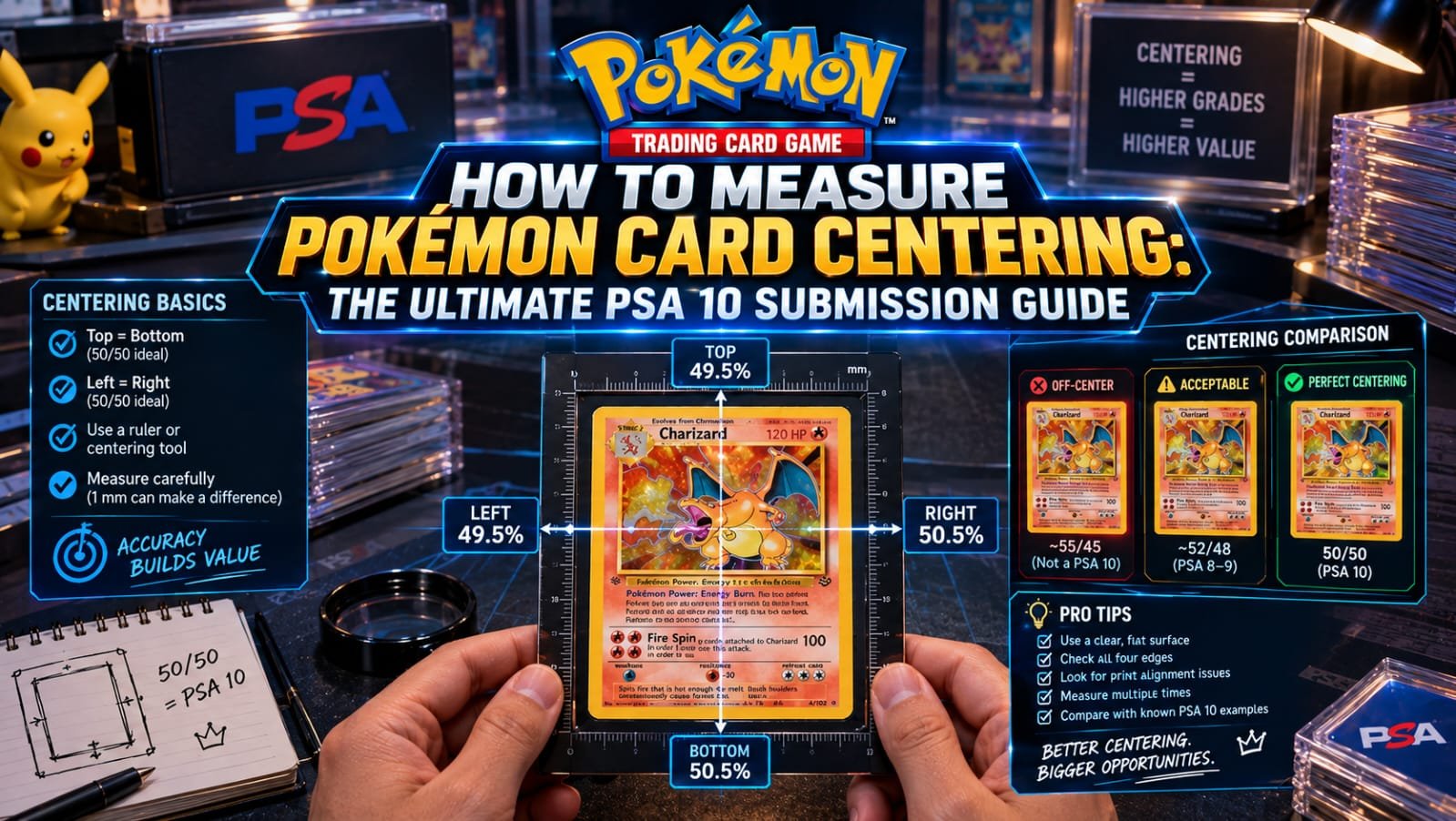
When sending your prized Pokémon cards off to third-party grading services like PSA, BGS, or CGC, nothing is more frustrating than receiving a PSA 9 Mint grade on a card that appears completely flawless to the naked eye. More often than not, the hidden culprit behind a missed Gem Mint grade is off-center printing.
While surface scratches, edge wear, and corner dings are physical flaws created through handling, centering is a factory manufacturing variance. In this comprehensive guide, we will break down the exact mathematical ratios used by major grading companies, how to inspect your cards at home using professional tools, and how to avoid wasting money on sub-optimal submissions.
The Four Core Grading Pillars Explained
Every major grading authority evaluates raw cards across four distinct parameters:
- Centering: The symmetry and balance of the outer card borders relative to the internal artwork frame on both the front and back.
- Corners: The sharpness, cleanliness, and lack of whitening or fraying on all four curved edges.
- Edges: The structural integrity of the card borders, checking for factory burrs, chipping, or silvering.
- Surface: The overall cleanliness of the card, free of print lines, scratches, dents, grease marks, or holo bleed.
Out of these four pillars, centering is the only metric you can measure with 100% mathematical precision before ever mailing your package.
Official Centering Standards: PSA vs. BGS vs. CGC
Each grading company maintains strict guidelines regarding how off-center a card can be while still qualifying for their top-tier grades:
- PSA 10 Gem Mint: The front centering must fall within a 60/40 to 55/45 ratio. The back centering is far more forgiving and can be up to 75/25.
- BGS 10 Pristine: Requires virtually flawless 50/50 centering on the front, with no more than 55/45 on the back to achieve a perfect sub-grade.
- CGC Gem Mint 10: Front centering must not exceed 55/45, while the back must remain within 60/40.
Step-by-Step: How to Calculate Centering at Home
Calculating your card’s border ratio requires basic tools like a transparent millimeter ruler, a digital metric caliper, or an acrylic centering grid.
Step 1: Measure Left and Right Borders
Measure the exact width of the left outer border in millimeters from the outer edge to the inner artwork frame border. Record this number as $W_L$. Next, measure the right border width and record it as $W_R$.
Step 2: Add Total Width
Add the two measurements together to establish your total horizontal border margin ($W_T = W_L + W_R$).
Step 3: Run the Percentage Formula
Divide the smaller border measurement by the total border width and multiply by 100:
$$\text{Ratio (\%)} = \left(\frac{\text{Smaller Border}}{\text{Total Width}}\right) \times 100$$
For example, if your left border measures $1.8\text{ mm}$ and your right border measures $2.2\text{ mm}$, your total border width is $4.0\text{ mm}$. Dividing $1.8$ by $4.0$ gives $0.45$, or 45%. This means your card’s left-to-right centering ratio is 55/45—which easily qualifies for a PSA 10 Gem Mint front grade!
Essential Tools for Pre-Grading Inspection
To avoid manual millimeter calculations on large card batches, consider adding these low-cost pre-grading tools to your workstation:
- Grading Centering Overlay: A clear PVC template printed with percentage grid lines. Simply place your card underneath the clear sleeve to visually verify 60/40, 55/45, and 50/50 boundaries instantly.
- Jeweler’s Magnifying Loupe (10x–30x): Essential for checking surface foil for subtle factory print lines that could drag down a high-centering card.
- Microfiber Cleaning Cloth: Always wipe down fingerprint oils or dust before placing your card into a semi-rigid card saver for submission.
Crucial Safety Warning: Protecting Foil Surfaces During Measurement
When measuring cards with metallic foils or vintage Holofoil patterns, even a slight slip of a metal ruler or a rigid plastic caliper can cause hairline scratches that instantly drop a card from a PSA 10 to a PSA 6. Never place bare metal tools directly against the surface of a high-value Pokémon card.
Always keep the card inside a clean, perfectly-sized inner sleeve (like a Perfect Fit sleeve) while conducting your initial horizontal and vertical border assessments. Subtract the negligible thickness of the sleeve film if you are using high-precision digital tools, or use specialized transparent grid overlays that rest over the sleeved card safely.
Pro-Tip: How Sub-Grades Affect Your Submissions
If you are debating between sending your card to PSA or BGS (Beckett), remember that BGS uses strict sub-grades. A card might have pristine 9.5 corners and surface, but if your centering sub-grade drops to 8.5 due to a miscalculation, your overall grade is heavily capped.
Quick Checklist to Avoid Sub-Optimal Submissions:
- Never eyeball a high-value card; always use a digital caliper or a transparent grading overlay[span_3](start_span)[span_3](end_span).
- Account for humidity changes; card stock can warp slightly, altering border measurements by up to 0.5mm.
- Check both the front and back under direct sunlight or LED desk lamps to catch invisible micro-shifts[span_4](start_span)[span_4](end_span).
Final Tip: Don’t Ignore the Back of the Card
While PSA allows up to 75/25 centering on the reverse side of Pokémon cards, extreme off-centering on the back can still trigger a “Qualifiers” label or drop an otherwise pristine card to a PSA 9. Always inspect both sides under strong desk lighting before finalizing your submission list.
Is It Worth It? The Cost-to-Value Centering Threshold
Grading fees and shipping insurance are non-refundable. Before submitting a card that hits right on the edge of the PSA 10 tolerance (such as a 57/43 front ratio), calculate the financial risk. For modern ultra-rares (like Special Illustration Rares), a drop to a PSA 9 due to marginal centering can sometimes result in selling for less than the raw card value plus grading fees.
As a rule of thumb for serious investors: only submit cards to PSA or BGS if your home centering calculation consistently shows a 52/48 ratio or better. This builds in a safety margin for human error during manual measurement and gives you the highest statistical probability of securing the gem-mint label.
Advanced Insight: Modern vs. Vintage Centering Tolerances
While standard centering formulas apply universally, grading companies handle modern (post-2018) and vintage cards with subtle psychological variances. Modern Pokémon sets printed with high-tech automated Japanese machinery (like Topps or modern TCG printers) have strict baseline cuts, making any deviation over 55/45 glaringly obvious under a loupe.
Conversely, vintage WotC-era cards (1999-2003) often suffer from “factory diamond cuts” (where the card isn’t cut in a perfect square). When measuring vintage cards for a PSA 10 submission, always measure the diagonals; a card with a slight diamond skew will fail centering thresholds even if top-to-bottom margins look technically compliant.