Pokémon TCG Master Set Guide: What Does “Complete” Really Mean?
Building a Pokémon TCG collection can start with something as simple as buying a few booster packs. Before long, however, many collectors begin chasing a much bigger goal: completing an entire expansion.
That is where the term Master Set becomes important.
At first glance, completing a Pokémon TCG set sounds straightforward. Find every card, put them in a binder, and you’re finished. In reality, modern Pokémon expansions can contain multiple rarity levels, secret cards, special subsets, reverse holo or parallel versions, and promotional cards that may or may not be considered part of the Master Set.
That creates one of the most common questions among collectors:
What actually counts as a complete Pokémon TCG Master Set?
The answer is more nuanced than simply reaching the final card number.
Pokémon itself now distinguishes between completing a Main Set and completing a Master Set within Pokémon TCG Live, showing that the two concepts are not identical. The exact cards included in a physical Master Set can still vary depending on the expansion and the collector’s definition of completion. Pokémon’s official announcement confirms that both Main Set and Master Set completion are tracked separately in the digital game.
In this guide, we’ll break down what a Master Set means, what normally belongs in one, how it differs from a regular complete set, how special subsets change the equation, and how to build one without spending money blindly.
What Is a Pokémon TCG Master Set?
A Pokémon TCG Master Set is generally a collection containing all of the cards and relevant card versions associated with a particular expansion according to the collector’s chosen definition of “complete.”
That definition is important.
There is not one universal physical-card rule that says every Pokémon TCG Master Set must contain exactly the same categories of cards. Different collectors may include different variants, promotional cards, or parallel versions.
For example, one collector may consider an expansion complete after obtaining:
- Every card in the main numbered set
- Every secret or higher-rarity card
- Every card in a special subset
Another collector may go further and add:
- Every reverse holo or parallel version
- Expansion-related promotional cards
- Stamped promotional cards
- Product-exclusive variants
- Other officially released versions connected to the expansion
Both collectors may describe their binder as a Master Set. The difference is the scope of their collection.
Before spending money on a Master Set, decide exactly what you are including. A written checklist prevents you from buying expensive duplicate variants simply because you were never sure what “complete” meant.
Master Set vs. Main Set vs. Complete Set
These terms are often used interchangeably in the collecting community, but they can describe different goals.
| Collection Type | Typical Scope | Goal |
|---|---|---|
| Partial Set | Selected cards only | Favorite Pokémon, artwork, or chase cards |
| Main / Numbered Set | The core numbered cards | Complete the primary checklist |
| Complete Set | Usually all cards listed in the relevant official set checklist | Finish the expansion’s listed card structure |
| Master Set | Main cards plus relevant additional versions, rarities, or subsets | Build a comprehensive collection |
The important distinction is that the final card number is not always the same thing as the total number of cards required for a collector’s Master Set.
Why the Final Card Number Can Be Misleading
Modern Pokémon TCG expansions can have a layered structure.
A set may begin with a standard numbered section and then continue with higher-rarity cards. Other releases can include separate gallery-style subsets or other special collections.
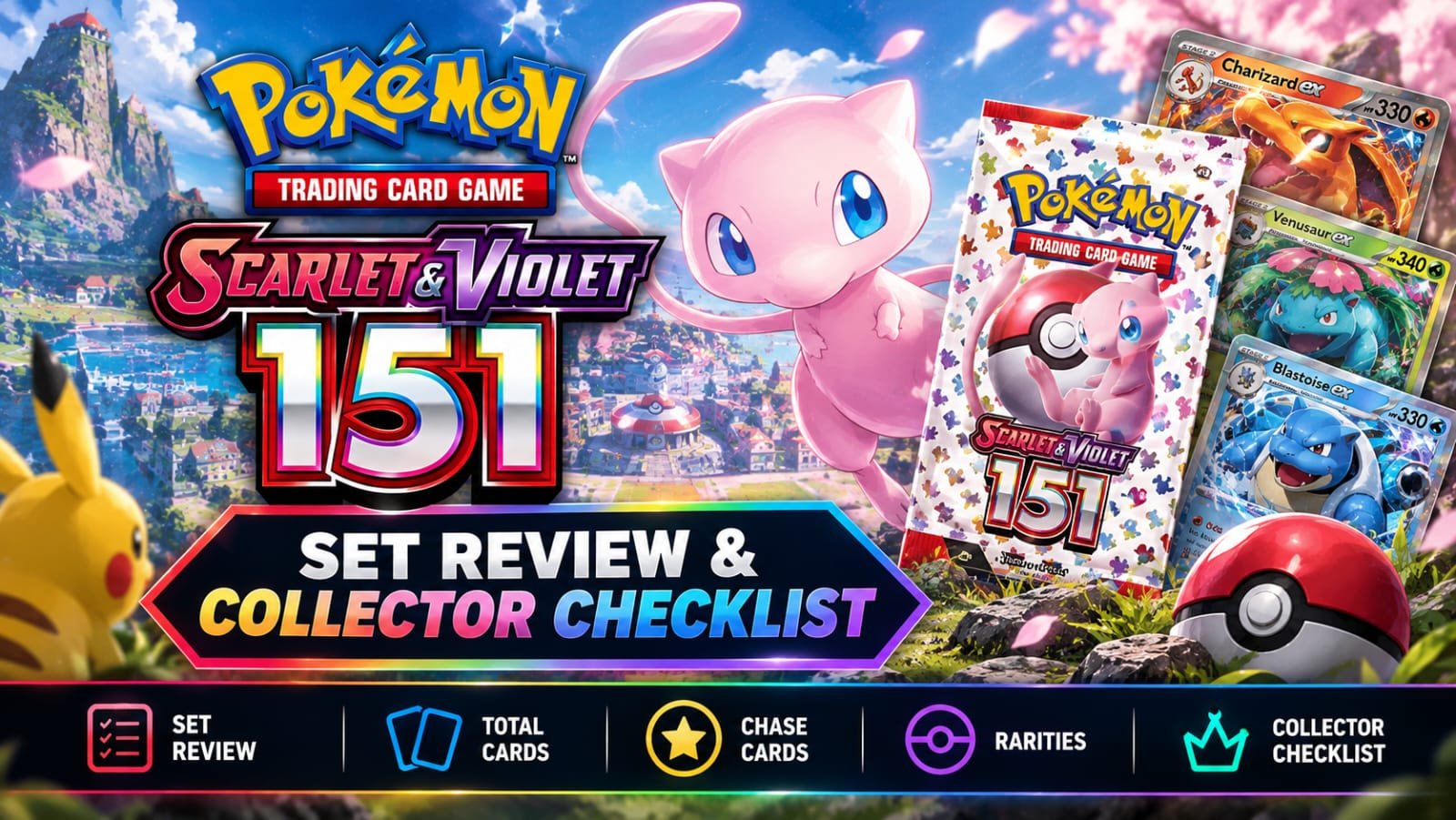
Scarlet & Violet—151 is a good example. Its official checklist contains 207 numbered cards, with the higher-numbered portion containing additional high-rarity cards beyond the main numbered section.
The official Pokémon checklist makes this structure visible and provides collectors with a reference for tracking the cards in the expansion.
That is why simply saying “I need cards #1 through #207” can still be an incomplete description of what a particular collector means by a Master Set if additional variants are also being collected.
Use the official Pokémon checklist as the foundation, then create a second section for the variants and promotional cards that you personally want to include.
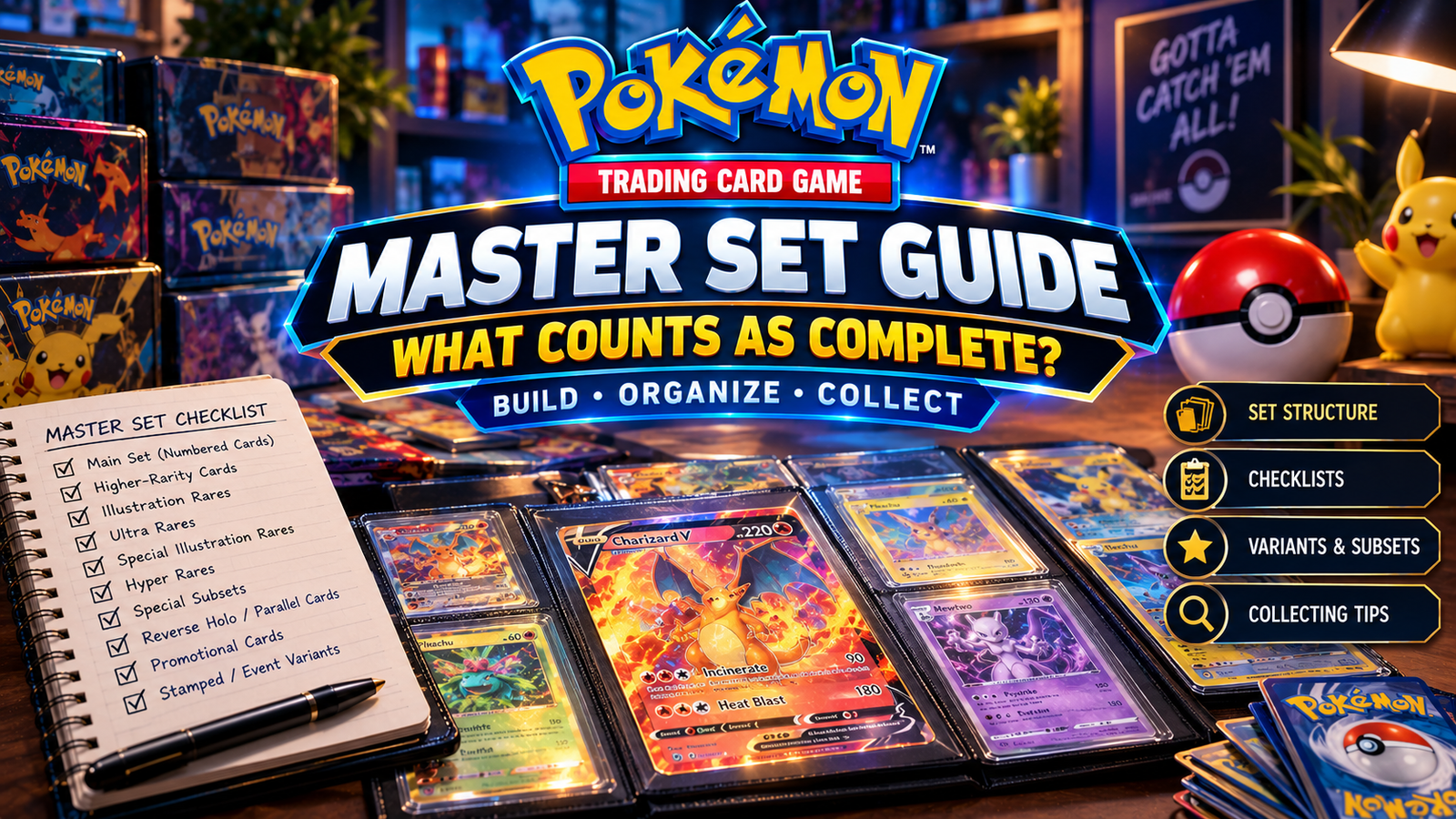
The Main Components of a Pokémon TCG Master Set
Although every expansion has its own structure, most modern Master Set projects can be divided into several recognizable categories.
1. Main Numbered Cards
This is the foundation of virtually every set collection.
The main numbered section normally contains the regular Pokémon, Trainer cards, Energy cards, and other cards that form the core expansion.
For a collector starting from zero, these cards are usually the easiest part of the Master Set to complete because many regular cards are inexpensive compared with the highest-rarity cards.
2. Higher-Rarity Cards
The next layer is made up of the cards that extend beyond the standard set structure.
Depending on the era and expansion, these can include categories such as:
- Illustration Rare
- Ultra Rare
- Special Illustration Rare
- Hyper Rare
- Other expansion-specific high-rarity cards
These cards are often responsible for a large portion of the total cost of completing a modern Master Set.
3. Special Subsets
Some Pokémon TCG releases contain an additional subset that is separate from the main expansion structure.
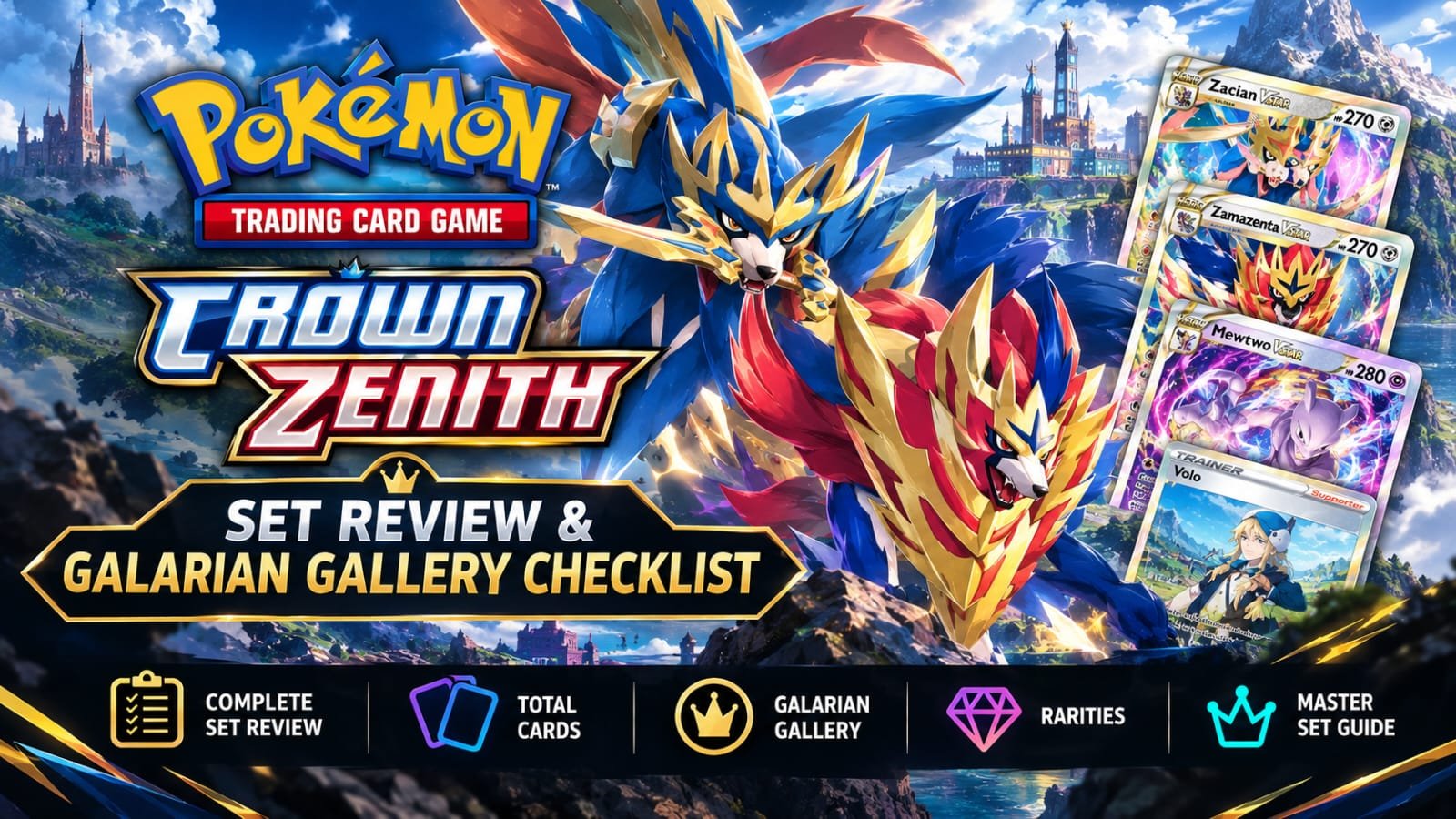
Crown Zenith is an excellent example. The expansion includes a separate Galarian Gallery containing 70 cards, meaning collectors looking for a comprehensive Crown Zenith collection have more to track than the standard numbered expansion cards alone.
This is exactly why collectors should research the structure of a set before calculating how many cards they need.
4. Reverse Holo and Parallel Versions
Parallel versions are one of the biggest sources of confusion when people discuss Master Sets.
A card may have the same name and card number but exist in a different foil or parallel treatment.
Some collectors consider those versions essential to a Master Set. Others collect one version of each numbered card and focus their Master Set on the higher-rarity cards and special subsets.
If you want a particularly comprehensive binder, create a dedicated checklist for these variants instead of mixing them randomly with the primary card list.
5. Promotional Cards
Promotional cards create another gray area.
A Pokémon TCG release can have promotional cards distributed through products, special events, Pokémon Center products, collection boxes, tins, or other promotional channels.
Because these cards may not belong to the expansion’s official numbered sequence, many collectors keep them outside the core Master Set.
Others deliberately create an expanded Master Set that includes them.
- Core Master Set: Main set + higher rarities + relevant subsets
- Variant Section: Reverse holo and parallel versions
- Promo Section: Expansion-related promotional cards
- Special Section: Stamped, event, or product-exclusive cards
How Pokémon TCG 151 Demonstrates the Master Set Concept
Scarlet & Violet—151 is one of the clearest modern examples of why Master Set collecting can become complicated.
The expansion is built around the original 151 Pokémon and uses National Pokédex order for its main Pokémon sequence. Its official checklist contains cards numbered through #207, including a higher-rarity section.
That means a collector cannot accurately determine the scope of a 151 collection by looking only at the first 151 Pokémon.
The regular Pokémon sequence is only one part of the overall checklist.
| 151 Collection Layer | What It Represents |
|---|---|
| Main Numbered Cards | The primary 151 expansion sequence and associated standard cards |
| Higher-Rarity Cards | Additional cards beyond the main numbered portion |
| Parallel / Reverse Holo Cards | Additional versions depending on the collector’s Master Set definition |
For collectors who want to understand the exact structure, the official Pokémon checklist should always take priority over marketplace descriptions or social media lists.
How Many Cards Do You Need for a Master Set?
This is one of the most searched questions, but there is no universal number.
The answer depends on the expansion and the scope you choose.
For example, a collector working on a standard numbered expansion may have a relatively straightforward checklist. Another collector working on a set with a large special gallery and multiple parallel versions could need hundreds of cards.
| Example | What Makes It Different? |
|---|---|
| Scarlet & Violet—151 | 207-card official numbered checklist with higher-rarity cards |
| Crown Zenith | Main expansion plus 70-card Galarian Gallery |
| Mega Evolution—Perfect Order | 124 numbered cards divided between the main set and higher-rarity cards |
The correct question is therefore not “How many cards are in a Master Set?”
The better question is:
Do You Need Every Reverse Holo for a Master Set?
This is where Master Set discussions can become confusing.
Some collectors include every reverse holo and parallel version. Others do not. The answer depends on the scope of the collection rather than a universal physical-card rule.
If your goal is the most comprehensive binder possible, tracking every recognized parallel version can make sense. However, it also increases the size and cost of the project considerably.
A practical system is to maintain two separate checklists:
- Primary Master Set: One copy of each main card, all relevant higher-rarity cards, and special subsets.
- Parallel Checklist: Reverse holo, parallel, and other alternate treatments.
This approach gives you a clear definition of completion while still allowing you to expand the collection later.
Do not let the search for every possible variant stop you from completing the core set. Finish the main collection first, then decide whether the additional variants are worth pursuing.
Should Promotional Cards Be Part of a Master Set?
Promotional cards are usually best treated as a separate category unless you have deliberately chosen an expanded definition.
Why?
Because promotional cards can be distributed through different products and channels and may not share the same numbering system as the main expansion.
If you put every promo into the same checklist without clearly labeling it, it becomes difficult to determine whether the collection is actually complete.
A cleaner binder structure is:
| Binder Section | Purpose |
|---|---|
| Section 1 | Main numbered cards |
| Section 2 | Higher-rarity cards |
| Section 3 | Special subset |
| Section 4 | Reverse holo / parallel variants |
| Section 5 | Promotional and stamped cards |
How to Build a Pokémon TCG Master Set Step by Step
Step 1: Pick One Expansion
Do not begin with the idea of collecting everything.
Choose one expansion and understand its structure before spending heavily.
Look up the official expansion information and determine:
- How many main-set cards it contains
- Where the higher-rarity cards begin
- Whether it contains a special subset
- Whether there are significant parallel versions
- Whether you want to include related promotional cards
Step 2: Create Your Master Checklist
The official Pokémon TCG database and official checklists should be your starting point.
Pokémon’s card database allows collectors to search by expansion and other characteristics, making it useful for verifying card identity and rarity.
For expansions with official downloadable checklists, use those documents as the primary reference.
Step 3: Divide the Cards Into Categories
Instead of keeping a single enormous list, divide the project into manageable sections.
- Main numbered cards
- Double Rare / equivalent cards
- Illustration Rares
- Ultra Rares
- Special Illustration Rares
- Hyper Rares or equivalent cards
- Special subsets
- Reverse holo / parallel cards
- Promotional cards
- Stamped or event variants, if included
Step 4: Complete the Affordable Cards First
There is little reason to spend hundreds of euros on the final chase cards while dozens of inexpensive cards are still missing.
Complete the common, uncommon, regular rare, Trainer, and other inexpensive cards first.
This gives you a much clearer picture of the true cost of finishing the collection.
Step 5: Trade Your Duplicates
Opening sealed product naturally creates duplicates.
Instead of letting those cards sit in boxes indefinitely, use them as trade material where appropriate.
Trading can be particularly useful when another collector is building the same expansion and needs cards that you already own multiple copies of.
Step 6: Buy Difficult Cards as Singles
Once your checklist becomes small, buying singles becomes much more efficient than relying entirely on random booster pulls.
This is especially true for expensive Illustration Rares, Special Illustration Rares, and other chase cards.
If you only need a few expensive cards to finish your binder, compare the cost of buying those singles with the cost of repeatedly opening sealed product and accumulating duplicates.
Step 7: Check Condition
A completed Master Set does not need to contain graded cards, but condition still matters.
Before purchasing expensive cards, inspect:
- Centering
- Corners
- Edges
- Surface scratches
- Print lines
- Whitening
- Dents or pressure marks
- Signs of counterfeit or altered cards
For expensive cards, buying a slightly cheaper damaged copy just to fill the binder can sometimes create another expense later if you decide to replace it.
How to Organize a Master Set Binder
The simplest system is to follow the official card numbering.
This makes missing cards immediately obvious and allows you to compare your binder directly against the official checklist.
For modern expansions, a side-loading binder with enough capacity for future additions is usually more practical than a binder that is already completely full.
One Card Per Pocket or Multiple Versions?
If you are collecting only the core cards, one card per pocket keeps the binder clean.
If you are collecting variants, you can reserve adjacent pockets for different versions.
| Possible Contents | |
|---|---|
| 1 | Standard card |
| 2 | Reverse holo / parallel |
| 3 | Additional variant |
Why Master Sets Can Become Expensive
Most of the cost of a modern Master Set is usually concentrated in a relatively small number of cards.
Regular cards can be inexpensive, while a handful of high-demand chase cards can account for a significant portion of the collection’s total cost.
Several factors influence this:
- Popularity of the Pokémon
- Rarity
- Collector demand
- Availability of clean copies
- Set popularity
- Age of the expansion
- Supply on the secondary market
This is why the final few cards can sometimes be much more expensive than the first hundred cards combined.
Master Set Collecting Is Different From Investing
Completing a Master Set and investing in Pokémon cards are two different objectives.
A Master Set is primarily a collecting project. The purpose is to own the expansion in a comprehensive and organized form.
That does not mean every card inside the binder will increase in value.
Card demand can change because of supply, reprints, collector interest, competitive play, character popularity, condition, and broader market conditions.
If your goal is collecting, choose a set because you enjoy its cards and artwork. If your goal is market exposure, research individual cards and market behavior separately. A completed Master Set does not automatically equal a profitable investment.
Booster Packs vs. Singles: Which Is Better for Completing a Master Set?
There is no reason to choose only one method.
Booster packs are part of the fun of Pokémon TCG collecting. They let you experience the excitement of pulling a card yourself and can build a large portion of the collection naturally.
Singles provide control.
| Method | Main Advantage | Main Limitation |
|---|---|---|
| Booster Packs | Fun and chance of pulling missing cards | Duplicates and unpredictable results |
| Booster Boxes / Sealed | Large number of cards quickly | Still randomized |
| Singles | Exact cards you need | Requires price and condition research |
| Trading | Can turn duplicates into missing cards | Requires desirable duplicates and trusted trading partners |
A hybrid strategy is often the most practical: open some sealed product for enjoyment, trade duplicates, and purchase the difficult remaining cards as singles.
How to Avoid Overpaying for Missing Cards
The closer you get to completion, the stronger the temptation can become to buy a missing card immediately.
That is where patience can help.
Divide your missing cards into three groups:
- Low-cost cards: Buy when convenient.
- Mid-range cards: Compare several sellers and conditions.
- High-value chase cards: Research recent market activity and prioritize authenticity and condition.
For expensive cards, do not focus only on the lowest listed price. A suspiciously cheap listing can become very expensive if the card turns out to be damaged, altered, or counterfeit.
How to Verify a Card Before Adding It to Your Master Set
Before checking a card off your list, verify four basic details.
1. Card Number
Make sure the card number matches the official checklist.
2. Expansion
Confirm that the card actually belongs to the expansion you are completing. Similar card names can appear across multiple sets.
3. Rarity and Version
Check whether you need the standard card, reverse holo, Illustration Rare, Special Illustration Rare, or another version.
4. Authenticity
For expensive cards, confirm that the card is genuine before considering the collection complete.
This becomes particularly important with older cards and high-value modern chase cards sold through the secondary market.
Master Set Checklist Template
If you are starting a new Pokémon TCG Master Set, the following structure can be adapted to almost any modern expansion:
Master Set Completion Checklist
☐ Main numbered cards
☐ Regular high-rarity cards
☐ Illustration Rares
☐ Ultra Rares
☐ Special Illustration Rares
☐ Hyper Rares / equivalent cards
☐ Special subsets
☐ Reverse holo / parallel cards, if included
☐ Relevant promotional cards, if included
☐ Stamped or event variants, if included
☐ Final comparison with the official Pokémon checklist
Common Pokémon TCG Master Set Mistakes
Mistake #1: Assuming the Final Number Is the Complete Collection
A set’s final numbered card does not automatically tell you everything that exists around the expansion.
Secret cards, special subsets, and variants can change the scope considerably.
Mistake #2: Buying Chase Cards First
It can be tempting to immediately buy the biggest cards in a set.
However, completing the inexpensive portion first gives you a much clearer idea of which cards are genuinely missing and how much the final stage will cost.
Mistake #3: Opening Packs Forever
Opening packs is fun, but the mathematics of randomized products does not change just because you are close to finishing.
If only a few expensive cards remain, buying singles can be a more direct way to complete the checklist.
Mistake #4: Ignoring Condition
A damaged card may fill a binder slot today but become a replacement expense later.
For valuable cards, condition should be part of the buying decision.
Mistake #5: Mixing Promos Without a System
Keep promotional cards clearly labeled so you know whether they are part of the core Master Set or an additional collection.
Mistake #6: Not Leaving Binder Space
If you are building a large collection, leave room for additional variants and organize the binder so that future additions do not force you to move dozens of cards.
Master Set vs. Chase Card Collection
A Master Set and a chase-card collection are two completely different collecting strategies.
A chase-card collection might contain only the cards you personally consider the most attractive or important.
A Master Set focuses on completeness.
| Collection Goal | Main Idea |
|---|---|
| Chase Collection | Collect the cards you personally want |
| Complete Numbered Set | Collect every card in the primary numbered checklist |
| Master Set | Collect the main set plus the relevant additional cards and variants you have defined |
Think of it this way:
Chase Collection: “I want the cards I love.”
Complete Set: “I want every card in the main checklist.”
Master Set: “I want the expansion as completely as I have defined it.”
Should You Grade Cards From a Master Set?
Not necessarily.
Grading every card in a Master Set can become extremely expensive and is not required for the collection to qualify as complete under a typical collecting definition.
Many collectors keep the majority of their cards raw while selecting a few important or valuable cards for grading.
Possible grading candidates can include:
- The most valuable chase card
- Your favorite Pokémon from the set
- A particularly clean copy
- A historically important card
- A card you specifically want to preserve in a slab
Before grading, inspect centering, corners, edges, and surface condition carefully. A Master Set can remain completely raw and still be a legitimate Master Set.
How to Protect a Completed Master Set
Finishing the checklist is only part of the job. Proper storage can help protect the collection over the long term.
Use quality sleeves and a binder designed for trading cards. Avoid excessive heat, direct sunlight, and environments with significant humidity changes.
For particularly valuable cards, additional protection such as top loaders or grading slabs may make sense depending on your collecting goals.
Do not overfill binder pockets. Cards should be inserted and removed without excessive friction.
Which Pokémon TCG Sets Make Interesting Master Set Projects?
There is no single type of expansion that every collector should choose.
Some collectors prefer nostalgia-driven sets. Others prefer modern artwork, special subsets, or expansions with large Illustration Rare and Special Illustration Rare sections.
Scarlet & Violet—151 is an obvious example of a set with a strong collector identity because it focuses on the original 151 Pokémon.
Crown Zenith provides a different collecting experience because of its Galarian Gallery.
Modern Mega Evolution expansions provide another style of Master Set project, with higher-rarity cards forming clearly identifiable sections of the checklist.
That variety is one of the best things about Master Set collecting: two binders can look completely different while both representing the same basic goal of completing an expansion.
How to Decide When Your Master Set Is Actually Complete
Before declaring a collection finished, perform a final audit.
- Compare every main-set number against the official checklist.
- Confirm every higher-rarity card is present.
- Check whether the expansion contains a special subset.
- Review your reverse holo and parallel checklist.
- Check the promotional cards you decided to include.
- Inspect expensive cards for authenticity.
- Record the final completion date.
Write down your personal Master Set definition at the top of your checklist. That way, you will always know exactly what “100% complete” means for your collection.
Frequently Asked Questions
What is a Pokémon TCG Master Set?
A Master Set is generally a comprehensive collection of an expansion that includes the main cards plus relevant higher-rarity cards, subsets, and other variants according to the collector’s chosen definition.
Is a Master Set the same as a complete set?
Not always. A complete numbered set normally focuses on the cards in the primary official checklist, while a Master Set can include additional variants, subsets, and other associated cards.
Does every Master Set have the same number of cards?
No. The size depends on the expansion and on which variants the collector chooses to include.
Do reverse holos count toward a Master Set?
They can, but whether they are included depends on the collector’s definition. If you want a comprehensive collection, track them separately so your checklist remains clear.
Do promotional cards count?
Not necessarily. Many collectors keep promos separate from the core Master Set because they are distributed outside the main numbered expansion. Others include them in an expanded collection.
Should I buy booster packs or singles?
Both can be useful. Sealed products are enjoyable and can provide many cards at once, while singles are more precise when only a small number of cards remain missing.
Is completing a Master Set a good investment?
Completing a Master Set is primarily a collecting goal and should not automatically be treated as an investment strategy. Individual card values can change over time based on supply, demand, condition, reprints, character popularity, and other market factors.
Should every card in a Master Set be graded?
No. Grading is optional. Many collectors keep their Master Set raw and grade only selected cards that are particularly valuable or meaningful to them.
Related Pokémon TCG Guides
If you are building a Master Set, these guides on PokeVault Guide can help you research specific expansions and related collecting topics:
Pokémon TCG Scarlet & Violet 151 Set Review & Collector Checklist
Pokémon TCG Crown Zenith Set Review & Galarian Gallery Checklist
Pokémon TCG Prismatic Evolutions Set Review & Complete Chase Card Checklist
Pokémon TCG Surging Sparks Set Review & Complete Chase Card Checklist
Pokémon TCG Mega Evolution—Perfect Order Set Review & Checklist
Reliable Sources for Pokémon TCG Set Research
When researching a Master Set, official Pokémon resources should be your starting point whenever they are available.
- Pokémon TCG Card Database: Useful for searching cards by expansion, rarity, and other characteristics.
- Official Pokémon TCG Checklists: Useful for verifying card numbers and the structure of individual expansions.
- Official Expansion Pages: Useful for confirming expansion information and special subsets.
- Pokémon TCG Live: Pokémon’s current digital collection system distinguishes between Main Set and Master Set completion, reinforcing the distinction between the two collecting goals.
Final Thoughts
A Pokémon TCG Master Set is much more than a binder filled with expensive cards.
It is a structured collection built around the goal of documenting an entire expansion as completely as the collector chooses.
The most important step is therefore not buying cards.
It is defining what “complete” means before you start.
Use official Pokémon checklists whenever possible. Separate the main numbered set from higher-rarity cards and special subsets. Decide whether reverse holos, parallel versions, and promotional cards belong in your collection. Then track everything systematically.
Once you have that structure, completing a Master Set becomes much less confusing—and you are far less likely to spend money on cards you never actually needed.
A Master Set Is About Completeness, Not Just Rarity.
Build the checklist first. Define your scope. Then collect with a plan.
Whether you are completing Scarlet & Violet—151, Crown Zenith, Prismatic Evolutions, Surging Sparks, a Mega Evolution expansion, or another Pokémon TCG release, the same principle applies: know exactly what you are trying to complete before you start buying.